We hadn’t even arrived in Mexico yet to represent the Union of Journalists of Cuba (UPEC) at the XIII Congress of the Latin American Federation of Journalists when we received our first embrace and expression of solidarity and affection during a layover at Tucumán Airport: “Long live Cuba, Damn it!” Nelson del Castillo, then Secretary General of the continental organization, told us after the handshake with his wife, in which we felt the full brotherhood of our Puerto Rican colleagues.
The phrase was shouted again in a text by Juan Carlos Camaño, respected and admired president of FELAP until this event, in a message to journalists across the continent included in a text reviewing the organization’s 50 years, which are being celebrated with this event.
The text, which extols the principles and political, social, cultural, and professional practices of the Federation since its founding in 1976, concludes by saying that what is important today is to show solidarity with UPEC and repeats the cry of “Long live Cuba, Damn it!”
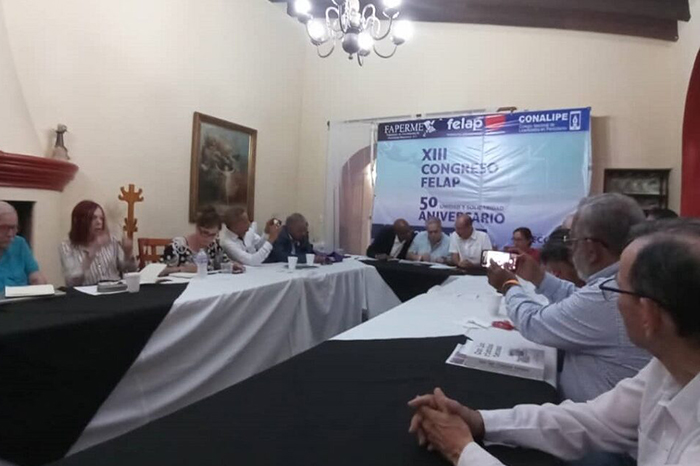
Although not always in that tone, the one thing that was not lacking in the lead-up to the opening of the congress, which began this Saturday in Cuernavaca, Morelos, was concern about the criminal effects of the collective punishment that Cuba faces from the United States government and the impact of this crime on journalists, the media, and society as a whole.
Questions and expressions of solidarity arose at almost every moment, in formal and informal encounters. There were even those who asked Tubal Páez Hernández, Honorary President of FELAP and UPEC, and myself, to take photos with us and tell us that one of the purposes of their participation in this continental gathering was precisely to meet with their Cuban brothers and sisters, express their support, and their willingness to help.
Leandro Torres, Secretary General of the Buenos Aires Press Workers Union (UTBA), an organization with a rich history of brotherhood with Cuba, emphasized this at the opening of the Congress on Saturday evening, to the applause of representatives from other countries present, such as Chile, Bolivia, Brazil, Guatemala, the Dominican Republic, and the Mexican hosts—the Federation of Journalists’ Associations of Mexico (FAPERME) and its College of Journalism Graduates—whose organizational efforts, hospitality, and welcome were recognized by the attendees.
These expressions of love for Cuba were witnessed by our country’s diplomatic representatives in Mexico, led by Ambassador Eugenio Martínez Enriquez, who met with their colleagues from the region.
Tubal Páez deeply appreciated the expressions of support and recounted the malice and criminality of the measures imposed on Cuba by the United States, which will not break the dignity and patriotism of the Cuban people, despite the campaigns of manipulation and lies to which they are subjected by the distorting machinery of imperialism.
The gravity of the moment facing humanity was precisely the focus of the opening remarks of the Dominican colleague and current ambassador to Mexico, who was a member of FELAP in its early days.
Juan Bolívar Díaz Santana denounced the profound crisis facing journalism, politics, and multilateralism in our world, to the point, he emphasized, that the only certainty we have is nothing less than uncertainty. He emphasized that confusion and manipulation prevail.
He warned that we are living in a period of turbulence, a dramatic concentration of wealth, and that countries that once presented themselves as beacons of democracy now represent the very opposite in their attempt to impose themselves on others.
At the opening of the Congress, a message from Juan Carlos Camaño was announced, in which he stated that, due to health reasons and the need for renewal of FELAP’s leadership to increase its influence in the difficult conditions of today’s world, he would be stepping down as head of the organization.
The message had been presented to the FELAP board a few hours earlier, and, as at the opening, it elicited admiration and applause from those present, who recognized Camaño’s leadership in keeping the regional entity alive when others would have presumed its demise.
The proposal, which has already received the approval of representatives from the participating organizations, as well as those from Venezuela, Peru, Nicaragua, Panama, and Ecuador, who expressed their opinions through audiovisual messages, is for FELAP to have a board of directors comprised of representatives from five countries, with a general coordinator. This leadership will be announced this Sunday at the closing of the event.
Following the opening session, attendees worked in three committees to address topics such as Press and Communication, Youth, New Technologies and Training, and Health and Gender. The results of these analyses and the resulting proposals will also be presented this Sunday.
On Saturday, congress attendees toured the impressive World Heritage Site of Xochicalco, the cradle of Mexico and human civilization, and the Gardens of Mexico, another of the country’s wonders located in this region.
IMAGE CREDIT: Ricardo Ronquillo Bello Photo: cubaperiodistas.cu
[ SOURCE: AGENCIA CUBANA DE NOTICIAS ]