The abominable crime—the execution by firing squad in Havana of eight innocent medical students on November 27, 1871—was driven by the repression and hatred inherent in a decaying colonial system and the Spanish “Volunteer Corps” (*Cuerpo de Voluntarios*) serving the Crown—a system that had been challenged since 1868 by the war for independence.
These two factors were closely intertwined; where one might have been less overt, the other stepped in with intensified zeal and malice. Together, following two summary courts-martial, they led to the unjust deaths of eight young men—all first-year medical students at the university in the capital—who were falsely accused of treason for allegedly damaging the tomb of the pro-Spanish, hardline journalist Gonzalo de Castañón.
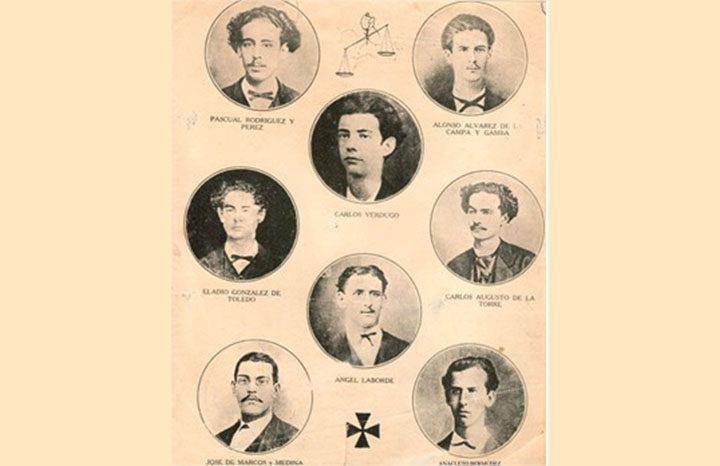
The students, who had barely reached adulthood, were Anacleto Bermúdez, Angel Laborde, José de Marcos, Juan Pascual Rodríguez, Alonso Alvarez de la Campa, Carlos de la Torre, Eladio González, and Carlos Verdugo.
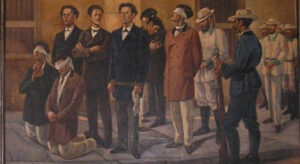
Fusilamiento de los 8 estudiantes de medicina
Three of them were selected by lottery to be included in the death sentences, serving to sate the bloodlust and violence unleashed by the so-called “Havana Volunteers”—a paramilitary organization that operated from 1855 to 1898, notorious for its excesses, abuses, and reactionary spirit. There are accounts that, at the time, his henchmen roamed the capital, committing outrages with the tacit approval of the authorities—all to terrorize the population and keep the war for liberation at bay. That conflict was unfolding primarily in the eastern and central parts of the island, even though many patriots in the area had signaled their support for the *Grito de Yara* and were conspiring in favor of the Revolution initiated by Carlos Manuel de Céspedes.
Amidst this turbulent society—subjugated by colonialism and slavery—began the innocent story of these young men, which the Crown would later use as a pretext to inflict a monstrous, exemplary punishment upon the sons of this unredeemed land. It is a story worth remembering in every detail.
On the afternoon of Friday, November 24, a group of first-year medical students at the University of Havana, growing impatient as their Anatomy professor failed to arrive, decided to leave the lecture hall. Some of them crossed over to the nearby Espada Cemetery, located on San Lázaro Street.
Only a few actually wandered through the grounds; others remained outside, playing with the cart used to transport corpses from the cemetery to the medical school’s dissection room. One of them plucked a flower from an offering left in a container.
This sudden, youthful commotion naturally angered the cemetery caretaker, who was particularly concerned about the safety of the gardens and plantings.
Driven by this, he took a vile and extreme step: he accused the students before the political governor, claiming they had scratched the glass covering the niche of Gonzalo de Castañón’s tomb. Castañón—who had been killed under mysterious circumstances in the United States that same year—was notorious for his persistent attacks against the Cubans living in exile there.
The governor ordered the arrest of the youths—initially, all 46 students who had been waiting for their absent professor. An attempt had also been made to seize the second-year students, but the dignified stance of their professor prevented such an arbitrary act.
The first court-martial was then held; based on false accusations, severe sentences were imposed, though the death penalty was not among them.
During the trial of the innocent students, the defense attorney—an honorable Spanish army officer—distinguished himself; he stood firm in his sense of honor and professional duty. Yet, these were times of barbarism.
The dreaded and despotic “Volunteers of Havana”—who held the equally reactionary Castañón as one of their moral icons—took action. They rioted with great violence, threatening further upheaval and bloodshed outside the building where the first trial had taken place.
Consequently, a second trial was hastily convened, resulting in the barbaric imposition of the death penalty upon the young men in question, who were executed by firing squad on the afternoon of November 27.
Of the others who stood trial, 11 were sentenced to six years in prison, 20 to four years, and four to six months.
Among the latter was Fermín Valdés Domínguez. After serving his sentence, he was able to complete his studies in Spain. Upon returning to his beloved island, he practiced his profession and dedicated himself to locating the lost and cursed burial site of the young men—a proscribed mass grave situated outside the cemetery, which was even off-limits to their own families. He finally discovered it after a long, perilous, and selfless search.
The then-very-young José Martí and Fermín Valdés Domínguez had already courageously denounced the horrendous crime and the inhumane conditions of political imprisonment in Cuba—doing so almost immediately upon their arrival in exile in the Spanish metropolis, while they were pursuing different fields of study at the University of Zaragoza, bound together by the deep friendship they always maintained.
An unforgivable crime. A cruel and abhorrent event remains etched in the memory of the Cuban people, who unfailingly remember these young students every November 27th. Today, the tribute paid and a renewed patriotic commitment serve as our offerings.
IMAGE CREDIT: Martha Gómez Ferrals / Photo: La Demajagua website
[ SOURCE: AGENCIA CUBANA DE NOTICIAS ]