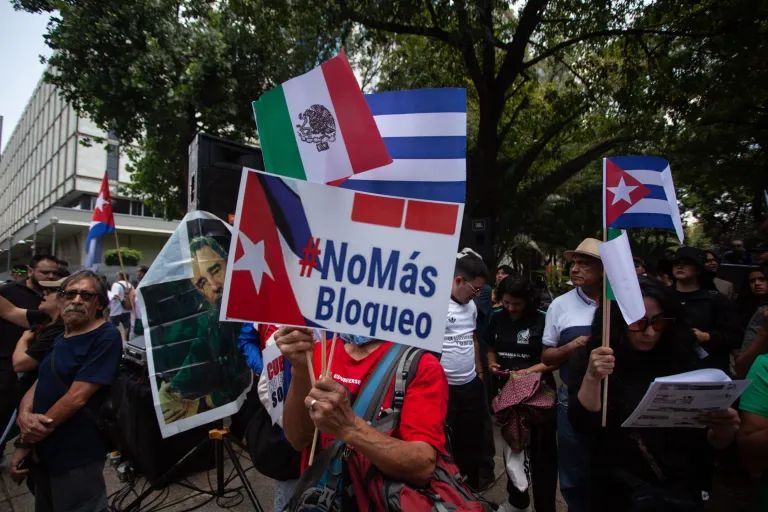
Pablo Moctezuma Barragán / Contralínea
US imperialism and Israeli Zionism have unleashed their fury against Cuba and Palestine—peoples who are resisting genocide. Meanwhile, protests against these atrocities have erupted globally, and the political price has been exacted—at the ballot box—from Trump and the Republicans. Expressions of solidarity with both peoples have emerged in Mexico, Argentina, Bolivia, Brazil, Colombia, France, Italy, Austria, Albania, Spain, Portugal, Belgium, Greece, Germany, and Serbia…
The world is at a critical juncture following centuries of colonialism and neocolonialism, during which the most heinous crimes have been committed. The United States was founded 250 years ago, and ever since, it has relentlessly attacked peoples in inhumane ways—first targeting the 200 Indigenous nations within its own borders, and subsequently, the rest of the world. Today, the empire—along with its Western partners—is in decline.
The devastation inflicted upon peoples and Mother Earth has been immense; yet, humanity will prevail. Life will triumph over death, and the old order will be defeated by the new. Today, peoples everywhere are preparing to build a world free from oppression and exploitation. This struggle is possible, and the peoples of Cuba and Palestine are the primary proof: for decades, they have inspired youth and grassroots movements across the globe that strive for a new reality. They stand as two beacons illuminating the path of resistance.
For this reason, the United States and its European partners suppress any demonstration in support of Palestinian rights—persecuting and imprisoning those who dare to condemn the genocide—while simultaneously ignoring the demand to end the blockade against Cuba.
The wave against imperialism and Zionism has manifested with great force across the globe this year. In the United States, young people and women organized to decisively defeat Trump and his supporters on November 3rd. In Europe, mobilizations against neoliberal policies and war have linked social demands—such as those for education, healthcare, and housing—with support for Palestine and Cuba. In recent weeks, Argentina, Bolivia, Brazil, Colombia, France, Italy, Austria, Albania, Spain, Portugal, Belgium, Greece, Germany, and Serbia have all seen young people take a stand in defense of their own rights, as well as the rights of peoples who are victims of genocide.
A movement of solidarity is growing worldwide. On October 30th, for instance, dockworkers across Europe organized strikes and demonstrations to protest the use of commercial ports for military purposes, under slogans such as “Ports are not for war!” and “Workers do not work for war!” The dockworkers made it clear that they would not handle shipments of weapons destined for Israel. They also expressed their support for the youth movement in Europe, joining young people in the struggle against war and for a better future. Alongside these dockworker strikes, demonstrations in support of Palestine were held in many cities.
Hundreds of thousands of people took part in actions across 113 ports in 22 countries spanning five continents. In Europe, dockworkers went on strike in France, the Basque Country, Italy, Greece, Cyprus, Denmark, Sweden, and Germany. Strikes also took place in India, Turkey, and Morocco. In Oakland, California, the International Longshore and Warehouse Union (ILWU) Local 10 also joined the movement. In addition to the work stoppages by dockworkers, dozens of unions and federations from other sectors carried out acts of support and solidarity across the globe.
The “No Port for Genocide” campaign pointed out that several ports—including Genoa, Livorno, and Gioia Tauro in Italy; Marseille in France; Piraeus in Greece; and Tangier in Morocco—have been linked to arms shipments to Israel. The campaign tracked 315 shipments of components destined for Israel’s largest arms manufacturer, Elbit Systems, which passed through 56 commercial ports in 29 countries between August 2025 and September 2026.
As Mexicans who cherish humanity, we are particularly sensitive to the aggression endured by our sister peoples, because Europeans once inflicted the same horrors here: genocide, unprecedented massacres, and the destruction of Mexico-Tenochtitlan—a great city founded over 700 years ago—leaving not one stone standing upon another. What is unfolding in Gaza echoes that history of extermination and has ignited the indignation of peoples worldwide. Tenochtitlan was subjected to a cruel blockade by the Spanish invaders, who prevented food and potable water from reaching the resisting Mexica people. The resistance of the Cuban people brings to mind that of our great hero, Cuauhtémoc.
When the great Lázaro Cárdenas expropriated the oil industry and carried out agrarian reform, we, too, faced a blockade—we could not import even a single screw, nor could we sell a single drop of oil. More than half of our territory was stolen from us, a wall was erected against us, and the Border Patrol has killed our young people, accusing them of throwing stones. Even today, immigration authorities—or ICE—kill Mexicans with impunity in Texas, California, and Arizona—lands that were once our own. For this reason, the people of Mexico stand in solidarity, heart and soul, with the Palestinian and Cuban peoples, recognizing that their fate is our fate—and, indeed, the fate of all humanity.
Mexico has always opposed the blockade against Cuba; it was the only country that refused to obey the “Empire” and maintained relations with the island. In May 2004, when Vicente Fox expelled Ambassador Jorge Bolaños and recalled Mexico’s ambassador to Havana, Roberta Lajous, a massive popular outcry erupted overnight—forcing Fox to reverse course. The Mexican people made their stance clear with lightning speed: “Leave Cuba alone.” In recent years, relations with Cuba have reached an unprecedented level of strength.
Thanks to this popular sentiment, our country’s diplomatic tradition has earned Mexico the affection of the world. Mexico was the first nation to denounce Hitler and Mussolini on the international stage, at a time when everyone else remained silent. Mexico severed ties with the Pinochet dictatorship in Chile and with Franco’s Spain; it opposed apartheid in South Africa; and, more recently, it has broken off relations with the governments of Noboa in Ecuador and Dina Boluarte in Peru.
In the face of the current genocide, the time has come to sever all ties with Israel and to demand that Netanyahu face justice. Despite pressures and threats—and in keeping with its own history—Mexico must send oil to Cuba. We cannot allow a situation where—in a world where the Americans claim to revere freedom as the highest value—Cuba is denied the freedom to purchase oil, and Mexico is denied the freedom to sell it to them.
If, throughout the “Ten Years’ War” (1868–1878), Juárez and Mexico provided logistical support and arms to the Cuban independence forces, why should we not sell them oil today? Juárez pursued a policy of supporting the self-determination of nations; he demonstrated solidarity with anti-colonial movements, a stance that encompassed the cause of Cuban independence. Let us honor our history:
During the French intervention, it was a Cuban—Pedro Santacilia Palacios—who took on the task of procuring arms in the United States for the republican cause in Mexico; this was a difficult undertaking, as the northern nation was then in the midst of its own civil war. His contribution was vital to the cause of the *Reforma* (Reform) in Mexico. Just as Mexico once needed arms, Cuba today needs oil—as a tool to jump-start its economy. It is essential that we continue our support, regardless of whether it angers Trump.
Our nation has always offered moral support and refuge to the Cuban people. In 1870, Carlos Manuel de Céspedes, a leader of the Cuban independence movement, expressed his gratitude to Juárez for his interest in their struggle and for the generous sacrifice of the Mexicans who fought in Cuba. We sent not only arms but also combatants; approximately 50 Mexicans took part in the Cuban independence campaigns, most notably Generals José Inclán Risco and Gabriel González Galván.
Today, the Mexican Movement of Solidarity with Cuba is actively working to send pediatric and oncological medicines for hospitals, along with other technological supplies, in coordination with the ICAP (Cuban Institute of Friendship with the Peoples) and the Cuban Embassy. The federal government also dispatches aid ships. Nevertheless, the most fundamental form of assistance that Cuba requires is oil. We are no strangers to blockades; in our own lands, the siege of Cuautla—which lasted more than two months—is well-known. During that time, Morelos’s insurgent troops were reduced to eating lizards and even their own *huaraches* (sandals). Yet, they did not surrender, and in the end, they broke the siege. The blockade against Cuba has persisted for over sixty years and grows harsher by the day, yet the Cuban people refuse to surrender. This spirit of resistance bolsters the morale of all peoples, especially the youth. Such a form of genocide is condemned by any human being worthy of the name.
The decaying Empire suffers defeats on every front: it withdrew from Afghanistan and Iraq; it failed to defeat Russia in Ukraine, despite deploying the full might of NATO; it is losing the economic war against China; it cannot prevail against Iran; and it is losing ground to the BRICS nations. In a state of structural and historical decline, the United States attempts to stave off the erosion of its hegemony through indiscriminate violence, economic sanctions, geopolitical destabilization, and the plunder of resources—most notably within the Americas. It has achieved its objectives in Greenland; it attacked Venezuela—going so far as to abduct President Maduro and lawmaker Flores—and has intervened in the elections of Honduras, Colombia, Argentina, and Brazil. Yet, it cannot subdue Cuba, despite the relentless imposition of a blockade and an ever-tightening encirclement.
Regarding Juárez, José Martí remarked: “With his own chest, he broke the surging waves that an entire continent was hurling against the Americas; the waves shattered, yet Juárez remained unmoved.” Now we can say of Cuba: “It breaks with its own chest the monstrous waves that the Yankee Empire hurls upon the Americas—upon the entire continent—and while the waves shatter, Cuba remains unmoved.”
In 1961, in the face of the invasion at the Bay of Pigs (Playa Girón), Lázaro Cárdenas called for mobilization in support of Cuba. He attempted to fly to the island, but President López Mateos prevented him—grounding the plane and detaining the pilot. Cárdenas then headed to the Zócalo, which was packed with protesters, and, standing atop an automobile, delivered a speech in defense of the Cuban Revolution. If Lázaro Cárdenas were alive today, he would be in the Zócalo demanding: “Oil for Cuba!” Even during the most brutal and irrational phase of the Cold War, Mexico never turned its back on Cuba.
Over these 60 years, our peoples have maintained a relationship rooted in brotherhood, respect, and cooperation. Today, we must honor this history.
We have given our own blood for our Cuban brothers and sisters. Another Mexican who gave his life for this sister nation was Juan F. Noyola Vázquez—one of Mexico’s most prominent economists, who served as an official at ECLAC (CEPAL) from 1950 to 1960. He was in Cuba at the time of the Revolution’s triumph and chose to stay to support it. He lived there as an advisor to Commander Che Guevara—who was then Minister of Industries—and championed nationalization, centralized planning, and rapid industrialization, with the goal of diversifying the economy and reducing dependence on the United States.
Juan F. Noyola participated in the creation of the Central Planning Board (JUCEPLAN), where he served as Director of Planning, Investments, and Balances until his death. He was assassinated after attending a meeting of the FAO (the UN Food and Agriculture Organization) in Rio de Janeiro: the plane… …in which he was traveling with the Cuban delegation, he became the target of a CIA attack; he lost his life on November 27, 1962, when the aircraft exploded. Juan F. Noyola—a true hero—is the namesake of the Faculty of Economics in Havana.
Currently, the people of Mexico are mobilizing in support of Palestine. In Mexico City, they have installed an “anti-monument” in solidarity, titled “The Gate of Resistance and Life”; furthermore, dozens of demonstrations are taking place across the country. In September 2025 and April 2026, a group of Mexicans joined the Global Sumud Flotilla. On both occasions, their vessels were intercepted in international waters, and the participants were subjected to attacks, beatings, sexual assault, and arbitrary detention. The Mexican participants in the second flotilla—Violeta Núñez, Sol González, Ana Jimena Hernández, Paulina del Castillo, and Diego Vázquez—reported being mistreated. Yet, the Mexican government maintains all manner of relations with Israel. In several Mexican states, the Zionist entity is involved in highly sensitive areas—such as water management, security, military and paramilitary training, and the sale of weapons and espionage technology. It is time to sever all ties with Israel.
The history of nations demonstrates that independence and social justice are won by defending sovereignty against empires and great powers. Palestine and Cuba are the ones that best honor this history. The epic struggles of Cuba and Palestine will be etched in memory as truly remarkable feats. Peoples organize themselves by drawing inspiration and lessons from examples such as those provided by these sister nations. For this reason, today more than ever, Mexico must uphold its tradition of solidarity with oppressed nations and with peoples who resist colonialism. This is the best way to confront counter-revolution—just as, 80 years ago, the… Peoples rose up and a great coalition defeated the fascists; today, the time has come to defeat the Yankee Empire and Zionism. And in this great endeavor, Palestine and Cuba carry the torch with pride.
Long live a free Palestine!
Down with the blockade against Cuba!
IMAGE CREDIT: PHOTO: Andrea Murcia / Cuartoscuro.com
[ SOURCE: www.cubainformacion. tv ]