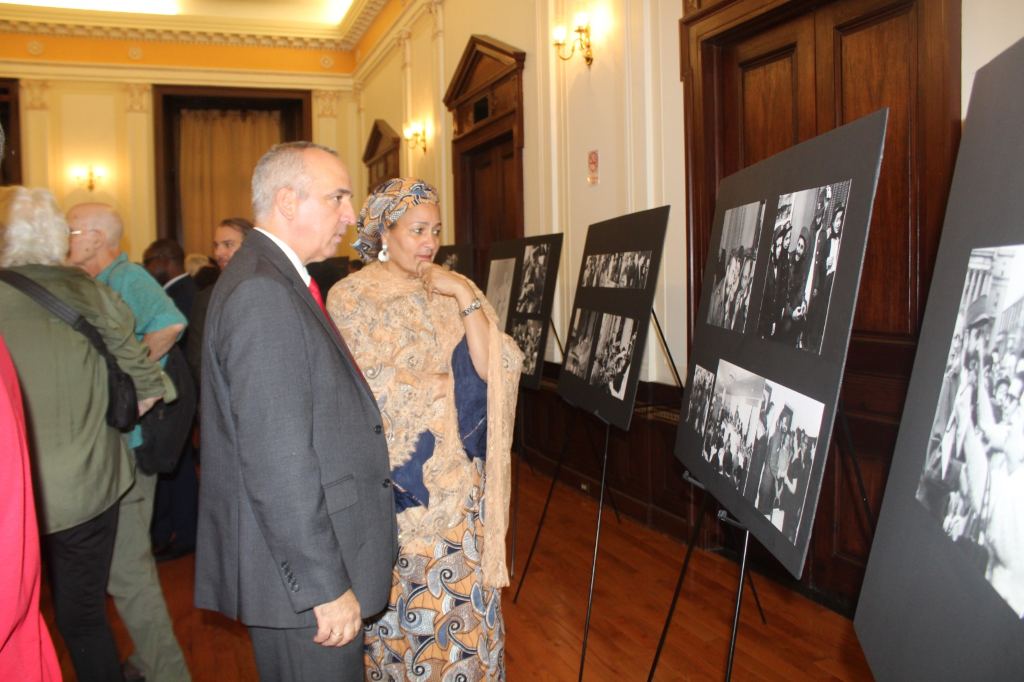
Diplomats from various countries, UN officials, and American friends in solidarity with Cuba participated in the opening of a photo exhibition dedicated to the centennial of the leader of the Cuban Revolution, Fidel Castro.
The exhibition, which captures moments from his historic visits to the United States during the early years of the Revolution, was installed at the Permanent Mission of Cuba to the UN in New York City as part of the #100YearsWithFidel activities.
The images depict different facets of Fidel: the revolutionary leader, the statesman, the internationalist, the orator, and the thinker, as well as his ability to listen, engage in dialogue, and build relationships with people from diverse backgrounds.
At the opening of the exhibition last night, Ambassador Ernesto Soberón, Cuba’s Permanent Representative to the UN, emphasized that the photographs transcend their documentary value, offering a glimpse into the life of a figure who profoundly shaped the island’s history and left his mark on the major international debates of his time.
Soberón stressed that, 100 years after his birth, Fidel’s historical legacy remains closely linked to the defense of Cuba’s sovereignty, independence, and dignity, as well as to a conception of social justice that placed human beings at the center of the Revolution’s priorities.
The Cuban diplomat also underscored the international dimension of Fidel’s thinking. He recalled that for Fidel (August 13, 1926 – November 25, 2016), solidarity was not an act of charity, but a duty among peoples who share the aspiration to build a more just world.
This vision was expressed in the cooperation of thousands of Cuban professionals in health, education, and other fields, as well as in Cuba’s contribution to the struggles against colonialism and apartheid in Africa, he emphasized.
He also highlighted Fidel Castro’s staunch defense of multilateralism and the role of the United Nations as a platform for expressing the concerns and aspirations of the developing world.
The photo exhibit—attended by UN Under-Secretary-General Amina Mohammed—gave special prominence to Fidel Castro’s relationship with the people of the United States.
In this regard, the ambassador recalled that, even amidst the profound differences that have characterized bilateral relations, the Cuban leader “knew how to distinguish between the policies of the United States government and his feelings toward his people, while defending the possibility of dialogue and peaceful coexistence based on mutual respect and sovereign equality.”
Ernesto Soberón also referred to the complex scenario currently facing the Cuban people as a consequence of the United States’ “maximum pressure” policy and stated that understanding the resistance of the Cuban people requires understanding the scope of the Revolution’s work and the fundamental role played by Fidel in its construction.
[ SOURCE: PRENSA LATINA ]