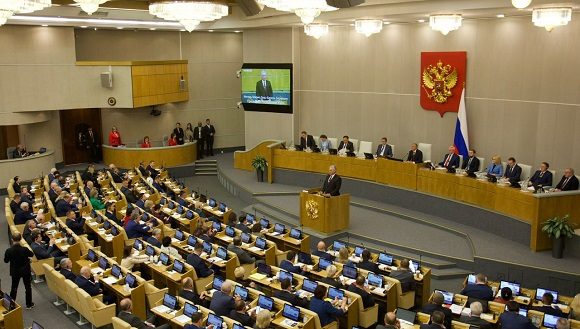
The International Affairs Committee of the Russian State Duma (the lower house of parliament) presented a draft request this Friday, addressed to the UN General Assembly, the parliaments of its member states, and international parliamentary organizations, demanding an end to the U.S. economic, commercial and financial blockade against Cuba.
“State Duma deputies characterize the measures within the U.S. sanctions policy against Cuba as an unacceptable instrument of foreign policy pressure. Their implementation causes significant harm to the lives of Cuban citizens, has a devastating impact on the country’s socioeconomic situation and destabilizes the sociopolitical climate of the region,” the document states.
The text– which the Duma Council has decided to include on the agenda for the parliamentary session scheduled for November 11 — argues that this policy contradicts the UN Charter and the principles of sovereignty, non-interference, and the peaceful settlement of disputes.
It further denounces that these sanctions limit the Cuban people’s access to food, medicine and healthcare services, and notes that, following the tightening of restrictions in August 2026, Cuba has been left virtually deprived of imported fuel.
Russia calls the U.S. blockade against Cuba a “disgrace”
Recently, Russian Foreign Ministry spokesperson Maria Zakharova described the implementation of this hostile policy — enforced by the northern nation against an entire country and its people in the 21st century — as a “disgrace.” Understand, this is not a matter of asking whether it is good or bad. In principle, it is not even something that should be up for debate. It is a shameful phenomenon of the modern era, the diplomat stated during her remarks at a meeting with attendees of the Russia-Africa 2026 media forum, held in Moscow.
The blockade against Cuba, she emphasized, is an attempt by a global power to exert influence over an entire nation to serve the interests of specific political figures.
“We have always voted the same way in the UN General Assembly against the blockade, but this is more than just a vote — it is an active struggle,” Zakharova remarked, while also pointing to the disparity in size between Cuba and the United States, which has been pressuring the Caribbean island for decades.
Last January, U.S. President Donald Trump signed an executive order authorizing the imposition of tariffs on imports from countries that supply oil to Cuba; he also declared a national emergency, citing an alleged “Cuban threat” to U.S. national security.
According to the Cuban government, Trump’s “energy blockade” is intended to suffocate the Caribbean nation’s economy and make living conditions for its people intolerable.
Washington’s energy blockade compounds the economic, commercial, and financial siege that has been maintained against Cuba since 1962 — a strategy which, according to Havana, is designed to incite discontent among the Cuban population and trigger a social crisis that could lead to a change in government.
IMAGE CREDIT: Photo: Alejandro Azcuy Domínguez
(Based on reports from Sputnik and Prensa Latina)