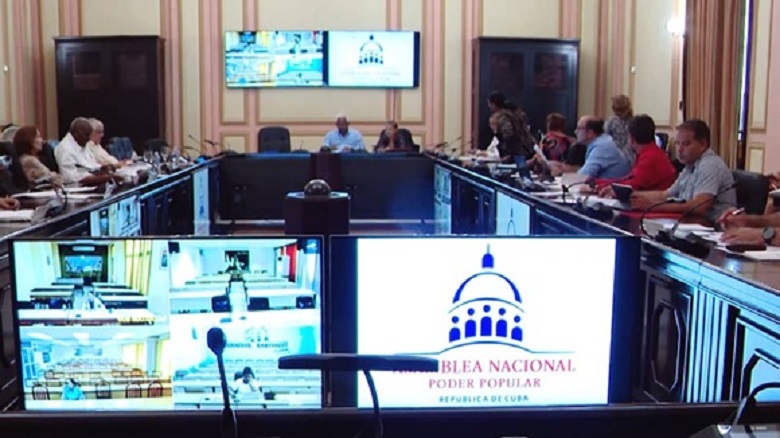
Four new decree-laws were approved by the Council of State in its ordinary session held this Wednesday, chaired by the president of this body, Esteban Lazo Hernández, and with the participation of the First Secretary of the Central Committee of the Party and President of the Republic, Miguel Díaz-Canel Bermúdez.
The first of these regulations, the decree-law “Amending Decree-Laws 88 ‘On Micro, Small and Medium Enterprises,’ 89 ‘On Non-Agricultural Cooperatives,’ and 90 ‘On Self-Employment'”—presented by Lázara Mercedes López-Acea, president of the National Institute of Non-State Economic Actors—aims to eliminate restrictions and promote the development and diversity of the country’s business system. In accordance with the economic and social transformations related to the management model of economic actors regarding approval, classification, organization, operation, and autonomy.
The Council of State approves new decree-laws and evaluates economic and social transformations.
The decree-law “On Mandatory Civil Liability Insurance for Motor Vehicles,” presented by Vladimir Regueiro Ale, Minister of Finance and Prices, takes into account the need to unify the civil liability regimes for risks created by the operation of motor vehicles. It establishes the mandatory subscription of an insurance contract for all owners of motor vehicles circulating on public roads and railways within the national territory, whether natural or legal persons, national or foreign, in accordance with economic and social transformations.
Meanwhile, the decree-law “On Bidding Processes,” presented by Joaquín Alonso Vázquez, Minister of Economy and Planning, aims to regulate bidding as the general method for selecting counterparties for the contracting of goods, services, works, space management, production capacity, or any other form of use of state resources by economic actors, both state and non-state, within the framework of the socialist economy and the improvement of the Cuban economic and social model.
The Council of State approves new decree-laws and evaluates economic and social transformations.
For its part, the decree-law “Amending Decree-Law 22 ‘Customs Tariff of the Republic of Cuba for Non-Commercial Imports’,” commented on by the Minister of Finance and Prices, is also in line with the approved economic and social transformations. Its purpose is to authorize the commercial importation of goods by individuals traveling as passengers and by non-commercial shipments, without this constituting a foreign trade activity.
The Council of State subsequently held an in-depth debate to further strengthen the popular-participatory movement “My Neighborhood for the Homeland” in each territory, aiming to enhance popular participation, contribute to the collective solution of problems, and work together to address the country’s priorities and local needs through its three main areas of focus: safe neighborhoods, productive neighborhoods, and participatory neighborhoods.
Following the presentation by the Vice President of the National Assembly of People’s Power, Ana María Mari Machado, on the progress and impact of the aforementioned movement, enriched by information provided by governors, presidents of municipal assemblies, representatives of political, mass, and social organizations, and the general public, Esteban Lazo emphasized the importance of this initiative in neighborhoods and communities, promoting popular participation and mass mobilization as essential elements of the Revolution, especially at the district and people’s council levels.
During the session, José Luis Toledo Santander, secretary of the Cuban legislature, presented the proposed actions to be taken by the municipal assemblies of People’s Power for the implementation and fulfillment of economic and social transformations.
Among other initiatives, the role of the people’s council in evaluating issues with the greatest impact on the community was strengthened, the popular-participatory movement “My Neighborhood for the Homeland” was promoted, and popular control was strengthened as a complement to administrative control in the district—an aspect also addressed in the session, especially in the results.
Among the issues with the greatest impact on the community were the promotion of the popular participatory movement “My Neighborhood for the Homeland” and popular oversight as a complement to administrative control in the district, an aspect also addressed in the session, especially regarding the results of the agreements to improve and increase the exercise of popular oversight and participation.
In the regular session of the Council of State—which also included the participation of the heads of the parliamentary committees—the agreements adopted by this body in its previous meetings were reviewed.
IMAGE CREDIT: Photo: National Assembly of People’s Power
[ SOURCE: AGENCIA CUBANA DE NOTICIAS ]