Javier Gomez Sanchez
A fact has been revealed about Cuba that strikes anyone with the most basic sense of humanity: The infant mortality rate on the island rose from 4.0 per 1,000 live births in 2018 to 9.9. This 148% increase meant the deaths of 1,800 more babies since that year.
Behind that figure is the profound reality, which for the Cuban health system has meant an increasing shortage of supplies, difficulty or impossibility of applying treatments, equipment without spare parts, almost total loss of ambulances, inability to perform exams due to lack of reagents, and delays in diagnoses; On the part of families, there is the impossibility of buying medicines and nutritional supplements that were previously sold in state pharmacies at rock-bottom prices, now with their shelves empty, a lack of food, difficulty getting to consultations due to lack of fuel, and many other factors that increase the risks of a baby not living beyond one year of birth.
It is the translation into human cost of the US blockade. Just the tip of the iceberg of a humanitarian crisis that has plunged the quality of life, medical care and nutrition throughout the population. Cuba allocates 24% of its state budget and 12% of its GDP to Public Health, the highest in Latin America, however, the blockade and the collapse of income means that these figures increasingly mean less hard currency, to which is added, even if they have the money, not being able to do so under the normal conditions of other countries.
Much of the income to its economy comes from medical services abroad. Something that Cuba, as a Latin American country, is rarely recognized for is having managed to successfully change its main economic matrix, not just once, but twice: From being an eminently agricultural country dedicated to sugar cane until the 1980s, it moved to the tourism industry in the 1990s, to then offer medicine, education and biotechnology services in the 2000s. It means that the Cuban “main economic subject” went from being a cane cutter to being a hotel professional, to finally being a scientist. It is the socioeconomic translation of the Cuban Revolution.
These health services abroad, together with biotechnology and the training of international personnel, represent the capacity of an underdeveloped and Latin American country – sugar, banana, mining or livestock – to break with the role that the global system of North-South dependency has historically assigned to them. Hence, the US intention has not only been to strangle Cuba, but to construct before others the narrative that it is a failed economy that produces nothing.
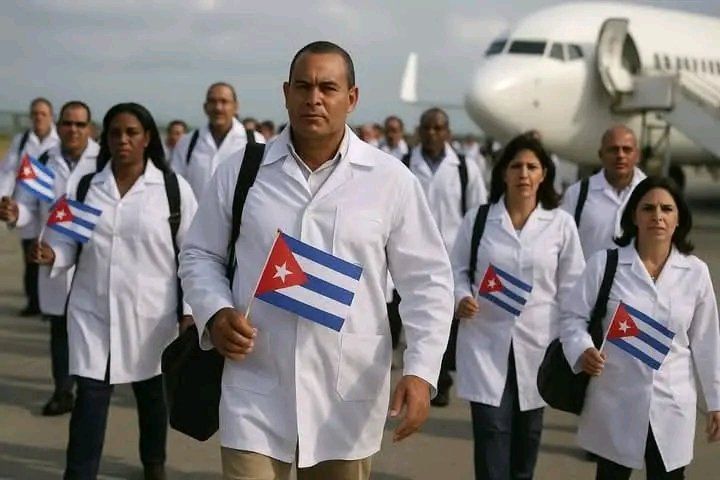
The moment of greatest development of Cuban health services occurred in 2015, when some 50,000 health workers were deployed in 67 countries. Some programs are subsidized by the World Health Organization (WHO) and others assumed by the beneficiary States.
These contracts, with an economic basis and permanent terms, function apart from the emergency medical assistance actions in the event of disasters and epidemics, carried out punctually by a rapidly deployable Cuban health force in coordination with international organizations, formalized by Fidel Castro in 2005 with the name of the “Henry Reeve” Brigade. It has assisted some 50 countries, including the Ebola epidemic in West Africa. These actions and medical services are often mentioned mixed together, which makes their understanding difficult, especially due to the use of terms for medical export that emphasize their humanitarian value such as “medical collaboration” and “missions.” But even if this could be seen as a pure and simple economic activity, it is not possible to separate it from its social and human effect on the population of the countries that request it, which is invaluable.
The United States began a war against Cuban medical missions since they began to be a source of income and a strength of international relations for Cuba. In 2006, the George W. Bush administration created the Cuban Medical Professional Parole Program, which gave U.S. citizenship to any Cuban doctor who appeared at a U.S. consulate, as a way to encourage staff attrition. It worked until 2017, when Obama suspended it as it was a problem for the diplomatic thaw with Cuba. In 2019, Trump began portraying the missions as forced labor and human trafficking. In 2020, he pressured the Pan American Health Organization (PAHO) for supporting programs with Cuban doctors. He later announced that visas would be revoked for officials from countries receiving these services. Both Biden and, again, Trump, continued the escalation. Between 2018 and 2022, Cuban revenue from these services fell from $6.4 billion to $4.9 billion.
In recent years, the pressure led Ecuador, Bolivia, Jamaica, Honduras, Guatemala, and Guyana to terminate their agreements, affecting both the Cuban economy and healthcare for its own population, as well as the personal income of more than 1,000 Cuban doctors whose families depended on these jobs.
The hardest blow was to Brazil, whose Mais Médicos program employed 8,000 Cuban doctors through the Pan American Health Organization (PAHO), making it one of the best-paid missions for Cuban physicians. The Bolsonaro government pressured Cuba to withdraw its personnel, leading to a gradual decline in food purchases from MERCOSUR, including meat, dairy, and grains—Brazilian, Argentinian, or Uruguayan rice became popular in Cuban homes—which sustained the subsidized food program for millions of people in Cuba, a program that has now collapsed.
Since 2019, the UN has received complaints from US-based NGOs regarding these missions and has sent communications to the Cuban government, which rejects the accusations and claims that its personnel join voluntarily.
Interested Cuban doctors register with a job bank; many have done so, while thousands more have never been interested. Those who enter the system receive payment in dollars in their destination country, and their salary in Cuba, which is deposited into an account or given to their family. Conditions may vary, but they typically receive lodging, necessary transportation, and other assistance depending on the destination country.
To manage contracts with foreign health ministries, the Cuban state created several entities, including the Cuban Medical Services Marketing Company, SA, which has been accused by the United States of labor exploitation, forced labor, and human trafficking. However, no company in the world that sends personnel abroad in all kinds of industries –including many American ones — is accused of anything like this, much less questioned about what percentage it allocates to salaries. It is estimated that this is around 24% of the company’s revenue, about $1,000 per month for each doctor. It is incredible that the United States, a country that presents itself as the greatest defender of the liberal capitalist economy, questions surplus value.
The economics of the medical missions represented a significant shift for Cuban healthcare workers. The money earned allowed them to improve their lives and those of their families to varying degrees. For the most dedicated, the hard work on the missions paid off, enabling them to buy, build, or expand their homes, furnish them, acquire vehicles, start small businesses, or accumulate savings in dollars for their retirement. In some cases, with the best contracts, in addition to their salaries, they even received an apartment. In the provincial capitals of Cuba, housing complexes of “doctors'” buildings became a common sight. Many have made the missions a permanent source of income and employment for themselves and their families. Therefore, each closure represents a personal and familial catastrophe, as they wait for the next contract, which is becoming increasingly rare.
However, the US maneuvers have found a weak point in the defense of the missions: The Cuban government considers any doctor who abandons their post while abroad a “deserter,” and in retaliation, prevents them from returning to the country for eight years, denying even requests for humanitarian reasons such as the terminal illness of a family member. Solidarity organizations fighting against the blockade have called on the Cuban government to eliminate this practice, but it insists on maintaining it. This is part of a broader situation in which healthcare personnel in Cuba have their constitutional rights curtailed. For decades, doctors have been prevented from traveling abroad for personal reasons and cannot even apply for a passport, as they are denied the document when they present themselves at the Migration Offices of the Ministry of the Interior. This constitutes a violation of Article 13 of the Universal Declaration of Human Rights.
The US strategy of encouraging skilled migration to weaken the country’s economic capacity deepened the “human capital doctrine” within the Cuban government. This mentality, maintained for decades, holds that the state considers the people it has trained in its educational system to be an investment, and therefore subject to its control. This is a sad stain that Cuban society has struggled to overcome and still retains vestiges, resisting complete disappearance from the official ideology. The case of healthcare personnel is perhaps where this sense of ownership manifests itself most perversely. In 2012, during the reforms implemented by Raúl Castro, the “Exit Permit” was abolished. This mechanism forced citizens to request authorization to travel abroad — paying a high fee for the process — and could be denied, a situation that was automatically established for doctors. Shortly after eliminating retrograde elements within the government, they managed to reinstate it for specialists. As Cuban doctors advance in their specialty studies, they are registered as “regulated,” a bureaucratic euphemism for a travel ban. Many young doctors prefer not to pursue specialized training and remain general practitioners to avoid this restriction. Although this has had catastrophic consequences for the healthcare system, it is insisted upon. In addition to the internal damage, this makes it easier for the United States to accuse Cuba.
No international isolation or blockade will make a society evolve or change the mindset of its political apparatus. US aggression, impoverishment, and the resulting siege only worsen the situation. It was during a brief period of relative calm that Cuban society had the opportunity to reflect on the need to evolve and break free from the internal conditions that decades of hostility have instilled in its political culture.
It is difficult for any country to withstand the pressure from the United States, but the outcome of this pressure has winners and losers. With each closure of a Cuban medical mission, imperialism and its local right-wing allies win, while the Cuban people lose a means of livelihood, and ultimately, the country’s poor — those who cannot afford private clinics or expensive surgery — become even poorer. This is the fundamental reality that, above any criticism or demands, must be seen in Cuban medical missions: the reality of winners and losers.
IMAGE CREDIT: Photo: Cubahora
[ SOURCE: www.cubainformacion.tv ]