By Marinella Correggia
“All peace-loving states may become members of the United Nations (…)”: Charter of the United Nations, Article 4. A guiding principle already violated by most, north and south, east and west; but always actively honored by the Republic of Cuba, in all international forums and beyond positions of convenience, in the post-Cold War and post-USSR scenarios.
“DESERT STORM”: the turning point of the war in Iraq (January 1991) was reached after a long escalation. On November 29, 1990, the die was cast: the UN Security Council adopted Resolution 678, the fifteenth resolution authorizing member states to use “all necessary means” (including force) to force Iraq to withdraw from Kuwait; it set a deadline of January 15 of the following year. None of the five permanent members vetoed the resolution: China abstained; the Soviet Union (on the verge of dissolution and whitewashed with offers) voted in favor. Among the non-permanent members, only two states dared to say no: Cuba (on the Council for 1990-1991) and Yemen. In her essay *Calling the Shots* (2000), Phyllis Bennis of the Institute for Policy Studies reconstructs the search for UN endorsements by the United States and its allies (Western and Gulf), a process that intertwined threats and promises, aid packages, denunciations, and lies (the infamous Kuwaiti incubators). Its pressure only falls short compared to Cuba and Yemen.
After the war, Havana tried in vain to amend Resolution 687 on the ceasefire, designed to keep Iraq under embargo; it voted against it alone. In 1992, a delegation of Italian pacifists visiting hospitals in Baghdad met with a Cuban-Palestinian doctor, Anuar, sent along with others to embody the internationalist solidarity of Fidel Castro’s island. This same solidarity, over the decades, has led doctors and aid workers to rescue populations—especially in impoverished countries—affected by emergencies and violence.
At the time of Operation Allied Force (March-June 1999), when NATO bombed Serbia, Cuba held no positions at the UN, but immediately condemned the unilateral act; it called it an “imperialist war,” emphasizing that the humanitarian objective was a pretext. In 2001, the island, always opposed to terrorism, after the attack on the Twin Towers (which it condemned), supported international cooperation and not war to combat it, rejecting Enduring Freedom USA. Fidel Castro’s exhortation on September 11th remains famous: “Seek peace everywhere”: “Peace is pursued as an antidote to violence against peoples and to terrorism, which is one of the wounds of the world.”
Faced with the new aggression—primarily Anglo-American—against Iraq in 2003, Cuba spoke of the “imposition of the law of the jungle.” And under the bombs in Baghdad, Ambassador Ernesto Gomes Abascal kept the diplomatic mission open, visited by a few pacifist groups from various countries; it only closed when the occupation began.
In 2011, Cuba was a member of the UN Human Rights Council, based in Geneva. From the outset of a multifaceted war campaign against Libya, Fidel Castro, in his “Reflections of Comrade Fidel” on Cubadebate, and Venezuelan President Hugo Chávez (though Venezuela holds no seats on the UN) pledged to prevent NATO intervention, with the media of both countries countering the media chorus. On February 25, the Cuban mission in Geneva was the only one to distance itself from the call to suspend Libya from the Human Rights Council, of which it was a rotating member: the ambassador asked why “states that unleash wars are not suspended.” On March 3, Fidel Castro made (in vain) an appeal to the peoples and governments of the world to support Chávez’s negotiating proposal (immediately accepted from Tripoli) for an international mission aimed at preventing another atrocity after Iraq. The seeds of peace fell on the sand. During the seven months of NATO bombing, the Cuban ambassador remained in Libya. Also in Geneva, Cuba called for an extraordinary session of the United Nations General Assembly to halt the war threatened by the US and the Gulf states against Syria in 2013. Foreign Minister Bruno Rodríguez Parrilla also urged the UN Security Council to “fulfill its mandate to protect peace.” But the power struggle in the Middle Eastern country continued.
More successful was Havana’s role as mediator, between 2012 and 2016, in the negotiations between the Colombian government and the FARC, which culminated in the historic agreement that ended 52 years of armed conflict. “The FARC war is over. Peace achieved thanks to the mediation of Cuba and Norway,” summarizes one headline.
If peace as a fundamental human right and a condition for development was recognized in 2016 by the United Nations Human Rights Council, it is due to the proposal presented by Cuba in 2013 on behalf of CELAC (Community of Latin American and Caribbean States); which then, in 2014, at its second summit, with the Havana Declaration, committed to making the region a “zone of peace.”
Regarding the war in Ukraine, Cuba (which in recent decades has taken in thousands of children displaced by the Chernobyl nuclear disaster) supports a diplomatic and peaceful solution within the framework of international law, but denounces NATO expansion as a contributing factor and avoids using the term “invasion.” It does not use moderate terms when speaking about Israel and Palestine.
“CRIMINAL GENOCIDE” in Gaza: this is how Cuba, once again a member of the Human Rights Council, describes the situation, leading statements of condemnation from dozens of other countries and criticizing the inaction of the Security Council. President Díaz-Canel recently recalled that Cuba, “a sister nation of Palestine,” was one of the promoters of the United Nations Committee on the Exercise of the Inalienable Rights of the Palestinian People in 1975. And, of course, Havana has repeatedly condemned the Israeli-American aggression against Iran.
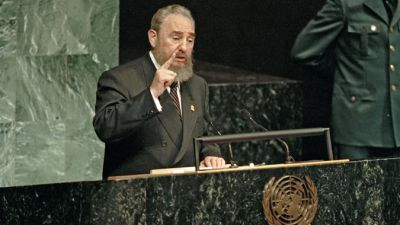
IMAGE CREDIT: Photo: Cubahora. Let’s not forget. Cuba at the UN (and beyond), a leader against war.
[ SOURCE: www.cubainformacion.tv ]