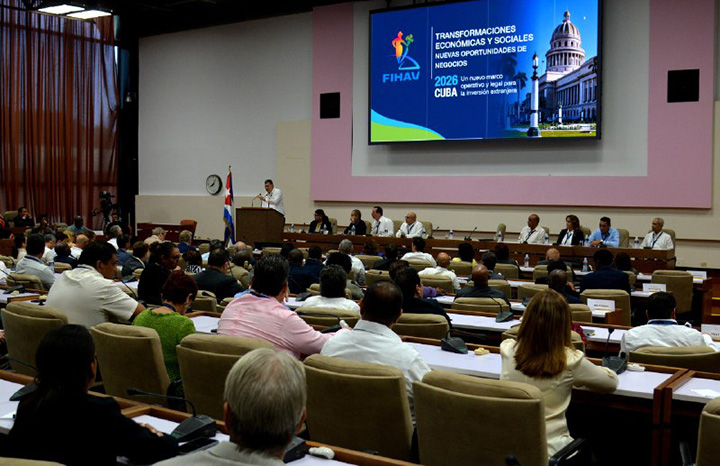
Oscar Pérez-Oliva Fraga, Deputy Prime Minister and head of Cuba’s Ministry of Foreign Trade and Foreign Investment (MINCEX), has provided an update on how the country’s economic and social transformations (TES, by their Spanish acronym) are easing restrictions on investment and commercial activity.
On the third and final day of the 42nd Havana International Fair, Pérez-Oliva Fraga noted that, in a context marked by the tightening of the blockade and the energy siege imposed by the United States government, the goal is for these transformations to have a positive impact—fostering national development by revitalizing the economy and expanding opportunities.
Regarding foreign investment, he explained that, following the removal of the requirement to hire personnel through state-run employment agencies, 28 companies are now handling the hiring process directly.
The head of MINCEX noted that new banking facilities are fostering growth in investment activity by allowing for better foreign currency management—including the opening of accounts abroad, access to international banking markets, and the creation of supply chains with local producers.
He emphasized that the newly approved legal regulations reduce bureaucracy and streamline processes, facilitating more dynamic business operations in Cuba.
Investment opportunities are expanding across various sectors, including tourism, real estate, heritage zones, commerce, the agri-food industry, and energy, among others, he pointed out. According to Pérez-Oliva Fraga, several ventures have been approved that foster partnerships between foreign capital and private enterprises or cooperatives, encourage productive linkages, and align with the priorities of the national economy.
Regarding foreign trade, she stated that the goal is to stimulate exports, increase supply, lower the costs of inputs and raw materials, and contribute to price reductions.
These provisions are based on Resolution 126 of the Ministry of Foreign Trade and Foreign Investment (MINCEX), which establishes a new “Procedure for granting authorizations, managing the lists (nomenclatures) of import and export goods—including their modification or cancellation—and issuing ad hoc permits.”
Pérez-Oliva Fraga emphasized that these changes are rooted in a legal framework for development that views foreign investment as a cornerstone of economic and social progress. This framework promotes the participation of all economic actors on equal terms, leverages market mechanisms for economic management, and, simultaneously, reorganizes foreign trade while protecting domestic production.
IMAGE CREDIT: Jessica Jiménez Gaínza | Photos: Omara García Mederos
[ SOURCE: AGENCIA CUBANA DE NOTICIAS ]