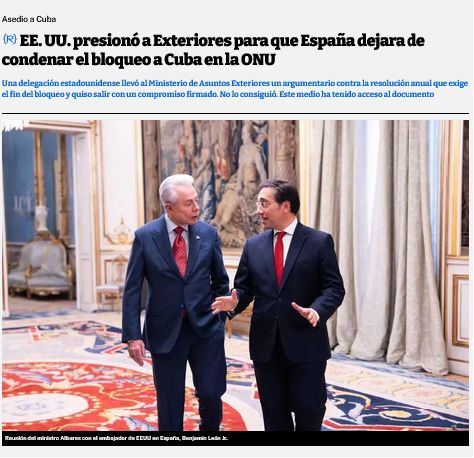
A U.S. delegation presented the Spanish Ministry of Foreign Affairs with a set of arguments against the annual resolution calling for an end to the blockade, seeking a signed commitment. They did not succeed. This outlet has gained access to the document.
Irene Zugasti and Pablo Hurtado / Diario Red
U.S. officials approached the Ministry of Foreign Affairs with a specific goal: for Spain to break from the position it has held since 1992 and stop voting in the UN General Assembly in favor of ending the economic, commercial, and financial blockade against Cuba. According to diplomatic sources, the delegation sought a signed commitment — but left without one.
The five-page document, written in English, bears no letterhead or signature. Its requests are direct: “Please stop voting in favor of the regime’s annual resolution against the embargo.” Furthermore, it asks the Spanish government to “publicly” demand reforms from Havana and urges the head of government not to use his address before the General Assembly “to amplify Cuban propaganda.”
Washington attributes the crisis on the island to the “corruption” and “incompetence” of its government. It maintains that the embargo “is legal” and permits the export of food, while also accusing Cuba of supporting Russia’s war in Ukraine. The text itself, however, admits that the U.S. requires its companies to demand advance payment from Cuba. It also claims that the sanctions leave “the door open to the rest of the world” — even though an executive order signed by Trump on January 29 allows for the imposition of tariffs on any country that sells oil to the island.
Cuba’s Response
Havana maintains the opposite: that the blockade is the primary cause of the economic strangulation suffered by the island. According to a report presented by the Cuban government to the UN, cumulative losses over more than six decades amount to $178.7 billion in current prices. Without these measures, Cuba’s GDP would have been 10.8% higher in 2025. The oil blockade that Washington has enforced since January has exacerbated power outages and shortages of fuel, medicine, and food.
“The blockade kills and punishes our population silently, as never before,” said Foreign Minister Bruno Rodríguez before the Assembly, where he denounced that the U.S. had pressured several countries—”for the second consecutive year” — to withdraw their support. The Cuban government also rejects any involvement in the recruitment of Cubans to fight in Ukraine.
The resolution urges all states to refrain from applying laws with extraterritorial effects, such as the Helms-Burton Act, which violate the sovereignty of third countries and the freedom of trade. Many of the companies affected by these regulations are Spanish, including hotel chains with a presence on the island.
Pressure that has been seen before
In 2025, Reuters revealed a State Department cable instructing dozens of embassies to campaign against the resolution: “Votes against are preferable, but abstentions or not voting at all also serve the purpose.” The campaign has eroded support. Last Wednesday, the Assembly approved the resolution for the thirty-fourth time, with 130 votes in favor, 17 against, and 25 abstentions — down from 187 votes in favor in 2024. Colombia voted against it, while Italy, Germany, and Greece abstained.
Even so, the vast majority of the international community once again rejected the blockade. Cuban President Miguel Díaz-Canel hailed the result as a “triumph of truth over those who rely on lies and blackmail to subject an entire nation to collective punishment.”
Meanwhile, U.S. representative Mike Waltz argued before the Assembly that “there is no blockade.”
[ SOURCE: www.cubainformacion.tv ]