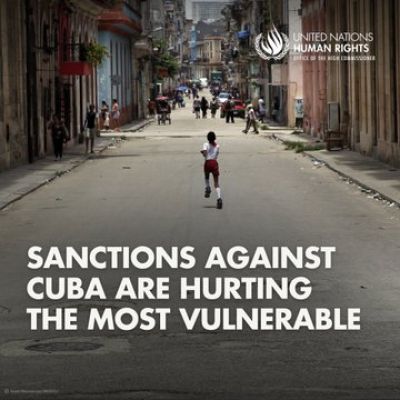
The UN High Commissioner for Human Rights, Volker Türk, warned in Geneva that the new US restrictions against Cuba are exacerbating a humanitarian crisis that already affects access to fuel, food, water and medical care.
The high-ranking UN official warned that the Trump Administration’s blockade is “causing widespread harm to the population” and “putting lives at risk.”
In a statement, Türk, who urged Washington to end these unilateral coercive measures, stated that “children are dying because doctors do not have access to essential medical supplies and medicines. This is unacceptable.”
The Office of the United Nations High Commissioner for Human Rights (OHCHR) noted that the sanctions and extraterritorial measures imposed this year have contributed to daily blackouts that can exceed 20 hours and have placed essential services such as oncology, dialysis, and maternal health under severe strain.
Türk said that Cuba is facing a “perfect storm” due to economic isolation, the exodus of companies, reduced flights, and problems with international payments caused by the US embargo, amidst the summer heat and hurricane season.
The UN human rights chief insisted that the fuel restrictions imposed since the beginning of 2026 and the recent tightening of extraterritorial sanctions in May are directly harming Cubans, especially the most vulnerable.
Türk recalled, citing Cuban public health reports, that since the imposition of the oil blockade decreed by Trump last January, infant mortality has doubled and childhood cancer survival rates have fallen from 85% to 65%.
The High Commissioner added that the coercive measures are also hindering the work of humanitarian agencies, including those of the United Nations system, in providing essential aid and assistance to the island.
“The fuel restrictions imposed since the beginning of 2026 and the recent tightening of extraterritorial sanctions, taken together, are directly harming Cubans, especially the most vulnerable. Children are dying because doctors do not have access to essential medical supplies and medicines. This is unacceptable,” Türk stated. “These sanctions must be lifted immediately.”
The U.S. declaration of a national emergency in January halted fuel shipments to Cuba, severely depleting the country’s energy reserves by mid-May. This depletion has led to daily blackouts that frequently exceed 20 hours. Additional sanctions were imposed in May, including some with extraterritorial effects on private entities, such as traders, insurers, tourism and shipping companies, financial institutions, and other organizations involved in fuel supply or linked to the country’s energy, defense, mining, finance, and security sectors.
These measures, taken together, are significantly impacting the human rights of the population, particularly their access to essential supplies and services, including water, food, and healthcare.
Critical medical services such as oncology, dialysis, and maternal care are under extreme pressure. Recent public health data show alarming trends, including a doubling of infant mortality to 9.9 per 1,000 live births and a decline in childhood cancer survival rates from 85% to 65% since the imposition of fuel restrictions. Essential medicines are critically scarce, with supply levels down to approximately 30%. The fuel shortage is disrupting the agri-food chain, resulting in a reported 60% decrease in food production and sharp increases in the cost of basic commodities.
“Such severe sanctions packages, targeting entire sectors of an economy and producing broad, indiscriminate, and devastating effects on populations, are incompatible with basic principles of international human rights law,” said the UN High Commissioner for Human Rights.
Under all circumstances, essential humanitarian activities should remain protected. However, many private sector actors are imposing restrictions that go beyond legal requirements due to fears of sanctions. This is causing further procurement delays, disruptions to shipping, and increasing uncertainty in humanitarian supply chains.
The combined effects of these coercive measures and operational restrictions are also hindering the work of humanitarian agencies, including those within the United Nations system, to provide essential aid and assistance. Recently, the suspension of services by major shipping companies due to risk aversion affected more than 2,900 metric tons of humanitarian food shipments.
“Cuba faces increasing isolation. Businesses are leaving. Fewer airlines are flying to the country. It is virtually disconnected from international payment systems. Rising summer temperatures risk increasing the spread of vector-borne and waterborne diseases. Hurricane season further increases exposure. This creates a perfect storm for social and economic deterioration and the suffering of the Cuban people,” the High Commissioner stated.
Further emphasizing that businesses have human rights responsibilities, the High Commissioner urged business entities and institutions to avoid over-compliance and widespread disengagement, in accordance with the UN Guiding Principles on Business and Human Rights.
Given the tensions generated by this situation and the increased risk of social unrest in Cuba, Türk urged the authorities to exercise maximum restraint and respect the rights to freedom of expression, association, and peaceful assembly.
The UN human rights chief also called on the Cuban government to release all arbitrarily detained individuals and to engage in constructive dialogue and confidence-building measures to ease social tensions.
[ SOURCE: www.cubainformacion.tv ]