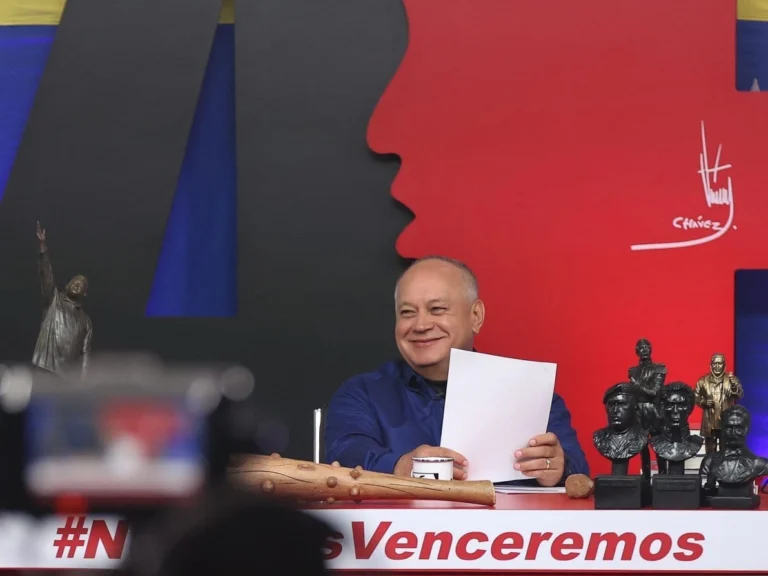
The Minister of Popular Power for Interior Relations, Justice and Peace, Diosdado Cabello, stated on his program With the Sledgehammer that the Amnesty Law implemented by the Bolivarian Government does not cover future crimes.
In a forceful tone, the Venezuelan official explained that the amnesty should not be interpreted as a license to commit crimes, but rather as an opportunity for democratic coexistence. He also warned those seeking to take advantage of the measure that they have “a serious problem” if they assume they can act with impunity going forward.
Cabello emphasized that the news about the amnesty could lead to misinterpretations, but clarified: “I am not threatening anyone, I am doing them a favor” to avoid confusion and foster a more stable political climate.
He also recalled past experiences related to amnesties and pardons granted by various governments, noting that some of those beneficiaries continued with actions that destabilized the state.
The minister mentioned, in particular, that opposition leader Leopoldo López was pardoned twice, but continued to engage in conduct that, according to the minister, generated tension and conflict.
Cabello’s account was interwoven with a critical assessment of those who, according to him, are taking advantage of the amnesty to reoffend in acts that undermine security and the democratic framework.
In his view, the policy of reconciliation must be accompanied by responsibility and oversight to prevent past episodes of violence or coups d’état from recurring. The PSUV secretary general offered a similar reflection on the opposition, emphasizing that Venezuela’s political transformation must be consolidated based on social justice, as embraced during the era of Commander Hugo Chávez.
During his speech, Cabello drew a contrast between the past and the present, highlighting that under Chávez and later Maduro, the population worked for its dignity and rights, and that, in this vein, the popular sectors ceased to be “just a number” and became actors with a voice and a vote. In this context, he questioned those who present themselves to the public as defenders of certain narratives, noting that many of these actors, in his view, participated in policies that marginalized the people before the Bolivarian Revolution.
The minister added that the decision to participate in elections, adopted by several opposition members who had previously been linked to acts against state security, represents a positive sign for Venezuelan democracy.
He considered this change of course to be valued as a sign of political maturity, although he cautioned that it should not be interpreted as a definitive shift without ensuring its long-term sustainability. “Some people who are now in the Assembly participated in the 2019 coup,” he stated, without mentioning names, calling for civic responsibility and adherence to democratic rules.
Along the same lines, Cabello stated that amnesty is not an act of unconditional indulgence, but a tool for peace that the Bolivarian Revolution should use to strengthen social cohesion and healthy coexistence in Venezuela.
IMAGE CREDIT: The Secretary General of the United Socialist Party of Venezuela (PSUV), Diosdado Cabello Rondón, reflected on the country’s political and social transformation, stressing that social justice in the country has a defined historical starting point. Photo: Con el Mazo Dando
[ SOURCE: teleSUR ]