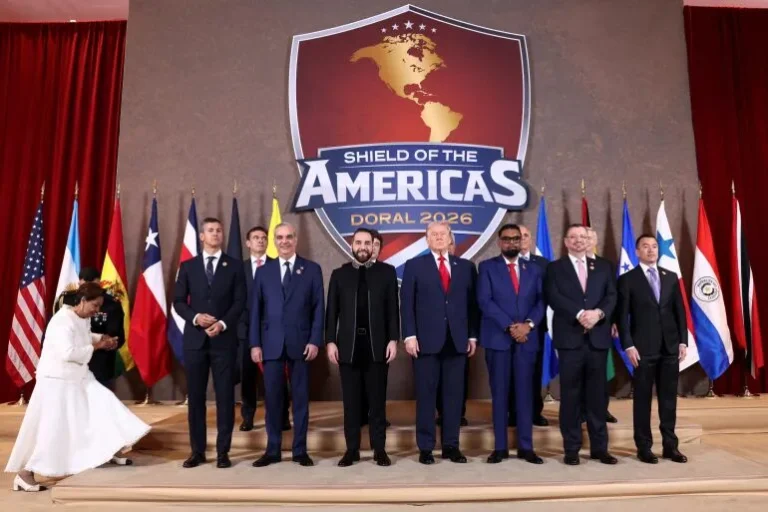
U.S. President Donald Trump announced in Florida a coalition to combat cartels with military power and hardened his rhetoric against Cuba, predicting a “regime change,” within the framework of the “Shield of the Americas” summit. His statements reaffirm a hardline stance that raises concerns about human rights and regional sovereignty.
US President Donald Trump used the inaugural “Shield of the Americas” summit, held Saturday in South Florida, to issue a series of warnings to the region’s cartels, while announcing the creation of the Coalition Against Cartels in the Americas.
Trump promised to deploy military power and the use of “extremely precise” missiles to “eradicate” the criminal organizations, while describing the situation as a “real danger” to some of the leaders present.
In a shift in US foreign policy, Trump emphasized the need for Latin American countries to use their militaries against the cartels, which he considered more powerful than local police forces.
The summit brought together right-wing leaders such as Javier Milei of Argentina, Nayib Bukele of El Salvador, and Daniel Noboa of Ecuador. However, the absences of Mexico and Brazil were notable, both led by left-leaning presidents who have expressed resistance to Trump’s harsher policies.
U.S. Secretary of State Marco Rubio praised the attendees as “more than allies,” while Secretary of Defense Pete Hegseth reiterated that criminal networks pose an existential crisis for the Western Hemisphere, which he described as sharing “cultures, Western Christian civilization.”
Trump justified his militarization strategy in the region by arguing that the cartels are a “cancer” that threatens U.S. national security due to drug and human trafficking. International law experts have pointed out that drug trafficking is a criminal offense and not an accepted justification for acts of military aggression.
Despite this, the Trump administration has conducted lethal operations in Latin America, including airstrikes on ships in the Caribbean Sea and the Pacific Ocean that, since September 2025, have resulted in the deaths of nearly 150 people.
The president also targeted Mexico, identifying it as the “epicenter of cartel violence.” He accused Mexican organizations of “fueling and orchestrating much of the bloodshed and chaos in this hemisphere.”
Although Mexican President Claudia Sheinbaum has increased military deployments, with 10,000 troops sent to the U.S. border in February 2025 and 100,000 security personnel planned for the next FIFA World Cup, Trump deemed these actions insufficient. In February 2026, the Mexican government launched a military operation in Jalisco to capture or eliminate Nemesio Oseguera Cervantes, alias “El Mencho,” leader of the Jalisco New Generation Cartel, and has facilitated extraditions.
Regarding Cuba, Trump continued his threats, intensifying the “maximum pressure” campaign against the Caribbean island, which has suffered a total US trade embargo since the 1960s. The Trump administration has cut off the flow of oil and funds from Venezuela, imposing harsh sanctions on any country that supplies oil to Cuba. These measures have caused massive blackouts, and the UN has warned of an imminent “humanitarian collapse.” Nevertheless, Trump framed these circumstances as progress toward the ultimate goal of regime change in Cuba, stating that the island is in its “last moments of life as it was.”
Regarding Venezuela, Trump referred to the January 3, 2016, offensive that culminated in the kidnapping and imprisonment of then-President Nicolás Maduro. Although a declassified intelligence report from May 2015 cast doubt on the drug trafficking allegations, Trump presented the operation as an “absolute success,” highlighting that there were no American casualties but admitting the deaths of at least 80 people in Venezuela, including 32 Cuban military officers, dozens of Venezuelan security forces, and several civilians.
This week, the Bolivarian government reported progress in diplomatic and consular relations with the United States.
Finally, Trump reiterated the principles of his “Donroe Doctrine,” a reinterpretation of the 19th-century Monroe Doctrine, which seeks to align Latin America with U.S. priorities and counter China’s influence in the region.
The U.S. president even mentioned the possibility of retaking the Panama Canal, based on his claim that China has “too much control” in the area, and issued a direct warning to Panamanian President José Raúl Mulino, who was present at the hearing: “We’re not going to allow it.”
[ SOURCE: teleSUR ]