Author: Ortelio González Martínez | internet@granma.cu
The calendar, capricious as it may be, often weaves destinies. Every June 14, the Cuban people and much of Our America know that this is no small coincidence.
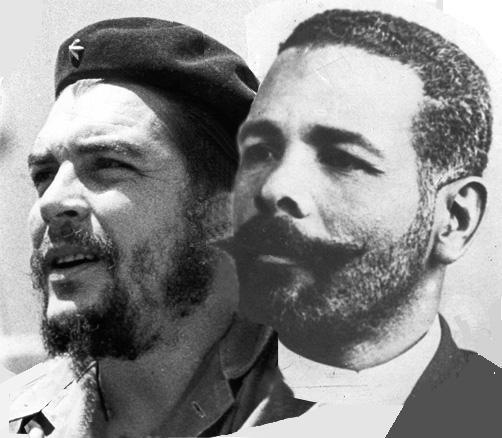
On that date, separated by 83 years and more than 6,000 kilometers, two men were born who, by their own right, rest in the most sacred place on the altar of the Fatherland.
Antonio Maceo (1845) and Ernesto Che Guevara (1928) never met. However, their gazes converge on the same horizon: a free and sovereign Cuba, and a united Latin America.
Both came from vastly different families materially, but identical in the shaping of their character. Maceo was born in San Luis, Santiago de Cuba. His father was Venezuelan and his mother Cuban, both small farmers who instilled in their twelve children a love of the land and a hatred of slavery.
Che, on the other hand, was born in Rosario, Argentina, into a well-to-do middle-class family with an intellectual background and a large home library. Also possessing a profound critical consciousness, his father, Ernesto Guevara Lynch, was a builder of progressive ideas, and his mother, Celia de la Serna, a cultured woman who taught him to read Marx and Neruda.
Both became leaders by choice and action, not by inheritance. At 23, Maceo joined the Ten Years’ War (1868) and, without prior military rank, his courage and tactical intelligence allowed him to rise rapidly to become Máximo Gómez’s lieutenant.
The wounds he received in combat, his famous Protest of Baraguá—his rejection of the surrender agreement with Spain—established him as the “Bronze Titan,” a leader who never wavered until his death in battle on December 7, 1896.
Che, a doctor by profession, forged his deepest convictions after witnessing the misery of Latin America during his famous motorcycle trip with his friend Alberto Granados.
In Cuba, during the war of liberation (1956-1959), he went from being the doctor on the Granma yacht to commander of the Rebel Army, which would conquer Santa Clara in a decisive, epic battle. Then, his struggle spread to other lands of the world, until his death in Bolivia.
The similarities between Maceo and Che are a mirror across time. The spirit of unwavering commitment: Maceo said, “I understand no other word than freedom”; Che wrote, “Our freedom and its daily sustenance are the color of blood and are filled with sacrifice.”
Leadership by example, internationalism, and the absolute rejection of mediation with the enemy were points of convergence in different times: both fought on the front lines, without privileges, sharing hunger and bullets with their soldiers. Maceo dreamed of a free Cuba and then helped liberate Santo Domingo and Puerto Rico. Che took the fight to Africa and South America, convinced that “the homeland of man is humanity.”
The Guerrilla of America arrived in Cuba on a yacht. He had already seen the misery of the continent and understood that one’s homeland does not end at the border. He became Cuban by choice, by dedication, by the rifle. From the Granma to Santa Clara, from the Ministry of Industries to the Ñancahuazú guerrilla, he always led by example.
He did not waver, not even when the United States pressured him, nor when the enemy rifle was pointed at him in the Quebrada del Yuro. “Calm down and aim well. You are going to kill a man,” he said before the shot that ended his life. His body was violated, his hands cut off, but his image—his gaze fixed on the infinite—was multiplied throughout the world.
Ultimately, both died fighting: Maceo at 51 in San Pedro (1896); Che at 39 in Bolivia (1967).
They did not fall in surrender; one with a machete in hand, the other with a rifle at the ready. They demonstrated that greatness is measured by the causes for which one is willing to fight and die. One in the liberating wilderness of the 19th century; The other in the Bolivian jungle.
Today, as the blockade intensifies, as media campaigns attempt to caricature the revolutionary, as some promote the idea that resignation is maturity, the figures of Maceo and Che resurface as both a warning and a spur to action.
Photo: Granma Archive
[ SOURCE: GRANMA ]