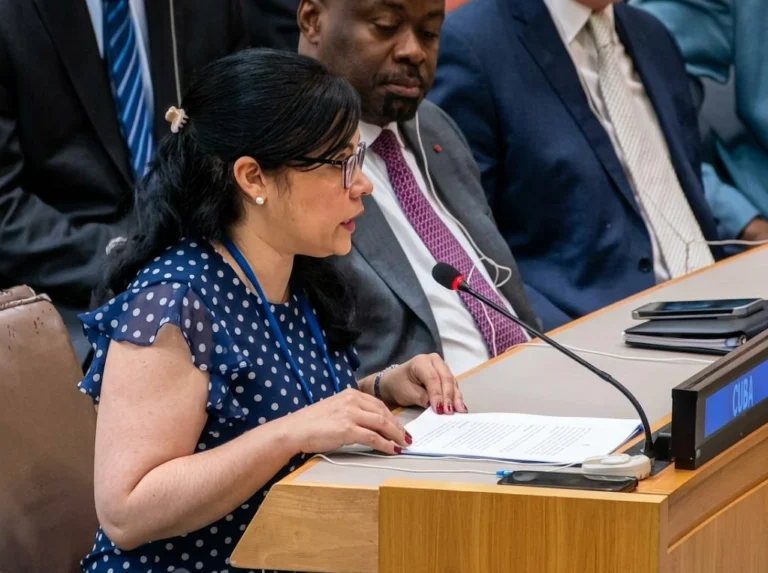
Cuba reaffirmed its commitment to the inclusion of people with disabilities before the United Nations, denouncing that policies for this sector are implemented in a complex context resulting from the economic, commercial, and financial blockade imposed by the United States, as well as the energy embargo and the application of secondary coercive measures also originating from the US.
During the 19th Conference of States Parties to the Convention on the Rights of Persons with Disabilities, the Cuban delegation emphasized that the comprehensive development of citizens with disabilities remains a high priority for the State, despite the material limitations imposed by coercive measures.
Ambassador Daylenis Moreno Guerra, Cuba’s Deputy Permanent Representative to the UN, explained that the Caribbean nation has strengthened its legal and institutional framework based on the guarantees established in the 2019 Constitution of the Republic. She argued that national public policies are constantly being updated to ensure the autonomy, well-being, and social inclusion of people with disabilities, under the principle of leaving no one behind.
During her remarks, the ambassador stated that the intensification of financial and trade sanctions and the existing energy blockade directly impact essential public services. She noted that these actions significantly affect the daily lives of people with disabilities by limiting their access to public health and specialized education.
To illustrate the scope of US policy, the Cuban representative specified its social cost through concrete examples of its impact on specialized education. She explained that the economic resources lost in just 19 minutes of restrictions are equivalent to the budget needed to acquire all the conventional and electric wheelchairs required by the education system, while those lost in 10 minutes would be enough to cover the demand for hearing aids for the children and adolescents enrolled in that system.
Finally, the Cuban delegation reaffirmed its determination to continue improving human rights policies for this group and to advance in compliance with the provisions of the international Convention.
In order to demonstrate its commitment to promoting an increasingly inclusive, equitable, and just society, the ambassador announced that the Caribbean nation is currently working on its second national report for the UN Committee on the Rights of Persons with Disabilities.
On numerous occasions, Cuban authorities have stated that the intensified US blockade represents collective punishment, which, through shortages, seeks to subdue a people who resist imperialist policies.
IMAGE CREDIT: The Cuban delegation reaffirmed its determination to continue improving human rights policies for people with disabilities. Photo: @DaylenisMorenoG
[ SOURCE: teleSUR ]