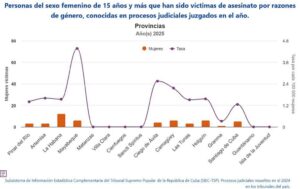
The number of gender-related murder cases tried in Cuba in 2025 totaled 49, for a rate of 1.19 per 100,000 women aged 15 and over, according to official data released ih the Cuban capital.
However, the updated figures represent a decrease compared to the 76 cases in 2024 (rate 1.79) and the 60 in 2023 (rate 1.37), as confirmed by the Cuban Observatory on Gender Equality (OCIG).
Havana topped the provincial list with 12 cases tried, followed by Mayabeque, Camagüey, and Holguín, with six each, and Santiago de Cuba, with five.
46.9 percent of the crimes were committed by the victims’ former partners, and 89.7 percent occurred in the home. 75.5 percent of the murdered women were unemployed, and the 20-44 age group accounted for 38 of the deaths.
Urban areas (33 cases) had more incidents than rural areas (16), although the rate was higher in rural areas (1.65 per 100,000 women). Thirty-two of the victims had minor children, leaving 54 children without maternal care.
The distribution by skin color reflected the Cuban population structure, with a predominance of white women. None of the victims had a disability at the time of death.
The updated Gender and Gender Identity Observatory (OCIG), a joint effort of the National Office of Statistics and Information (ONEI) and the Center for Women’s Studies of the Federation of Cuban Women (FMC), compiles, processes, and visualizes indicators with a gender and rights-based approach. This August, it reached 21 of its 33 indicators.
For specific types of violence, the OCIG uses four indicators: femicides reported in court proceedings; deaths caused by current or former partners; sexual violence prosecuted; and the proportion of women who have been victims of physical, sexual, economic, or psychological violence by their partners in the last 12 months.
These indicators only show a part of the phenomenon of gender-based violence, as they do not include unreported murders, those that do not reach the courts, or those still under investigation—something the OCIG seeks to improve, as Teresa Amarelle Boué, Secretary General of the FMC, explained to Prensa Latina in a recent interview.
Even so, the tool allows for the identification of trends and patterns that are useful for designing prevention policies.
On Orange Day, this August 25, “the OCIG asserts that the first step to prevent violence against women and girls is to measure their behavior in society,” the official Cuban statistical platform declared on its social networks.
[ SOURCE: PRENSA LATINA ]