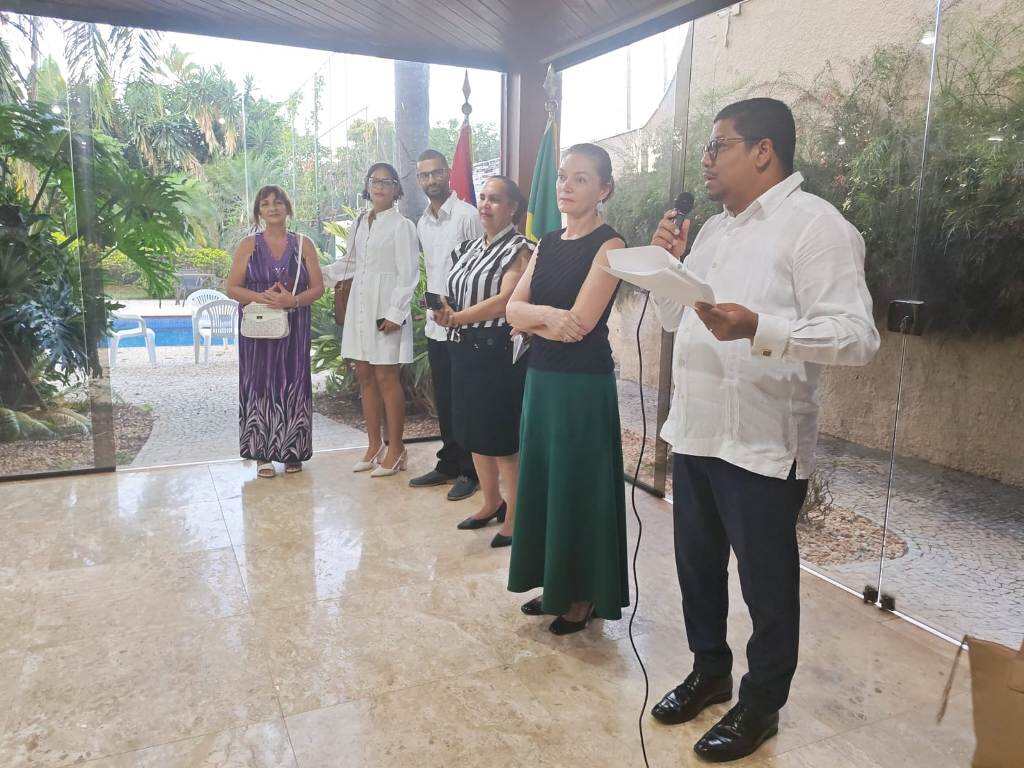
Brazil and Cuba celebrated four decades since the re-establishment of their diplomatic relations on Friday, in a gathering that highlighted the historic bonds of cooperation and brotherhood between the two nations.
The event, held at the residence of the Cuban ambassador in Brasilia, Víctor Cairo, was attended by officials, university students, representatives of left-wing political organizations and social movements, and members of solidarity groups supporting the Caribbean island.
Cairo recalled the complex process of normalizing bilateral ties and noted that this rapprochement involved various sectors of Brazilian society, including intellectuals, artists, journalists, political leaders, and trade unionists.
He mentioned writer Fernando Morais—who visited Cuba during Brazil’s military dictatorship (1964–1985) and established solidarity ties—and Ambassador Carlos Amat, one of the first representatives of the largest of the Antilles to foster these overtures.
The diplomat noted that, during the 1970s, Cuba became a symbol of resistance and emancipation for many young Brazilians persecuted by the dictatorship.
The ambassador also highlighted exchanges regarding film and television, visits by political representatives to Havana, and meetings with the historic leader of the Cuban Revolution, Fidel Castro (1926–2016).
As a result of these efforts, he added, the first parliamentary friendship group with Cuba was established in the Brazilian Congress in 1983.
Subsequent negotiations, held in various capitals, led to the agreement signed in June 1986 to re-establish diplomatic relations, he noted. Reflecting on these four decades, Cairo paid tribute to the diplomats and officials from both countries who helped maintain and deepen ties, and recalled Fidel Castro’s visits to the South American giant.
Cairo also denounced the negative impact of the United States’ economic, commercial, and financial blockade against his country, as well as the restrictions Cuba faces regarding access to energy and food resources.
In this regard, he commended the statements made by Brazilian President Luiz Inácio Lula da Silva against the financial pressures exerted on the island.
He maintained that defending the Caribbean nation on the international stage also means upholding international law, the United Nations Charter, and the sovereignty of peoples.
He highlighted bilateral cooperation in areas such as health, literacy, food security, and biotechnology, and recalled the contributions made by Cuban doctors through the “More Doctors” (*Mais Médicos*) program.
He also acknowledged the solidarity shown by Brazilian social organizations and citizens who send medicines, seeds, and food to Cuba, describing the movement in Brazil supporting the island as one of the strongest in the region.
He emphasized the cultural dimension of the bilateral relationship and highlighted the inauguration of “Casa Brasil” in Havana this year—a space designed to foster meetings and exchanges among young people, creators, and intellectuals from both nations.
He underscored that Cuba and Brazil share aspirations regarding social justice, the eradication of hunger, health as a universal right, peace, and respect for sovereignty.
IMAGE CREDIT: Photo: Martha Isabel Andrés
[ SOURCE: PRENSA LATINA ]