By Alejandra Garcia
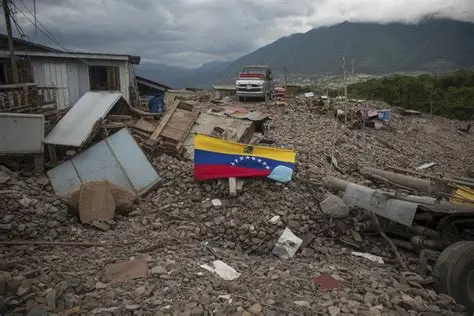
Since 6:05 p.m. on June 24, Venezuela has not been the same. The earth roared with unprecedented force, and in just a few seconds, hundreds of homes were reduced to rubble. The twin earthquakes, measuring 7.2 and 7.5 on the Richter scale, left the country with a wound made of dust, shattered memories and loss.
Three weeks later, the tragedy continues to shape the lives of those who managed to survive. The simplest question has become the hardest to answer: “How are you?” Saying “I’m fine” feels like a betrayal of the pain of a country mourning its dead. Venezuela is not fine. Those who are gone are in pain, but so are those who remain to face the void—stories cut short by a force impossible to stop.
Among the faces marked by loss is that of Mr. Pablo, a man who was returning home by bus when the earthquake caught him on the highway connecting Caracas to La Guaira. During those minutes of chaos, he never imagined that, upon arriving in Catia La Mar, he would find his life reduced to rubble. The building where he lived with his wife and daughter had collapsed. Both were trapped under tons of concrete.
The images circulating on social media showed Pablo with a shovel in his hands, fighting against time and despair, searching through the rubble of the building for the two people he loves most. He wasn’t just looking for bodies; he was looking for one last chance to change fate. The day of the funeral was a heart-wrenching farewell. Pablo, a man of profound nobility, bore an unbearable burden of guilt: not having been able to foresee the tragedy, not having been there to protect them, and not having been able to give his own life in exchange for theirs.
Meanwhile, thousands of families cling to a single hope: to receive news of those who have not yet returned. Rescue efforts continue relentlessly at the last remaining sites where there is still a chance of finding survivors. However, unofficial estimates put the number of missing people at over 10,000. Behind every number is a face, a story, and a family waiting for a phone call that could change everything.
Even amid the destruction, compassion endures. While rescuers continue to search for life beneath the concrete, young volunteers sift through the rubble to recover whatever managed to survive the disaster: a photograph, a letter, a family memento. Photo albums, ornaments, toys, silverware, and scraps of fabric. Each recovered object represents the possibility of returning a fragment of their history to a family.
In the temporary camps set up in the San Bernardino parish in Caracas, initiatives also emerged to heal invisible wounds. Children who had lost their homes found in paintbrushes and watercolors a way to express what words could not explain. Their drawings depicted not only the ruins but also the sea at La Guaira, the sun, and their families. On paper, for a few moments, the disaster ceased to exist, and a small window of hope opened.
Amid so much pain, another story touches the heart. A young man who had lost both legs years ago approached a boy who had just had one leg amputated following the collapses to tell him—using his own life as an example—that the future is still possible.
Solidarity also saves lives. In these days of mourning, that certainty takes on special meaning and brings to mind a quote from Hugo Chávez: “If I could take my heart out and give it as a gift, I would give it to the people of Venezuela.”
As evening falls in La Guaira, near one of the refugee camps, a boy plays ball with his father amid the rubble. The scene is an open wound, but they are creating a moment of normalcy. There lies the essence of a nation that, despite the pain, continues to seek reasons to rise again.
As Haruki Murakami wrote in After the Quake: “After the earthquake, life goes on, even if the sky collapses, even if the earth roars and splits open.”