“Dear people of Pinar del Río, on this July 26th, please accept my affection and recognition for having earned, through your effort, dedication to the revolutionary cause, and creative work, the great honor of hosting the central commemoration of the 73rd anniversary of the attacks on the Moncada and Carlos Manuel de Céspedes barracks, National Rebellion Day. A warm embrace to all, Raúl Castro Ruz.”
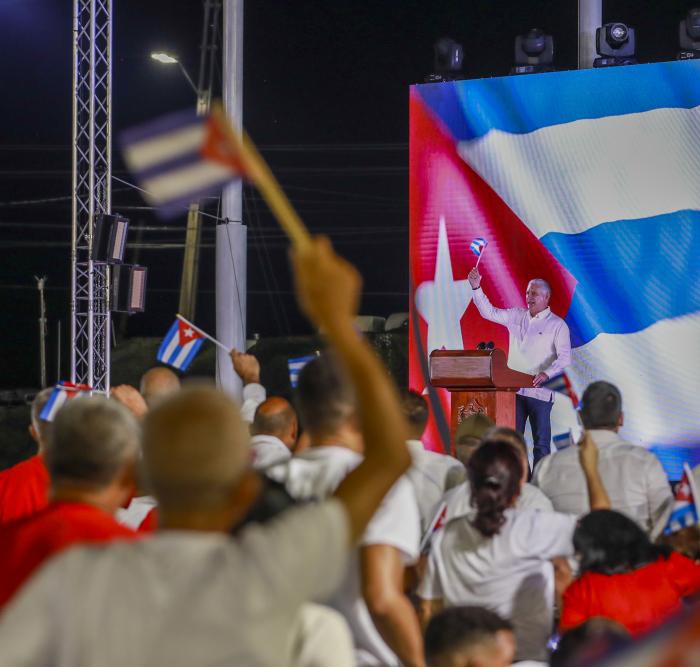
With this heartfelt message from the Leader of the Revolution, Army General Raúl Castro Ruz, the First Secretary of the Central Committee of the Communist Party and President of the Republic, Miguel Díaz-Canel Bermúdez, began his speech at the National Commemoration of July 26th.
The Cuban president emphasized that “Cuba is waging a historic battle today, a new Moncada,” and recalled Fidel Castro’s words, when he described the Moncada attack as the small engine that later powered the great engine that is the Revolution.
Díaz-Canel insisted that today Cubans are fighting “fiercely and stubbornly for our sovereignty and our right to freely choose how to govern ourselves, with the same passion with which José Martí set out to achieve complete justice.”
In his remarks, he recalled the example of Commander of the Revolution Ramiro Valdés Menéndez, who remained true to his ideals until the very last moment of his life.
Once again, the President referred to the displays of everyday heroism, among which he highlighted the results of the Maternal and Child Health Program in Pinar del Río, with 4.8 live births per 1,000 live births and zero maternal deaths, “amid blackouts and shortages of all kinds.” He also acknowledged other elements that were essential to the results the province boasts today, such as food production, tobacco production, and the food industry supply chains.
He also highlighted the work in science and innovation, cultural development, and heritage protection. The province also has a work system that has fostered greater engagement with communities. “Congratulations to Pinar del Río for its heroism and achievements,” the President said. He also commended Matanzas and Villa Clara, outstanding provinces, and recognized the achievements of Guantánamo and Sancti Spíritus.
Díaz-Canel reflected that the historical adversaries of the Cuban nation “launch a threat against the Revolution every day, and every week announce a new punishment for Cuban companies and officials, even for those, whether Cuban or foreign, who dare to send an oil tanker or invest in Cuba.” He especially condemned as infamous the arguments for the sanctions targeting Cuban Public Health entities and officials.
“They have declared a world war against the left and against Cuba, as the capital of Communism in the 21st century,” the President said, adding that they are not only criminalizing protest, but also opportunistically seeking a new excuse to justify their genocidal policy against Cuba, which the world condemns. “Let Cuba live in peace,” he affirmed, adding that “Cuba is not a threat to the United States, nor to any other country on earth.”
He also spoke of the merits of our island in terms of international solidarity, highlighting that, despite the difficulties, Cuban universities have graduated more than 30,000 professionals, more than 300 of whom come from other countries. He emphasized that, among them, 23 were Palestinian doctors and five were Americans. “Is this what they call terrorism? Is this what they call a threat?” he questioned.
“The only threat to security in the region, the true and real threat to world peace and to human life, is the policy of aggression that causes famine, impoverishment, disorderly migrations, chaos, instability, and tens of thousands of deaths worldwide,” he stated.
The President firmly declared: “From this platform, I denounce that Cuba is the victim of a coldly calculated genocide. The United States government has consciously designed and implemented a policy of maximum economic strangulation against the Cuban people. It has intensified its six-decade-long blockade policy, imposing an energy and financial embargo, causing a profound crisis in the electrical power system that results in blackouts lasting more than a day, the paralysis of industries, and the impact on tens of thousands of workers.”
He also denounced statistics that reveal the suffering of Cuban families, such as deaths due to a lack of medicines that were always free in the country; more than 100,000 surgeries that cannot be performed because hospitals cannot be protected from unexpected power outages during the already frequent failures of the National Electric System (SEN) and due to the lack of fuel for backup power plants. More than 118,000 cancer patients, including 1,200 children, are unable to receive first-line treatments and are forced to resort to second- and third-line alternatives. “And what is just as, or even more, painful, the infant mortality rate has risen to 9.3 per 1,000 live births, compared to 4.5 in previous years. Those numbers include the faces of children who never saw life as a consequence of the blockade,” he said, adding that it is illegal and criminal to torture a people simply to provoke them to rebel against their government.
“The blockade is a weapon of war and causes deaths,” he stated, adding that the blockade only works because of the complicity of those who fear Washington’s power more than the judgment of history. “This is a new call to the conscience of the world: do not become complicit in another genocide.”
“Before it was Gaza, Lebanon, Iran; today it is Cuba.” “Tomorrow it could be any other nation,” he said, recalling that international solidarity arrived too late for thousands of Gazans, including more than 21,000 children. He emphasized that, for this reason, solidarity with Cuba cannot wait, and therefore thanked those who risk everything to bring their solidarity to the island and the governments that voted in favor of the Cuban resolution against the blockade at the UN, despite the pressure.
Díaz-Canel said that 2026 has special significance not only for Cubans, “the centennial year of Commander-in-Chief Fidel Castro Ruz, has universal resonance,” he affirmed, adding that Cubans honor his memory not only with words, but also with deeds, with work, with unity, with dignity, and “with sufficient clarity and determination to implement, in the shortest possible time, the transformations that the moment and the nation demand of us.”
He told young Cubans that they are the present and the future, saying, “You are the youth of Fidel’s centennial; you are called to lead this moment from every neighborhood and every corner of this island.”
Towards the end of his remarks, the President said, “The call now is to action, not to wait, not to lament, not to be complacent, to think as a nation, to seek alternatives with boldness and creativity, to care for every resource as if it were the last, to produce, to substitute imports, to develop our potential, to trust in our own strength.” He called on every Cuban to be a protagonist of the moment we are living through and said that “today’s call is to hope.”
“May each dawn find us standing ready to fight,” he concluded.
On July 26, 1953, a group of young people simultaneously attacked the Moncada and Carlos Manuel de Céspedes barracks in the eastern cities of Santiago de Cuba and Bayamo, with the goal of initiating the struggle to rid Cuba of the Batista dictatorship.
The morning of Santa Ana arrived amidst the fervor of rebellion, accompanied by hundreds of shots that heralded the dawn of the Revolution.
Today, the people of Cuba commemorate the 73rd anniversary of that feat, with the province of Pinar del Río hosting the main event for National Rebellion Day.
Fifty years after first being chosen as the host city, in 1976 the Plaza de la Revolución in Pinar del Río welcomed approximately 5,000 residents of Pinar del Río, representing all Cubans.
In her address, the First Secretary of the Party in the province, Yamilé Ramos Cordero, reaffirmed that the designation of Pinar del Río as the national venue for the Day of National Rebellion, especially during the centennial year of Fidel Castro’s birth, ratified the people’s response to the intensification of the U.S. blockade. “Faced with these grave and challenging circumstances,” she stated, “our response is and always will be unwavering: to defend the revolution and its achievements.”
Ramos Cordero recalled that more than 40 residents of Pinar del Río participated in the Moncada attack, of whom three fell in combat and 13 were murdered by the Batista dictatorship.
Regarding the current situation, the First Secretary of the Party in the province acknowledged the many challenges faced after Hurricane Ian in 2022, including the construction of housing for victims, the installation of new tobacco greenhouses, and the building of 27 children’s playhouses in the most remote areas of Pinar del Río, as well as the ongoing maintenance of schools and healthcare facilities.
The First Secretary in Vueltabajo also affirmed that these difficulties forged a loyal and steadfast people who have always persevered, thinking of the country and the Revolution.
Ramos Cordero highlighted the province’s progress in the energy transition with the installation of four photovoltaic parks totaling 87 MW, in addition to the installation of renewable energy systems in hospitals and other high-demand social centers.
In Public Health, the province maintains an infant mortality rate of 4.8 per 1,000 live births, with several municipalities at zero for extended periods. Life expectancy at birth is 78.1 years, and more than 1,000 healthcare professionals provide medical assistance in 38 countries.
Despite current challenges, the people of Pinar del Río continue to cultivate crops, maintaining the province’s position as the country’s largest rice producer.
The official explained that, “Pinar del Río produces 70% of the nation’s tobacco, with a growing number of young people and women joining the industry.” She acknowledged that the demand for food is not yet fully met, but affirmed that “this is the path to achieving it, by producing more and leveraging all available resources.”
In sports, She highlighted Leyanis Pérez’s gold medal at the World Athletics Championships and Mijaín López’s fifth Olympic gold medal, which uphold the pride of “this land of champions.”
Ramos Cordero called for continued action, expressing his loyalty and commitment to the people of Pinar del Río: “Faced with imperial threats, we will respond with more Revolution. Faced with the blockade, we will respond with more work, more unity. Faced with lies, we will respond with the truth of our history and the righteousness of our cause.”
In her speech, she evoked Fidel Castro’s words from 1976: “This province provided one of the best contingents for the beginning of the revolutionary armed struggle. Young people from Artemisa, Guanajay, and the city of Pinar del Río. Therefore, we remember the contribution of this region of Cuba to the revolutionary struggle before July 26, after July 26, before January 1, yesterday, today, and tomorrow.”
The First Secretary of the Central Committee of the Party and President of the Republic, Miguel Díaz-Canel Bermúdez, presides over the ceremony commemorating the 73rd anniversary of the attacks on the Moncada and Carlos Manuel de Céspedes Barracks, attended by 5,000 residents of Pinar del Río representing all of Cuba.
Also in attendance are Rebel Army Commander José Ramón Machado Ventura, members of the Political Bureau of the Central Committee of the Party, members of the international solidarity movement, and leaders from the provinces of Matanzas and Villa Clara, which received outstanding recognition.
The celebration of National Rebellion Day is dedicated to the centennial of Commander-in-Chief Fidel Castro Ruz, the 95th birthday of Army General and Leader of the Revolution, Raúl Castro Ruz, and the 50th anniversary of Pinar del Río first hosting this commemoration.
IMAGE CREDIT: Author: Amelia Quintero Becquer | internet@granma.cu
[ SOURCE: GRANMA ]