By Hedelberto López Blanch
On August 7, a shadowy figure assumed the presidency of Colombia. He has been involved in several drug trafficking and money laundering cases, but because he is a friend of the convicted US president, Donald Trump, and other far-right figures in that northern nation, his crimes were silenced.
On June 2, Trump congratulated Abelardo de la Espriella for having obtained a narrow majority of votes in the first round and added on his Truth Social account: “As president, Abelardo would be tremendously successful in leading Colombia to grow the economy, create jobs, promote trade, stop illegal immigration, crack down on crime and drugs, and restore law and order.”
“Due to his enormous achievements in life and his political support for me, it is personally an honor to give Abelardo my full and absolute endorsement,” he added.
In response, De la Espriella stated: “We are going to form a partnership with the Washington government and with President Trump like never before Colombia has had with any other US administration.”
With that rhetoric, the die was cast. By any means necessary, the far-right candidate was destined to win the election.
His first actions have been deplorable: he announced that he will break diplomatic relations with Cuba and Nicaragua; that he will move the Colombian embassy to occupied Jerusalem and recognize Israel’s “right” to seize the Syrian Golan Heights; he will recognize Morocco as the “owner” of Western Sahara despite the years of anti-colonial struggle by the Sahrawi people and the support given to that brotherly nation at the United Nations.
The Cuban Ministry of Foreign Affairs issued a statement on the matter, expressing: “Should this decision be implemented, which has no justification whatsoever and does not serve Colombian national interests, it would clearly demonstrate the subordination of the next Colombian government to the policy of division and confrontation between our nations, a policy always promoted by the United States, as well as its connections to the most infamous and vulgar aspects of anti-Cuban politics in that country.”
Who is Abelardo de la Espriella?
Dr. Diana Carolina Alfonso, an international analyst, describes him in the pages of Diario Red as “an individual whose name appears repeatedly in the testimonies of former paramilitary leaders, in court records, in journalistic investigations, and in testimonies that, while not always resulting in convictions, do paint a disturbing picture. This legal entrepreneur built his career where the law is intertwined with dispossession and politics is cooked up in mass graves, on farms, and in civil foundations.”
He was born in Bogotá in 1978 into a wealthy family. Between 2001 and 2002, his father, also named Abelardo, coordinated the regional election campaign in Córdoba for Álvaro Uribe, who was elected president despite his murky ties to drug traffickers and paramilitary groups.
Uribe’s governments (2002-2010) were characterized by divisive neoliberal reforms and the systematic repression of all forces of civil society that he considered “internal enemies” guilty of “subversion,” including opposition political parties, unions, and human rights organizations, which is why he is often labeled a fascist.
Like Uribe, De la Espriella has extensive ties to paramilitarism. During the demobilization process of the Uribe administration with the United Self-Defense Forces of Colombia (AUC), the country’s main paramilitary federation, Abelardo served as an advisor to the group. He also served as legal counsel to politicians involved in “parapolitics” scandals, such as Eleonora Pineda and Dieb Maloof.
Based between Bogotá and Miami, De la Espriella distinguished himself as a defense attorney for paramilitaries, businesspeople, and politicians accused of corruption. In 2007, he represented former Justice Minister Alberto Santofimio, suspected of involvement in the 1989 assassination of presidential candidate Luis Carlos Galán. Later, he defended David Murcia Guzmán, a Colombian businessman who, through a pyramid scheme, defrauded tens of thousands of low-income individuals, stealing their life savings and laundering drug trafficking proceeds.
De la Espriella created the Foundation for Peace Initiatives (FIPAZ), which gave paramilitary commanders a platform in university forums and campaigned to prohibit extradition requests. In 2008, Ernesto Báez, a paramilitary member who had participated in FIPAZ events, stated that the AUC (United Self-Defense Forces of Colombia) “sought out students, through Abelardo de la Espriella, as a channel to justify the war.” In 2011, the Supreme Court of Justice of Colombia affirmed that FIPAZ “did not promote peace when self-defense groups were massacring, disappearing, murdering, and torturing, but rather sought to project itself politically through university students.” The Court ordered an investigation against De la Espriella for conspiracy and money laundering, but this was blocked by the Attorney General’s Office, then headed by Mario Iguarán, a friend of De la Espriella. Several paramilitaries have testified that Iguarán’s appointment to the position came after they paid his opponent to withdraw from the race.
Abelardo maintains a particularly close relationship with the imprisoned former paramilitary leader Salvatore Mancuso, whose forces carried out some 10,000 forced disappearances and more than 40,000 displacements. They both attended the same school in Montería, and when the Uribe government extradited Mancuso to the United States (which some believe was to prevent him from testifying about the links between politicians and paramilitaries), De la Espriella defended his friend, saying, “Mancuso is from my town and carried a burden that all the people of Córdoba should have fought,” implying that the killings and violence were somehow justified.
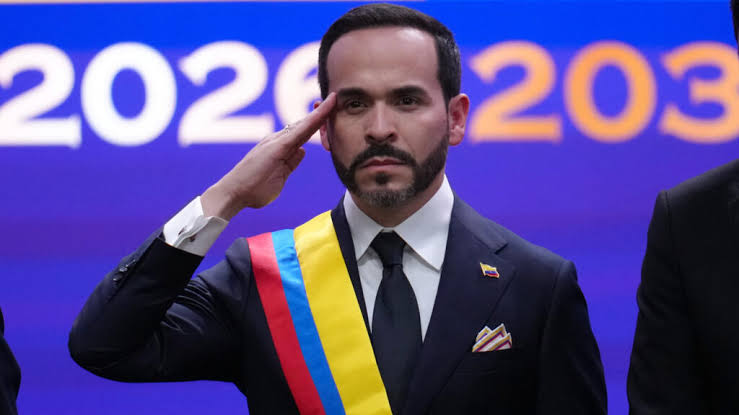
Like other far-right leaders, De la Espriella uses militaristic symbols and language. He has promised to intensify the violent confrontation with illegal armed groups in what he calls a policy of “renewed democratic security.” His Air Force cap and military salutes reinforce the hardline security narrative, which seeks to exploit public concern about violence and crime.
These are just some of the countless fascist-like “virtues” of the new Colombian president, who will join other new Latin American leaders brought to power by the White House chief, Donald Trump.
(*) Hedelberto López Blanch is a renowned Cuban journalist. He writes for the newspaper Juventud Rebelde and the weekly Opciones. He is the author of “Cuban Emigration to the United States,” “Secret Stories of Cuban Doctors in Africa,” and “Miami, Dirty Money,” among others.
[ SOURCE: RESUMEN LATINOAMERICANO Y DEL TERCER MUNDO CUBA / EN RESUMEN ]