José Ramón Cabañas Rodríguez *
References to McCarthyism or Reaganomics marked eras of political and economic thought in the United States, reflecting the aims of the ruling (or dominant) groups, even though the figures who received historical credit for using their names did not exactly possess an intellectual caliber worthy of such recognition.
In the first case, it was a political and ideological reaction against any idea or discourse that could be considered leftist, socialist, communist, or simply progressive, years after the Soviet Union (not the United States) was the main actor in the victory over German fascism. The internal sympathies generated by this reality, plus the social achievements the USSR was making, despite its massive losses on the battlefield, served as a catalyst for a veritable witch hunt across the United States against anyone who was not an Aryan Republican or an ultraconservative Democrat. During his ten years in the federal Senate throughout the 1950s, Joseph McCarthy was the figurehead of such an abomination.
Thirty years later, the so-called Republican New Right rose to power with Ronald Reagan at its head. The group that came together to bring him to the presidency had, among other objectives, the redistribution of social wealth, making the rich richer and the poor poorer, based on the argument that the country was losing economic competitiveness and needed to radically transform its productive base. Social spending was drastically reduced, while military spending increased dramatically. In the foreign policy arena, there was also an offensive, also in the McCarthyist style, to try to stop the social and revolutionary movements that were multiplying throughout Latin America and Africa.
We summarize these antecedents, among others, to understand the current era, when we have arrived at what some media outlets or pseudo-academics have identified as Trumpism. But the very authors who have tried to construct the term, and by extension a “legacy,” have struggled to identify its main components, or anything associated with a certain intellectual activity, beyond the purpose of destroying societies, including the American one, changing the rules of the political game, corrupting the entire governmental and judicial system, turning negotiations with third parties into dialogues between mafia clans, and, again, redistributing wealth to a select few. All this is happening when the US economy is in worse shape than it was 40 years ago and faces the greatest challenge of its contemporary history: the People’s Republic of China.
It is an era of hard and pure power, which feels no need to establish alliances and which divides the world between victors and vanquished. Perhaps the only novelty is the high penetration orchestrated from the State of Israel, as a generator of chaos and one of its main sustainers.
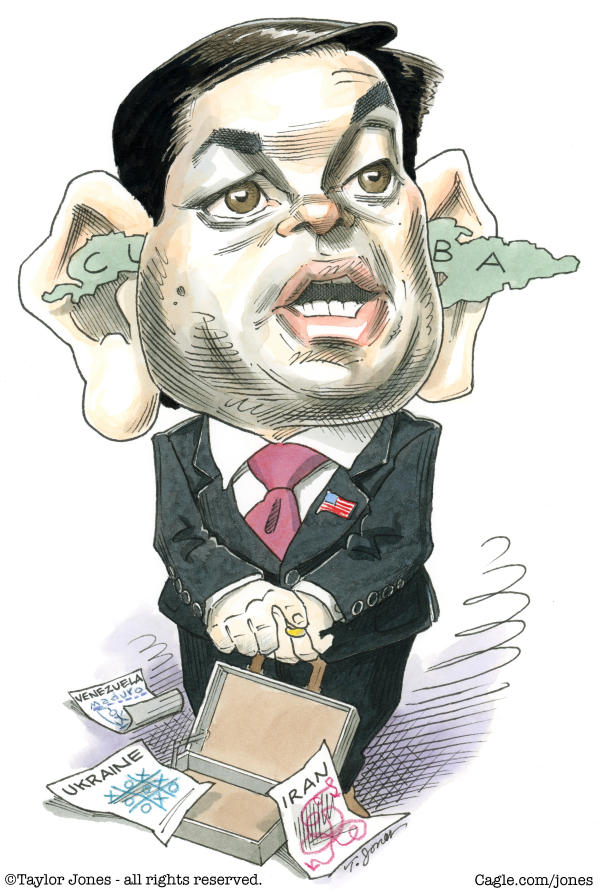
Under the rags of Trumpism 2.0, another phenomenon is emerging that doesn’t deserve any “ism,” but which it would be useful to try to describe because of the possible implications it could have for the United States itself, for Latin America, and, definitely, for Cuba. The leader of this sect is someone whose name is difficult to translate into a historical term, as it would require referring to Marcoism or Rubiism, labels that image consultants don’t consider appropriate.
So, let’s forget the term and try to describe the phenomenon. Marcoism, before Trump, was a way for someone who showed no aptitude in business, culture, science, or any other area of human knowledge to gain political advantage. With the Cuban issue constantly on his mind, Marco Rubio constructed a fabricated family history to portray himself as a “victim of Cuban communism,” despite having no relatives involved in the Escambray uprising, the mercenary brigade at Playa Girón, or among the CIA’s selected candidates to govern “the Cuba of the future.” He did have relatives linked to drug trafficking, but that’s another story.
The fact is that this prospective candidate, with no property in Cuba to “claim” and no “family members who were victims of the regime,” took advantage of experiences like those of the members and directors of the Cuban American National Foundation, who understood that much more could be gained by milking federal “regime change” programs in Cuba than by trying to sell used cars in Hialeah. In this analysis, his main advisor was perhaps David Rivera. His roommate and fellow aspiring member of Congress shared the same confusion about the boundaries between being a legislator and a lobbyist. He ended up being accused in a trial, which Marco attended as a witness, for having represented Venezuelan Bolivarian interests within the United States.
Marco, who was finally elected to the U.S. Senate in 2010, spent the next 24 months doing aerobic exercises to gauge the interest of every potential Republican presidential candidate who might emerge in the lead-up to the 2012 elections. But he failed to gain traction with any of them and had to return to his Senate seat, where he accumulated the dubious distinction of being among the senators with the lowest attendance at plenary sessions and having a low number of legislative initiatives—that is, bills introduced and passed—which was supposed to be his primary (and only) job.
Despite belonging to the Republican majority in Congress, he had no success whatsoever in trying to obstruct, through legislative obstruction and backroom deals, the executive actions undertaken by the Barack Obama administration to negotiate a range of issues with Cuban authorities and reach mutually beneficial agreements for both nations, which were formalized in 22 memoranda of understanding.
Leading up to the 2016 presidential elections, Marco Rubio’s movement incorporated an anti-Trump stance into its public image. There are now forgotten phrases from the senator-candidate that reveal his chameleon-like, opportunistic nature, his ability to adapt to changing circumstances. At the time, his advisor Todd Harris even stated: “There is a growing anti-Trump movement, and our goal has been for Marco to emerge as the leader of that movement.”
After tasting defeat in November of that year, Marco Rubio considered changing course and attempting to return to wielding behind-the-scenes influence, utilizing all the connections he had cultivated in Washington. Two rather philosophical reasons stopped him: the call from the Republican majority in the Senate to maintain their leadership and the lucrative contract offered by billionaire Norman Braman to his wife to cover family expenses. His change of heart wasn’t driven by a desire to defend an altruistic agenda, nor even by a desire to combat the threats of communism, which are a constant theme in his recent speeches.
Heavy contributions from the Mossad lobby, which isn’t exactly the Jewish lobby, also played a part.
In 2018 and 2019, Marcos’s policies couldn’t prevent millions of Cubans and Americans from visiting the island as tourists, academics, artists, athletes, or simply as people interested in learning about the “enemy” they’d been told about since elementary school, through the corporate press, and even on Netflix. But instead of supporting and promoting Cuban entrepreneurs residing in the US, who were already beginning to make substantial profits from cruise ships, airlines, and other more modest commercial ventures, Marco found his gains in supporting the clan of the eternal “claimants,” those who have forged countless documents to convince judges that they owned something in Cuba, something “stolen from them by Castro.” This would constitute sufficient justification for them to act like vultures, demanding bribes and threatening to sue anyone who did business with the “tyranny.”
In other words, Marcotism did not support, then or now, those who created goods or services—the essence of modern capitalism—but rather those who lived off extortion, an old practice that originated in the Chicago underworld.
The political behavior we are referring to here has a preference for backroom deals, for the shadowy backstage. It is not in the bloodstream of leaders who can defend their views before crowds, among other things, because they cannot articulate a coherent discourse that can be shared by the majority.
Therefore, Marco Rubio waited until Donald Trump was on the ropes due to the Democratic impeachment attempt in 2019, before stepping into the spotlight and seizing control of the agendas against Cuba and Venezuela. In exchange for this favor, he would prevent the impeachment proceedings against Trump from moving forward in the Senate Intelligence Committee (or at least prevent its absence), to which he belonged. “We have a deal,” was the phrase repeated by the former sworn enemies, reminiscent of the actions of the crime bosses in the television series “Godfather of Harlem,” which, coincidentally, was beginning filming at that time.
The Marco Rubio faction then allied itself with thinkers of the caliber of John Bolton and Elliot Abrams, both of whom were later implicated by the U.S. justice system for lying under oath or manipulating confidential official information. The objective in those years was to justify a blockade against Venezuelan assets in the United States and abroad, allowing them to be consolidated under the ownership of a supposed government in exile (Guaidó Brand), which would then siphon off a percentage into the pockets of those who orchestrated the heist. At that time, the plans against Cuba were clearly confrontational, but they occupied a secondary role in the larger extortion schemes.
Marcoism seems to have “elevated” itself to another level of complexity upon entering the inner circle of Trumpism during the latter’s second term as president. In any case, since it is not the result of coherent intellectual activity, it continues to face major contradictions that make its inclusion in the history books unlikely.
Starting with the Monroe Doctrine attack against Venezuela on January 3, 2026, and the kidnapping of President Nicolás Maduro, the senator-secretary-archivist-advisor began a frenzied pursuit of the issue that had previously allowed him to rise from Calle Ocho to the National Mall: Cuba.
Since then, a series of drafts, later converted into presidential directives, have been repeatedly issued, portraying Cuba both as a failed state and as a major threat to U.S. security.
To avoid obstacles to his schizophrenia, the Secretary has purged hundreds of State Department officials, aiming to prevent any questioning of the “content” created by the tools of Elon, Mark, and Jeff (among others) who, from the realm of so-called Artificial Intelligence (or IS, Propine Ignorance), have constructed arguments against Cuba that have made them the laughingstock of most of the American population.
By cutting off a centipede’s legs and asking it to walk, Marco has concluded that the animal is deaf. By extorting third parties to prevent trade and economic activities with Cuba, and by subjecting the Cuban people to the most brutal blockade in decades, he has tried to sell the conclusion that the Cuban authorities are inefficient. One would have to calculate how many minutes other nations subjected to similar pressures would remain standing.
But the main problem with Marcoism, or Rubinism, as you prefer to call it, continues to be with the spiritual leader of Trumpism. Faced with the profusion of anti-Cuban “strategies” and messages, questions are piling up that the subordinate is apparently unable to answer for the Boss:
– On what basis was the 15-day deadline calculated, the limit for the Cuban government to capitulate due to the lack of oil and essential supplies?
– Given the heightened intelligence activity, now reinforced, why has it not been possible to identify a “dissident” bloc within the Cuban government?
– Despite the immense resources spent on the corporate press, digital platforms, and even prank phone calls, how is it possible that dates like July 11th did not justify mass demonstrations in Cuba?
– How is it possible to leave the Cuban people “without any outlets” and not provoke a new mass emigration, the antithesis of Trump’s policies?
– How is it possible to return tens of thousands of unwanted Cuban emigrants to Havana amidst an unstable situation, the consequences of war, or a change of government in Cuba? – If a large expenditure is decided upon for a military invasion of the island, what tangible benefits would be obtained in return, and in what timeframe?
– How can the “Cuban vote” be guaranteed in the upcoming midterm and presidential elections if plans are being drawn up to bury the Cuban Adjustment Act?
– Why are the so-called “immediate changes in Cuba” now being postponed until the end of the current Trump administration?
– How can capitalism in Cuba be fostered if the suffocating measures are also depriving the island of new productive forms of life?
– What impact would weakening Cuban law enforcement authorities have on the rise of crimes such as drug trafficking and undocumented immigration?
– If the People’s Republic of China is the main “threat” according to the US National Security Strategy, how is this responsibility now being assigned to Cuba? On what grounds would the United States enter into a new armed conflict, when the confrontation with Iran can already be described as yet another fiasco with no end in sight?
Faced with some of these questions, the Secretary-Advisor is often seen gesticulating profusely before the press cameras due to a lack of solid arguments. His rapid-fire speech, without commas or periods, is meant to convey intensity of thought, when it is precisely the opposite.
There is a clear purpose in the current manifestation of Marcoism, or perhaps Marquism, and it is the intention to try to erase, with a single stroke or through the relentless repetition of lies, the significance of what was achieved in the 2015-2017 period and even during a good part of Trump’s first term. The objective is to erase minds, decapitate leaders, and destroy ties, especially between Cubans residing in the United States and their families or acquaintances in Cuba.
Marcosism also has other questions to answer in South Florida:
– If it rose in the U.S. political spectrum by selling the so-called “Cuban vote,” and a key premise for this social group is securing their residency status in the United States, how is it that all the privileges this group accumulated over the years are now at stake?
– On what basis is a group of “businessmen” who still have to prove their knowledge and success in the Cuban market being given preferential treatment over those who have done business with the island for years, with the backing of U.S. legislation?
– Where will the municipalities of Florida cities with the largest Cuban populations find the resources to support the social services that their citizens often received in Cuba, especially healthcare?
– From which Cuban authorities will the Miami Hurricane Center receive the upcoming reports regarding the approach of future hurricanes, given that this information has been critical in preventing natural disasters on the peninsula?
– With which counterpart will efforts to rebuild the shared coral reef, essential for the health of the fishing industry in Florida, continue?
– How will future oil spills in the Caribbean Sea be prevented and combated given the continued offshore drilling, in the absence of official Cuban expertise?
– From which authority on the Island will U.S. vessels navigating the Florida Straits and facing unexpected accidents receive search and rescue support?
– How will air safety in the area be guaranteed without frequent communication between aeronautical authorities on both coasts?
These are just some of the issues that the Marcos administration has ignored, or considered to have a simple solution, due to the intellectual shortcomings of its main proponents.
It will always be much easier to destroy than to build, but a major problem will be anticipating the costs. For some, it could mean the end of their political or bureaucratic careers, and above all, a burial without honorable inscriptions on their tombstone.
Any doubts? Ask for their soulmate, Robert Menéndez.
( * José Ramón Cabañas Rodríguez is Director of the International Policy Research Center -CIPI- in Havana )