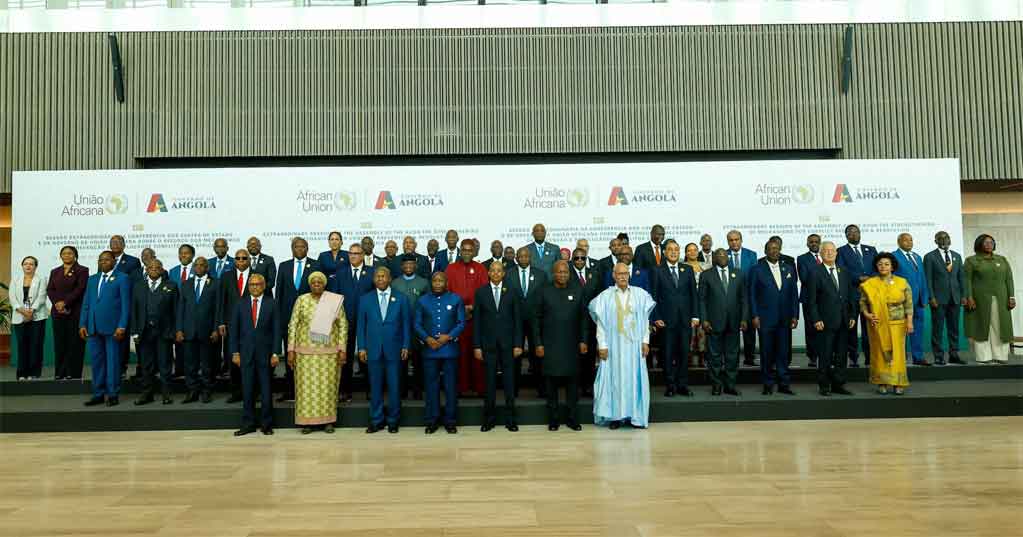
The Chairperson of the African Union Commission (AU), Mahmoud Ali Youssouf, called on Sunday for the summit in Luanda to produce the necessary decisions to strengthen Africa’s capacity to collectively assume responsibility for its peace and security.
Youssouf, speaking at the 21st Special Session of the AU Assembly on Conflict Prevention and Resolution in Africa, reiterated the numerous peace and security challenges currently facing the continent.
He mentioned that from southern and eastern Democratic Republic of Congo (DRC) to Somalia and the Sahel, from Libya to northern Mozambique, and including Madagascar, persistent crises and worrying tensions are being experienced.
Mahmoud Ali Youssouf stated that emerging threats — such as terrorism, violent extremism, piracy, and the mistreatment of migrants — are realities in Africa.
“Transnational crime and international geopolitical competition only exacerbate our crises; the time has come to undertake reforms,” he asserted.
The Chairperson of the AU Commission declared that these reforms must focus, first and foremost, on a continental early warning mechanism, given that prevention remains our Achilles’ heel.
He urged continued vigilance regarding the effective implementation of the decisions adopted. This is an unfinished task, as the peace and security architecture requires a thorough review, he affirmed.
He went on to discuss the funding of peacekeeping operations—and the Peace Fund—acknowledging that it is practically inoperative and far from being a model of effectiveness.
“Our partnerships with the United Nations and other groups no longer meet our expectations; this is an undeniable reality. It is up to us to accelerate the pace of reforms, supported by the unwavering political will of our Member States,” he emphasized.
In this regard, the Chairperson of the African Union Commission called for the consolidation of functional mechanisms that enable effective preventive diplomacy, supported by the central role of the Regional Economic Communities (RECs).
Ongoing coordination between the Peace and Security Council, the Commission, Member States, the RECs, and regional mechanisms remains key to our collective action, he noted.
He considered that, in the face of emerging threats that exceed individual capacities, active solidarity and the pooling of resources—to confront terrorism and transnational crime—have become essential steps.
“We are obliged to adapt our means and strategies. In the face of unconstitutional changes of government, the AU’s position remains unchanged: firmness based on our norms, while offering dialogue and support,” he reiterated.
Alongside the heads of state and government participating in the summit, Youssouf agreed that there are no miracle solutions to these challenges.
It is a long-term undertaking; some crises on the continent — from Mali to the DRC — have dragged on for decades, while others threaten to worsen, hence the need for pan-African sovereignty in matters of peace and security, he stated.
The Chairperson of the African Union Commission called for strengthening the AU’s capacities, consolidating the role of regional economic communities and regional mechanisms, and establishing adequate funding channels.
The United Nations, as the guarantor of world peace, must assume an active and decisive role, he emphasized. Our demand for the implementation of UN Security Council Resolution 2719 is entirely legitimate.
On behalf of the AU Commission, he acknowledged the contribution of Angolan President João Manuel Lourenço to the extraordinary progress recently made in conflict resolution on the continent.
As the African Union Champion for Reconciliation (Lourenço), he has spared no effort in recent years. I pay him sincere tribute for his unwavering commitment to peace on our continent, he concluded.
[ SOURCE: PRENSA LATINA ]