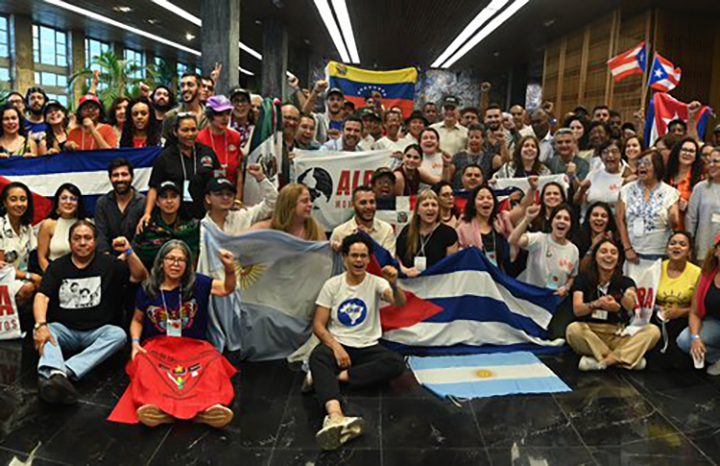
With the commitment of each movement and member to strengthen solidarity with the Cuban people, to continue clarifying the truth about the Cuban Revolution, to pressure their governments to help Cuba by sending fuel, medicine, and other resources, and to continue fighting against the blockade, the latest meeting concluded between delegates to the IV Assembly of ALBA Movements and the First Secretary of the Central Committee of the Communist Party of Cuba and President of the Republic, Miguel Díaz-Canel Bermúdez.
The exchange took place on Saturday morning in the Portocarrero Hall of the Palace of the Revolution and was attended by a large representation of the more than 190 delegates from 27 countries across several continents who gathered in Havana to celebrate their IV Assembly “as a reaffirmation of the solidarity and committed support of popular movements for the Cuban Revolution’s struggle for resilience.”
It was also, the participants agreed, further proof that Cuba will continue to defend just causes around the world, a legacy of Commander-in-Chief Fidel Castro Ruz, who is also the focus of the platform’s tribute as part of the commemorations for the centennial of the Cuban Revolution leader’s birth.
The IV Assembly of ALBA Movements met over four days in panels that addressed the current situation in Cuba resulting from the increased aggression of the U.S. government, including the threat of military invasion.
They also analyzed topics related to the history of revolutions; the challenges of the socialist project; socialism in building unity; and the development of ALBA Movements as both the present and the future.
Participating in the discussion were members of the Political Bureau, Roberto Morales Ojeda, Secretary of Organization of the Central Committee of the Communist Party, and Bruno Rodríguez Parrilla, Minister of Foreign Affairs. Other attendees included Deputy Prime Minister Inés María Chapman Waugh and Noemí Rabasa Fernández, First Vice President of the Cuban Institute of Friendship with the Peoples (ICAP), who moderated the dialogue.
Delegates to the IV ALBA Movements Assembly pledged their commitment and oath in support of Cuba and its Revolution, convened by Comrade João Pedro Stedile, a member of the national coordination of the Landless Workers Movement of Brazil. Stedile urged them to adopt a platform of commitment to support the Cuban people, stating, “because without them, we will not move forward.”
“Cuba,” affirmed João Pedro, “is humanity’s front line today, as are other peoples like Palestine in Gaza, Venezuela, and Haiti, who are facing the harsh life imposed upon us by the empire.”
“Therefore,” Stedile explained, speaking on behalf of the Landless Workers Movement, “we must embrace this commitment to share what we have with Cuba and guarantee our victory against imperialism.”
Karen Gutiérrez, from Colombia and representing the Patriotic March movement, brought with her “a message of integration, dignity, and hope for the Cuban people” and a commitment to continue working together toward the horizon of socialism and the construction of the Greater Homeland.
Camille Chalmers, a popular leader and coordinator of the Haitian Platform for Alternative Development (PAPDA), and a leading figure in Caribbean critical thought, conveyed from his people—a nation with a history of social movements—”the respect and admiration for the Cuban people, the Party, and the government.” “The Cuban Revolution,” he affirmed, “is a beacon of dignity and hope for all peoples who want to build socialism.”
Rafael Barajas, director of the National Institute for Political Training of Morena and a prominent cartoonist and journalist, emphasized the historical ties between Cuba and Mexico, dating back to Martí and Fidel, and expressed his gratitude for the important professional and humanitarian work being carried out in that nation by the Cuban medical brigades.
“Today,” Barajas added, “defending Cuba is also defending Mexico and defending Latin America,” words that were reciprocated by Comrade Díaz-Canel Bermúdez, who conveyed his admiration and affection for the Mexican people and President Claudia Sheinbaum.
“From Mexico,” the Cuban statesman explained, “messages of encouragement, expressions of help, and solidarity arrive every day, knowing that they are under enormous pressure from imperialism to fracture that brotherhood.”
Pablo Ignacio Lombardi, historian and writer of Argentine national thought and chronicler of popular identity and sentiment, spoke on behalf of a people who are “the land of San Martín, Perón, Evita, Che Guevara, and Maradona, a great friend of Cuba.”
He denounced the dark times that mark the world today, with the most cruel imperialism ever seen in history, a sign that it is a regime in full decline, and that the violence it is employing is the clearest evidence of its impotence in the face of the destiny to which the world will drag it.
But now, he added, we are in Cuba, “a land that is making progress. A Cuba that continues to fight at the highest level in defense of the peoples of the world.”
At the close of the meeting with the friends of ALBA Movements, Comrade Díaz-Canel Bermúdez spoke for nearly an hour about the challenges the world faces with the resurgence of a neo-fascism with a new character; On the imperialist offensive against the Global South, on the Cuban reality, and on the challenges that the peoples of the planet must face to never relinquish that world which remains possible, but for which we must continue fighting with even greater strength.
Thus, among the challenges facing leftist forces in the region today, Díaz-Canel Bermúdez referred to the need to reverse the rightward shift in Latin America and the Caribbean; the struggle for peace; the defense of socialism; the defense of unity; and the defense of our own identity, the cultural identity that we, as peoples, share.
“Faced with fragmentation, let us defend unity. Faced with disinformation, let us defend awareness. Faced with resignation, let us prioritize organization. Faced with the algorithm they try to impose on us on social media, let us prioritize humanism. Faced with selfishness and extreme individualism, let us prioritize solidarity. And faced with cultural colonization, let us prioritize identity. These are our alternatives. These are our weapons,” Díaz-Canel stated.
(Taken from the Presidency’s website)
IMAGE CREDIT: Photos: Estudios Revolucion
[ SOURCE: AGENCIA CUBANA DE NOTICIAS ]