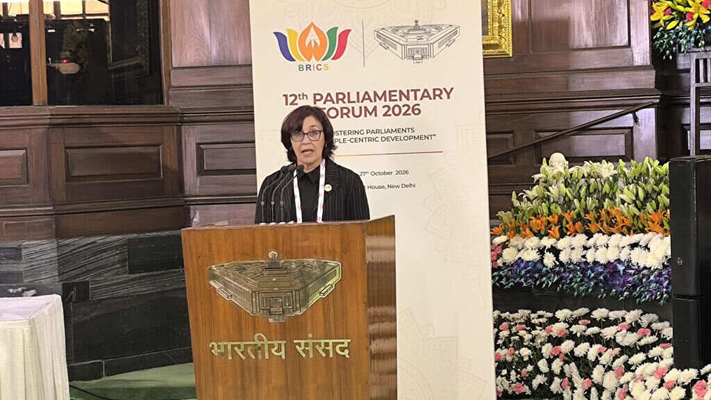
During the first plenary session of the 12th BRICS Parliamentary Forum, held in New Delhi, India, Cuba reaffirmed its rejection of the application of unilateral coercive economic measures — actions incompatible with international law and the United Nations Charter — reported Prensa Latina.
Tamara Valido, President of the Permanent Commission for Services of the National Assembly of People’s Power (ANPP), stated at the event that the Caribbean nation is currently facing a “war economy” scenario, driven by the intensification of the economic, commercial and financial blockade imposed by the United States, as well as Cuba’s inclusion on the U.S. list of state sponsors of terrorism.
The lawmaker denounced that the policy of “maximum suffocation” designed by Washington is accompanied by efforts to destabilize the country, discredit its government, and wage a media war — all with the aim of inciting social unrest in Cuba.
Valido explained that the ANPP serves as a forum for debating and approving profound economic and social transformations. She noted that this year, 23 thematic areas — comprising 176 specific measures — were approved, aimed at modernizing the business sector, diversifying management models and boosting productivity.
She pointed out that the state’s supreme governing body has strengthened oversight mechanisms and citizen participation in monitoring public administration, ensuring strict adherence to the law and the preservation of institutional integrity.
The parliamentarian detailed that the government’s program, alongside these economic and social transformations, forms the core of the lawmakers’ agenda, carried out through permanent commissions and monitored by the Council of State. It was highlighted that institutional resilience is rooted in the capacity to respond to citizens’ demands and in maintaining a direct link with the people — achieved through visits to municipalities and communities to identify problems and understand concerns.
The BRICS nations were urged to play a central role in improving the global monetary and financial system, making it more representative and fair. It was also emphasized that the Global South faces structural challenges that require a profound transformation of the international economic order.
Valido stated that Cuba’s presence as a partner country within the BRICS bloc opens up new opportunities for cooperation, noting potential in sectors such as biotechnology, the medical-pharmaceutical industry, healthcare, renewable energy, software and tourism.
“Cuba’s presence as a partner country in a group that is establishing itself as a new player in global geopolitics demonstrates the importance of strengthening integration and cooperation — based on multilateralism and respect for diversity — in pursuit of a just and equitable international order,” she expressed.
She concluded that the world is in urgent need of a new, civilized coexistence — one where solidarity and cooperation prevail — a goal that is further reinforced within this parliamentary framework.
This 12th BRICS Parliamentary Forum serves as a space for political and parliamentary dialogue, where Cuba, in its capacity as a partner country, reaffirmed its commitment to fully integrating into the bloc and strengthening cooperation with the Global South.
The Cuban delegation, led by the Vice President of the National Assembly of People’s Power (ANPP), Ana María Mari Machado, held bilateral meetings with parliamentary leaders from India and Russia. These discussions underscored the importance of expanding legislative exchanges and consolidating long-standing ties of friendship and solidarity.
The forum’s agenda includes sessions on resilience, innovation, cooperation, and sustainability, alongside cultural activities and commemorative tributes — all of which reaffirm the role of parliaments in building a more just and representative international order.
IMAGE CREDIT: ACN | Via Prensa Latina
[ SOURCE: AGENCIA CUBANA DE NOTICIAS ]