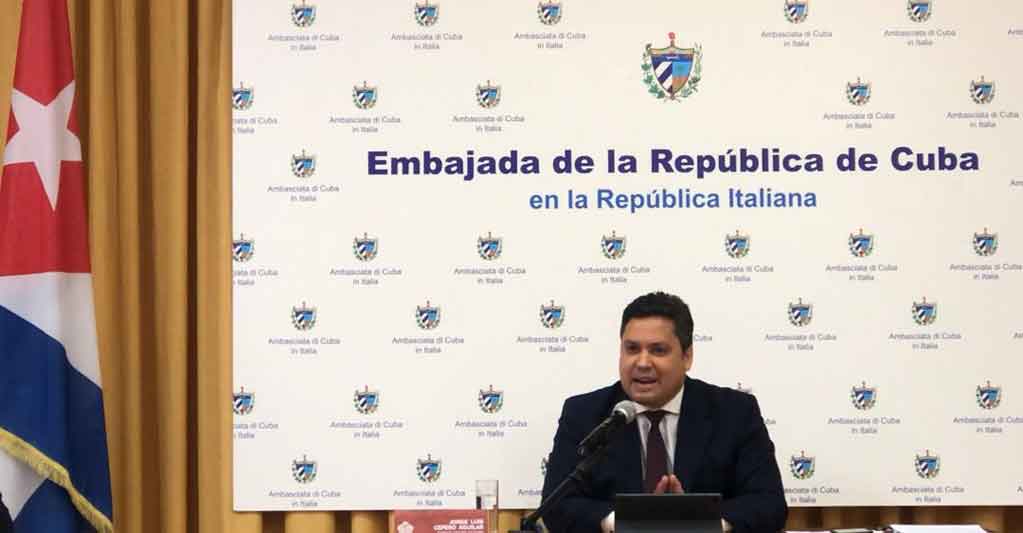
Cuba’s Ambassador to Italy, Jorge Luis Cepero, denounced on Monday the negative impacts caused by the extraterritorial application of the U.S. blockade, which affects both the delivery of solidarity-based aid and the operations of Italian companies on the island.
During a press conference in Rome held on the eve of a United Nations vote on a resolution calling for an end to the blockade against his country, the diplomat explained that Italian civil society organizations, political forces, and other sectors have facilitated the shipment of medicines, parts, and components — primarily for the Cuban healthcare system.
However, he noted that containers filled with aid remain held in the ports of neighboring countries, as various organizations struggle to find shipping companies willing to transport their cargo due to the threat of U.S. sanctions.
At the Cuban Embassy in Rome, Cepero pointed out that Italian business owners who have been established in Cuba for three or four decades face obstacles in conducting their business normally, due to barriers that hinder the arrival of raw materials and other essential supplies needed for their operations.
In his view, these restrictions affect both solidarity-based aid and commercial exchanges, and represent an attempt to isolate Cuba from the international economic system.
The ambassador compared the U.S. policy of economic, commercial, and financial encirclement of Cuba to a medieval siege — intended to cut off supplies and weaken a population through isolation — referring to the consequences the blockade has on the living conditions of the Cuban people.
Regarding the position Italy might take in the upcoming vote, the diplomat expressed his confidence that the country would maintain its long-standing support for the resolution calling for an end to the economic, commercial, and financial blockade imposed by the United States against Cuba. He noted that Italy has voted in favor of the Cuban-sponsored resolution since 1995, and argued that there is no reason to change this stance — especially given the worsening consequences of the economic blockade on the island’s population.
He expressed appreciation for initiatives taken by various Italian regions and municipalities, which have passed resolutions in solidarity with Cuba and urged Rome to maintain its favorable vote.
He specifically highlighted a motion approved by the Foreign Affairs Committee of the Italian Chamber of Deputies, which calls on the government to act consistently with its long-standing position.
The document refers, among other principles, to the universal right to health, international cooperation, and protection against secondary sanctions.
Regarding bilateral relations, Havana’s representative in Rome pointed out that the two countries have maintained uninterrupted diplomatic ties for over 120 years, rooted in the closeness between their peoples and in cultural, economic and cooperative exchanges.
He recalled the participation of Italian citizens in the 19th-century Cuban struggles for independence from Spanish colonial rule, as well as the presence of the Italian partisan Gino Doné in the *Granma* yacht expedition, which arrived in Cuba in 1956 to relaunch the revolutionary struggle.
The ambassador also underscored the Italian influence on Cuban architecture and the arts, which is evident in buildings throughout Havana and in other sites that form part of the island’s cultural heritage.
He suggested that the cultural affinity and similarities between Cuban and Italian society provide a solid foundation for the continued development of these ties.
He reiterated that cooperation between the two nations must be based on respect for international law and the principles governing relations between sovereign states—principles which, he maintained, are also central to the upcoming United Nations vote regarding the blockade against Cuba. Cepero emphasized that the Cuban resolution concerns not only the relationship between Washington and Havana, but also respect for international law and the rejection of unilateral coercive measures.
The United Nations General Assembly will examine the draft resolution this Tuesday and Wednesday — marking the thirty-fourth time it has addressed the need to end the blockade against Cuba.
[ SOURCE: PRENSA LATINA ]