By Angélica Paredes López
Just hours before celebrating the 66th anniversary of the founding of the Committees for the Defense of the Revolution (CDR), Miguel Díaz-Canel Bermúdez—First Secretary of the Party Central Committee and President of the Republic—conveyed his appreciation to all members of the country’s largest mass organization while meeting with outstanding CDR members from across Cuba.
“The CDRs are the Committees for the Defense of the Revolution; therefore, we—the CDR members—are all the revolutionaries who defend the Revolution,” the leader stated.
In this regard, he asserted that “this is an organization that does not become obsolete; rather, at every stage of the revolutionary process, it has constantly identified its motivations, aspirations, duties, activities, and responsibilities in order to contribute to the defense of the Homeland.”
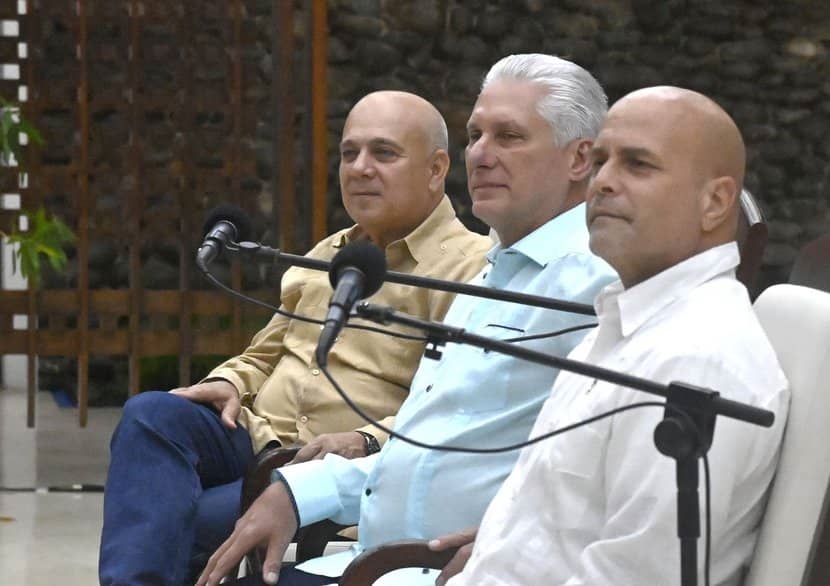
At the El Laguito protocol hall in Havana, the Cuban leader and Roberto Morales Ojeda—a member of the Political Bureau and Secretary of Organization of the Central Committee—shared a day of reflection and commitment with leaders of the Committees for the Defense of the Revolution from various parts of Cuba, primarily representatives of grassroots organizations.
During the meeting, the national coordinator of the Committees for the Defense of the Revolution — Hero of the Republic of Cuba Gerardo Hernández Nordelo — recalled the words of Commander-in-Chief Fidel Castro Ruz. On September 28, 1960, facing imperialist threats, Castro had called upon the people to organize a system of revolutionary vigilance in every neighborhood across the country. “We have been developing a process to revitalize and strengthen our ranks, adapting the organization to the times we live in—times that differ from the era of our founding. Yet, while that is true, it is equally true that our essence remains unchanged: neither the reason our beloved Commander-in-Chief founded the organization nor its purpose—which is and will continue to be the defense of our Revolution from within our neighborhoods and communities—has altered. It is an organization that, as Fidel himself said, was born to be eternal,” remarked the country’s top CDR leader.
Veterans and young people shared their experiences from their neighborhoods, where Cubans face daily the adversities imposed by the U.S. government’s economic and energy blockade.
Xiomara Mercantete Rodríguez, president of CDR No. 7 in Zone 188 — located in the municipality of Las Tunas in Cuba’s eastern province — affirmed that they remain “*cederistas* [CDR members] through and through, because we are the people of the neighborhood.”
Meanwhile, Alain Pérez—who has served for 20 years as president of a CDR in Mantilla, in the capital’s Arroyo Naranjo municipality—noted that as a self-employed worker, and with the support of neighbors during the COVID-19 pandemic, they “painted and repaired community medical offices, three schools, the pharmacy, and the bakery.”
Also during the gathering, Arlette Álvarez Romero—a young scientist at the Cuban Neuroscience Center, a resident of Havana’s Cotorro municipality, and president of CDR 9 in Zone 72—explained how the Community Youth Network has enabled her, as a young person, to “bring other young people closer to every neighborhood activity—engaging directly with the community—while seeking different alternatives to revitalize each of these movements.”
For his part, Víctor Hugo Calviño—coordinator of the Committees for the Defense of the Revolution (CDR) in Zone 84 of the Armada People’s Council, in the Cerro municipality—asserted that “even though the enemy is bent on destroying the Revolution, they will not succeed.” “We will stand firm; we are a bulwark of the Revolution,” he declared.
In a spirit of camaraderie, the leader discussed national government priorities with outstanding CDR members and organization officials, placing particular emphasis on the process of implementing economic and social transformations.
Díaz-Canel spoke of challenges, sources of dissatisfaction, and problems negatively impacting national life, as well as the role the Committees for the Defense of the Revolution must play in neighborhood development through popular participation.
Indeed, the Cuban President defined neighborhoods as “the main stage of the Revolution. If the neighborhood functions well, if the community functions well, then the municipality functions well; if the municipality functions well, the province functions well; if the province functions well, the country functions well,” he noted.
It is in the neighborhood—he observed— “where we have the potential to integrate and rally all the talent of our people, and to coordinate the efforts of all revolutionary institutions and economic actors—whether from the state or non-state sectors—to create local production systems rooted in the community; systems that must provide economic solutions and support the economic and social transformations we are currently undergoing.”
The neighborhood — he added — is also the space “where, through solidarity, we reach the vulnerable: the people who most need encouragement during a blackout, the elderly person living alone, the retiree who gave everything for the Revolution and now needs our support.”
“I have no doubt, based on what you have expressed, that there is an understanding of these transformations. I have no doubt that there is support for the ‘My Neighborhood for the Homeland’ movement and that it is already beginning to grow. And I have no doubt about the valuable work of the CDRs, which will continue to develop under these circumstances. And although we know we are facing many difficulties and complexities, you are a vanguard,” the leader emphasized.
The Head of State remarked that “in the sentiments you have expressed here—your ideas, your convictions, and your commitments—one also sees a reflection of the best values found in our people and in our communities; …and which are closely linked to the decision to defend the Revolution, to patriotism, anti-imperialism, the solidarity shown among neighbors, and the resolve to keep moving forward.”
Díaz-Canel recalled the origins of this organization, born of Fidel’s vision to defend the Revolution during very difficult times for Cuba—complex times, much like those we are living through today.
That is why—the Cuban President noted—I believe this meeting has been very important, “especially because an anniversary like the one approaching on September 28th should serve as motivation to recall the entire history that has shaped the organization.”
“In times as difficult as these—much like the challenging period when the CDRs were founded—there is much to be done. Let us address the tasks of the present; let us provide the responses from within the CDRs and the community that these times demand. I believe this lies in the priorities we have been sharing with you,” the leader emphasized.
“This meeting has been a learning experience during these very hard times,” the Cuban President stated in the final moments of the exchange held with CDR members—representatives of the country’s largest mass organization, established 66 years ago to defend a threatened homeland.
Since then, the Committees for the Defense of the Revolution have remained steadfast, true to their founding principle.
[ SOURCE: AGENCIA CUBANA DE NOTICIAS ]