By Dr. Rosemari Mealy
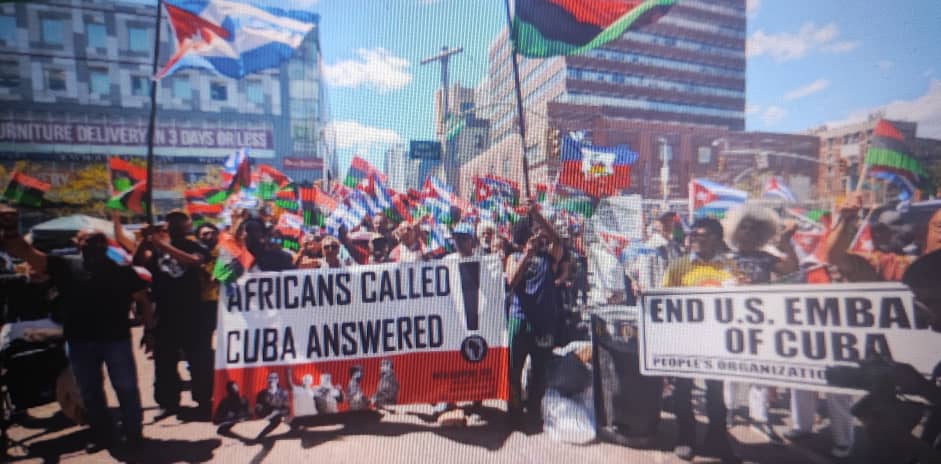
Blacks4Cuba, a citywide coalition of individuals and organizations representing people of African descent and the African diaspora, gathered Saturday, June 20th, outside Harlem’s historic Hotel Theresa, the site where Malcolm X and Cuban President Fidel Castro met more than six decades ago.
Organizers said the rally was meant to express solidarity with Cuba and denounce U.S. policies they described as economic warfare, a genocidal siege against the Cuban people, and part of a broader campaign of threats and military intervention.
From the hotel, marchers proceeded down Harlem’s famed 125th Street, chanting and waving both the Cuban flag and the red, black and green flag, a symbol of Pan-Africanism and Black unity. The demonstration briefly slowed traffic along the busy corridor as speakers addressed the crowd and framed the moment as a critical stand against U.S. policy toward Cuba.
Chants of “No war on Cuba,” “End the genocide,” “Cuba is our friend,” and “Trump is our enemy” echoed along the route. Organizers said many onlookers accepted educational materials about Cuba, while others nodded in support or joined the march. Speakers emphasized what they described as Cuba’s long record of support for Black liberation, including sanctuary for Black freedom fighters such as the late Assata Shakur and consistent advocacy at the United Nations.
Banners carried by demonstrators read, “When Africa called, Cuba answered,” a message organizers said was meant to remind onlookers of Cuba’s role in liberation struggles across Africa and the Global South.
Speakers and marchers pointed to Cuba’s support for Angola, Guinea-Bissau, Ethiopia, Vietnam, Venezuela and other countries, as well as its medical missions across Africa and the Caribbean. They also noted that, for more than two decades, Cuba has provided scholarships enabling more than 200 U.S. students to study medicine and return home debt-free.
For organizers, the march was both a protest against U.S. policy and a public affirmation of Cuba’s commitment to anti-imperialist movements and the liberation of African peoples worldwide.
[ SOURCE: Dr. Rosemari Mealy ]