Aníbal Malvar
Elián González, little Eliancito, the rafter child who saw his mother die during the crossing from Cuba to Miami in 1999 and made headlines in newspapers around the world, is today, at 32 years old, a deputy in the National Assembly of People’s Power of Cuba. “I didn’t get involved in politics. In Cuba, there are several ways to become a member of parliament. One is through selection in the neighborhoods, in the districts, where you can start as a delegate. Another way, as in my case, is for grassroots organizations to nominate you. I was elected in 2022. And my municipality, Cárdenas, put me on the ballot.”
The boy Elián, from that end of the century, of the millennium, became a symbolic child, a six-year-old trophy child for whom anti-Castro and pro-Castro factions competed. The former wanted him in the US to denigrate Fidel Castro’s regime. On the island, large demonstrations supported Elián’s father, who wanted to return with the boy. The matter reached the US Congress and the federal courts. A battalion of Immigration agents stormed the house where the boy was hiding, armed with submachine guns. One of them pointed a gun at Elián, and photographer Alan Díaz won the Pulitzer Prize for the image. The boy returned to Cuba.
This July, Elián visited Spain at the invitation of the State Movement of Solidarity with Cuba (MESC) to gather support and “convey to Spain the idea of what is happening in Cuba and, more specifically, what we need from this solidarity.” He was also hosted by the Gijón Noir Festival, always on the front lines.
I’m going to give you a very subjective opinion. I expected Donald Trump’s threats of invasion against Cuba to have more of an impact on the press, on the street, you know? I’m seeing more indifference than I expected. Because Cuba, in the end, is a sister nation, as they say, right? We share a history of light and shadow, as all histories do. How do you perceive it from there? And from here, these days?
The thing about Cuba is that the issue is heavily manipulated by the media outlets operating from the United States, and they speak very badly of us. The average Spaniard, what they know about Cuba is that there’s communism and that it’s the worst thing ever.
The average Spaniard, what they know about Cuba is that it’s communist and that it’s the worst thing ever.
Well, don’t be so sure. Among many left-leaning people, there’s enormous sympathy here.
Exactly. It’s among left-leaning people where we perceive this friendship. But people who aren’t involved in politics, the average citizen, are more distant. They believe that story, that rhetoric of Cuba as a country with a dictatorship and a repressed population. But I believe that societies, whatever they may be—and Spain has been a good example of this—when they get the details, the knowledge of what’s really happening, they manage to mobilize and make our cause their own. Today Cuba is under threat of war, but it’s not at war. That need to fight for Cuba hasn’t yet reached the Spanish people. Because it hasn’t reached them through the media. We take the example of Palestine: that did reach them. They saw a massacred people, and popular mobilizations in support of Palestine multiplied. It’s striking that, while there’s talk of a politically disengaged youth, it’s precisely the youth who have led many of these pro-Palestinian marches in Spain, Italy, and even the United States. I think what’s lacking is an understanding of what’s happening in Cuba, the risks we Cubans face. Then they’ll join us. Those who know are the ones who sympathize.
Many media outlets interpret President Miguel Díaz-Canel’s reforms as a step toward capitalism, even as a surrender to Donald Trump.
Well, reforms can be interpreted in many ways. The reality in Cuba is that today it’s experiencing the worst siege, a siege we could call medieval, brutal, and utterly illegitimate. Cuba is not a country that sponsors terrorism nor is it at war with anyone. Nor has it caused any harm to anyone. But we are being punished with this siege, which today is leaving the Cuban population in darkness. The worst blockade experienced in the revolutionary era. It became necessary to find any way to move forward, to survive. If today we are denied access, through traditional channels, to all the supplies the country needs, we will have to find other ways. And one is to open up to a private sector that can do it. Our idea is to open the shore so that resources can arrive, so that oxygen continues to flow in and we can breathe. Just a few days after announcing these measures, Trump granted Iran a license to export fuel, although he added three exceptions: Crimea, North Korea, and individuals and entities based in Cuba.
But you haven’t answered my question. Is this really an opening of the socialist project toward a more mixed system, closer, for example, to the Chinese model? And forgive the oversimplification.
We have always started from one premise: we are not going to copy any model. We didn’t copy the Russian one, we didn’t copy the Chinese one.
I wouldn’t be able to give you a concrete answer. What I can confirm is that these are necessary measures. But, as our president said, without losing sight of our goal, solely to bring prosperity, health, and education to our people. That’s for sure. We have always started from one premise: we are not going to copy any model. We didn’t copy the Russian one, we didn’t copy the Chinese one. We are trying to build our own socialism. The socialist character was always decreed, but the foundations for achieving socialism in Cuba never existed. We aspire to it, at our own pace, in our own style, and seeking ways to make it viable so that it reaches everyone. Of course, the difficulty is enormous, suffering isolation since the beginning of the revolution.
Last Tuesday, the UN General Assembly once again demonstrated its majority support for Cuba and against the blockade with 136 votes in favor, 9 against, and 30 abstentions. It happens every year, it’s been happening for decades, and nothing ever comes of it.
It’s the height of hypocrisy. For thirty-three years now, the United Nations has held referendums to end the embargo, claiming it’s unjust and must cease. As we say in Cuba, it gets cleaned up, but it hardly matters. This time, something unprecedented happened. It was proven that Trump’s Secretary of State, Marco Rubio, sent cables pressuring other countries, saying the US would be watching their response closely. It’s the tactics of a mobster, the neighborhood bully, intimidating everyone else.
The kidnapping of Nicolás Maduro has hurt you a lot. The new Venezuelan government, headed by Delcy Rodríguez, has distanced itself from you.
Cuba maintains its cooperative relations with Venezuela. The Cuban doctors are still there; they haven’t withdrawn. After the earthquake, we sent more.
Well, for now, diplomatic channels remain open, just as they always have been. Cuba maintains its cooperative relations with Venezuela. The Cuban doctors are still there; they haven’t withdrawn. Even after the devastating earthquake, we sent more medical personnel and rescue workers. Relations remain strong. We never intend to impose our will on another people. We have fought hard all these years precisely for that reason: to prevent the US from trying to rule our country. We are very disappointed by what has happened. A few years ago, people were talking to me about assassination, or about kidnapping a president like that by force, putting him on trial… and I said that those were things of the past, that that couldn’t happen now. As if they were talking to me about a war between Cuba and the United States. And I said: no, that’s impossible. And today we have it. And that’s what we prepared for. But in the end, it’s disappointing. The world mobilized to some extent, but it wasn’t forceful enough to bring Maduro back to his country. And all this with such banal, stupid accusations that not even the US government believes them.
Is there fear in Cuban society, in the streets, of this possible invasion? And you say you are preparing. How are you preparing?
Cuba has always been a country prepared to defend itself. We will never attack anyone, but we are always prepared to defend ourselves. Our vocation is humanist, based on solidarity, and sovereign; we have chosen to be free and live in peace. Now, that peace does not oblige us to be submissive. It is a peace we are prepared to defend. We see all this being plotted against Cuba, with increasingly blatant threats, with the presence at sea of ships preparing to invade… We also hear a lot of speculation from the media manipulated by the United States, stoking fear. Of course, the people have to be scared. It would be foolish for a people to want war for their country. Bombs don’t fall on an ideology. They fall and kill families, whether children or adults, left or right, whether they live well or poorly, whether they work for the government, whether they support the revolution or not.
Has Delcy Rodríguez betrayed you and betrayed Bolivarianism?
Even before [Maduro’s kidnapping], aid wasn’t arriving because it couldn’t. We have a clear example: the Venezuelan oil tanker [Olina] boarded by the US Coast Guard and Navy [January 2026]. Even if they wanted to help, they would be prevented from doing so.
I suppose the same could be said about Lula da Silva’s Brazil.
Yes, I think the same thing happens… Díaz-Canel said it best: Cuba has practiced solidarity, but always with the understanding that we don’t give it to receive it later in return. If it comes, we want it, we need it, but it’s not our attitude to demand it. And yes, sometimes we feel that more could be done from the rest of the world. Today it’s easier for solidarity organizations, non-governmental organizations, to send aid to Cuba in a container than it is for any government. Could more be done at the state level? The blockade also affects those who try to show solidarity with Cuba. We have to remember that the costs of sending anything to Cuba triple. The routes that once existed are now closed. Governments find it impossible to send fuel, even if they wanted to. We would like more aid, but we cannot force it. It has to be like the aid Cuba has provided: solidarity, of its own volition. We are not here to impose.
The embargo began in 1962, and the Cuban people continue to endure it, and, it seems, remain true to themselves. I don’t know if I can add that they are also true to their revolution.
I believe the Cuban people have proven themselves to be of the highest caliber, a people capable of resistance. They have been asked to resist, they have been asked to do the impossible.
Yes, okay. The Cuban people have been formed on very solid foundations. They may be discontented, they may be overwhelmed, weary from everything they are experiencing, but they also have the capacity to defend their sovereignty, to feel very proud of what they have achieved for the world, and they cannot imagine letting it go. Today, the people are subjected to the worst blockade, the worst crisis during the revolutionary period. The achievements of the revolution—healthcare, education—have collapsed. There’s no inflow of capital, no foreign currency, no fuel, no medicine, no electricity, and that creates unrest, which is what the Americans are after. That weariness turns against the Cuban government. But I believe the Cuban people have proven themselves to be of the highest caliber, a people capable of resistance. They’ve been asked to resist, asked to do what would be impossible for any other people in the world. I don’t think anyone could have withstood it, no one. I believe that, thanks to how we’ve been raised, we’re still standing today. If you tell any other country in the world that in six months only one oil tanker has entered, that all access routes have been closed, and that it’s still standing, still living, still surviving… That would be impossible for any other people, I think. However tired the Cuban people are, they know where the problem lies. And where the damage is being inflicted.
You seem convinced that they can continue to resist. Isn’t that overly optimistic?
Sometimes it’s difficult. The media is dominated by imperialism. It’s controlled from the West by transnational corporations, by those who are subservient to economic power. And it’s difficult to bring the truth to the people. It’s difficult because the people are also being subjected to that media power, and the lies are increasingly corroding them. But even so, it persists.
This blockade is killing people, isn’t it? You were talking earlier about hospitals without electricity, without medicine…
This blockade is genocidal; it’s killing Cubans, it’s killing children.
When we say killing, we need to delve deeper into what has happened. Cuba reached infant mortality rates similar to those of the most developed countries in Europe, and far lower than those of our Latin American brothers and sisters [before Trump, it was 4.8 per 1,000; by 2024, it had risen to 6.8, according to the World Health Organization]. Today, that mortality rate has increased. It is neither easy nor humane to work in a hospital with constant power outages, without medicine, without medical supplies, and that is what Cuba is experiencing. This blockade is genocidal; it is killing Cubans, it is killing children.
You come to Spain seeking solidarity. You were in Gijón. Today, you are in Valencia.
The solidarity movement is campaigning to bring solar panels to the William Soler Pediatric Oncology Hospital to care for children with cancer. Cuba once had high rates, comparable to those of developed countries, in pediatric cancer treatment. Today, these lives are being cut short. Today, the necessary medications for these treatments are unavailable.
American citizens cannot travel to Cuba. And we are accused of not having freedoms.
When Barack Obama became president of the United States, it was thought he might loosen the embargo, the blockade against Cuba. Many people were disappointed with the Nobel Peace Prize.
Yes. Look, Obama did make some changes in his final term. I like to use an analogy. The American government takes Cuba, covers its nose, covers its mouth, and then says: hey, you’re breathing badly. Right. In Obama’s case, he loosened this a little, and, as I say, allowed us to breathe at least through one orifice. But, with just that, the change that could be perceived in Cuba was enormous. Cruise ships began to arrive, and tourism was visible in Havana. Tourism is the driving force of the Cuban economy, the sector that most quickly brings in foreign currency. And without foreign currency, there’s no way to buy medical supplies, no way to buy school materials. Obama represented that. He showed that, after so many years of the blockade, we weren’t doing so badly. They gave us a little breathing room, and we improved. And if they let us breathe completely, we could improve even further. Cuba also opened up a bit more to the non-state sector. We began to see more MSMEs [small and medium-sized private or mixed enterprises; approved by decree in 2021], every day there were more self-employed workers, and there was a boom in Cuba. I will always remember that period when there were no blackouts, the hospitals were functioning, and there were supplies and everything was available. Then Trump came along and imposed more than two hundred measures, and a progressive strangulation began that has led us to where we are today. I understand the idea that America is for Americans, but not in the sense of the Monroe Doctrine [President James Monroe proclaimed in 1823 that America should be a continent free from European colonialism]. Not so that all of Latin America, all of South America, becomes the backyard of the United States. Whoever governs the United States has to be concerned about their own people, not mine. Do what’s best for your people, but let mine live. American citizens can’t travel to Cuba. And they accuse us of not having freedoms. I can drink an American beer, but Americans can’t drink Cuban rum, or smoke a cigar. So, where is the freedom? Who is it that doesn’t give freedom to their own people?
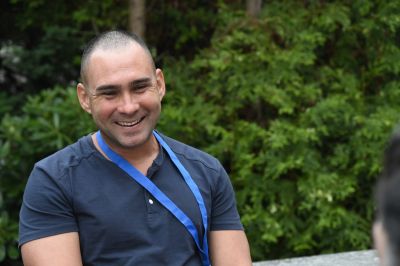
IMAGE CREDIT: Cuban deputy Elián González during the interview. Photo: MESC Comunicación
[ SOURCE: www.cubainformacion.tv ]