By Hedelberto López Blanch *
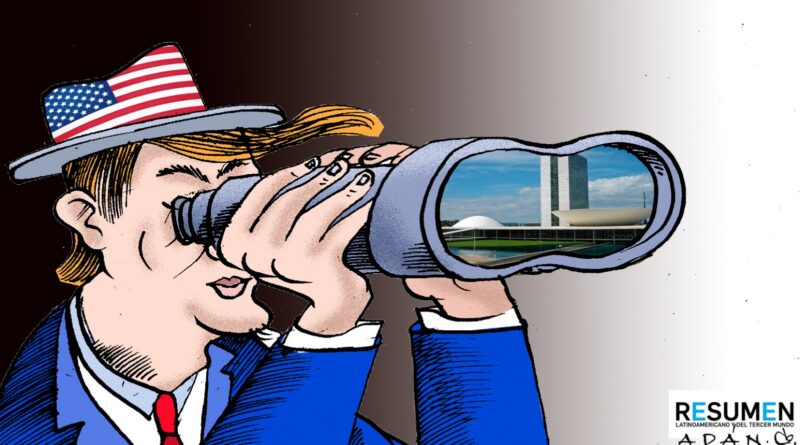
President Luiz Inácio Lula da Silva has been very clear in understanding the danger looming over his country and probably over Latin America if the United States, through the Brazilian far right, manages to win the presidential elections scheduled for October 4.
During a visit to the Aramar Nuclear Industrial Center, the president reaffirmed the importance of preserving national sovereignty as a fundamental pillar of the country. He defended international cooperation and the strengthening of multilateralism amidst threats and diplomatic tensions from the United States.
In speeches and posts on his Twitter account, Lula has insisted that “without sovereignty, Brazil would not exist” and that “a country of such size cannot live with its head down for its entire life,” a direct reference to the 50% tariffs imposed by the United States on products from the South American giant.
As the general elections in Brazil approach, convicted President Donald Trump has intensified his campaign in favor of the far-right candidate Flavio Bolsonaro, whom he received at the White House in June, saying that “it was a pleasure to have such a smart young man in the Oval Office.” He later posted two photos of another meeting he held with Flavio on May 26, a secret encounter that had not been publicized.
To bolster Bolsonaro’s chances (the son of former president Jair Bolsonaro (2019-2023)), Trump decreed a high tariff on Brazilian products, with the clear intention of damaging the Brazilian economy and discouraging the majority support Lula currently enjoys within the country. the population.
In the continuation of that campaign, the US administration designated the Brazilian groups PCC and Comando Vermelho as terrorist organizations, a step Bolsonaro requested of Trump during their meeting and which Lula rejected, considering that it “could open the door to a US military intervention” in his country.
Another ploy rejected by Brasilia was the approval of Trump’s nominee as ambassador to Brazil, Daniel Pérez, a Republican congressman from Florida and close to the mythomaniac Marco Rubio. The response was that this would only be done after the elections, since the United States had gone a year and a half without an ambassador in the country.
Brazil’s nationalist government also faces a strong disinformation campaign in all the hegemonic media outlets that try to denigrate the progress achieved in the South American giant in recent years.
In order to guarantee global stability and strengthen the country’s position on the international stage, Lula has adopted a constructive stance, which was confirmed in a recent telephone conversation with Trump to try to smooth things over. Difficulties.
Among the achievements of his government are the diversification of trade relations through expanded cooperation with the BRICS and Asia-Pacific countries; reducing the importance of the dollar in world trade; and promoting the creation of alternative payment systems.
Regarding the economy and social policy, Brazil was removed from the United Nations’ World Hunger Map; there was a marked decrease in poverty and extreme poverty: 8.7 million people were lifted out of poverty and 3.1 million out of extreme poverty.
For the end of the year, GDP growth is estimated at 2.4%; the unemployment rate reached one of the lowest in history at 5.3%. Exports of Brazilian products to various countries also increased, and the lowest inflation rate in recent years was achieved at 4.24%.
But Lula, with his long political history and experience in presidential administration, understands that in the upcoming elections, not only will Brazil’s independence be at stake, but also… Latin America, especially South America, is suffering due to the political and economic ambitions of the United States, which seeks to dominate and colonize the entire region.
That is why the Brazilian president’s recent statements on the matter have been scathing: “It is sovereignty that brought us freedom and independence (…) sovereignty is the authority a people has over its own destiny; for us, it is the right to build a free, just, and equitable society.”
(*) Hedelberto López Blanch is a renowned Cuban journalist. He writes for the newspaper Juventud Rebelde and the weekly Opciones. He is the author of “Cuban Emigration to the United States,” “Secret Stories of Cuban Doctors in Africa,” and “Miami, Dirty Money,” among others.
[ SOURCE: RESUMEN LATINOAMERICANO Y DEL TERCER MUNDO CUBA / EN RESUMEN ]
IMAGE CREDIT: Cover image: Adán Iglesias Toledo