By Frank Martínez Rivero
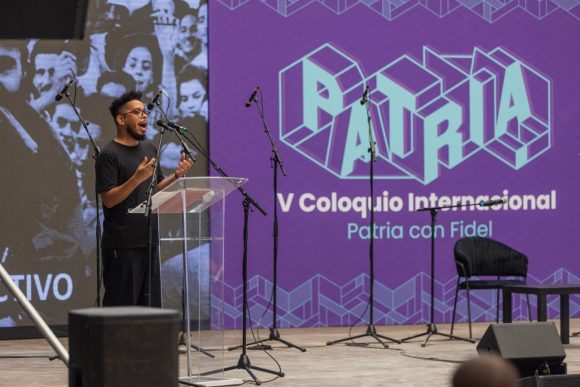
At the closing of the 5th International Patria Colloquium, Manolo de los Santos, director of The People’s Forum, delivered the keynote address — “The Word Made Revolution: Fidel and Communication,” which became a true lesson in history, politics and communication strategy.
Before an attentive audience, the intellectual began by taking us back to Fidel, because what the Commander built was not just a method of management or leadership, but an entire architecture in which millions of people could participate and witness.
The difference today, Manolo explained, is that this architecture is not limited to being involved in the organization of the Revolution or listening to the radio, but also includes digital platforms and new work dynamics. However, the logic remains the same: when communication ceases to be mere transmission and becomes a project embraced collectively; when people don’t simply repeat a message, but make it their own; and when individual voices don’t fade away, but merge into a single common voice, then the unique collective that Fidel understood emerges.
Manolo then recalled the words of President Miguel Díaz-Canel, when he spoke of how Fidel elevated the dreams of the humble people of this country. That, he said, is the essence of amplifying a political message: getting millions of people not just to dream, but to make the political discourse their own.
And with that, the myth of a global revolution was shattered. But Fidel’s response to each scenario reveals much about how he understood political communication: not only as a strategy or tactic for struggle, but also as a necessity for survival.
The Matthews Interview and the Birth of Radio Rebelde
One of the first actions taken by the 26th of July Movement, in February 1957, was to invite Herbert Matthews, an American journalist, to make a nearly clandestine trip to the Sierra Maestra. The main mission: to interview that young, bearded, revolutionary leader. The articles that began to appear on February 24th demonstrated not only that Fidel was alive, but that in the Sierra Maestra there was a movement of young rebels willing to give their lives to transform the reality of all the Cuban people.
But Fidel didn’t just stop at receiving interviews. In February 1958, he established Radio Rebelde. Manolo asked for respect for the station’s team, because it has an incredible history. For those unfamiliar with it, he explained that they broadcast with equipment mounted on mules that crossed the mountains; they searched for generators with scarce gasoline; their signal was extremely weak, and their programming was quite primitive.
They lacked the technical standards and marvelous capabilities of today. Nevertheless, Radio Rebelde became the most powerful weapon in the political arsenal of the people’s struggle. The reason? Because it didn’t broadcast propaganda in the simplest sense. They provided accurate news about the progress of the armed struggle; they reported on the atrocities of the Batista dictatorship, the conditions of the struggle in the cities, and, something unprecedented for its time, they named the peasants murdered by the dictatorship, putting a face to the repression.
They reported guerrilla casualties and explained in concrete terms why they were fighting in the Sierra Maestra: agrarian reform, education, healthcare, the need to end a cruel regime.
Manolo then referred to the Commander’s long speeches. We all know that Fidel spoke at length: there are thousands of speeches, some 15 minutes long, others 4, 5, or 6 hours.
For many foreign observers, they seemed strange, and some even went so far as to say it was somewhat pathological. But what we really need to understand—Manolo clarified—is Fidel’s true objective: he didn’t give monologues; he led political training courses. He didn’t operate on the basis of his personal authority, but rather sought to collectivize the process of governing the Cuban people.
The U.S. solidarity leader described the typical structure of his speeches: Fidel would begin with the topic of the immediate moment—the inauguration of a school, the anniversary of July 26—but from there he would connect it to broader, more universal historical causes; he would speak of the balance of power in the world. He might go on to detail how many cows, how many pigs, how many schools, and how many computers were going to be built.
But most importantly: throughout his speeches, he always acknowledged the problems. He moved from recognizing the problems to explaining their causes and proposing solutions. He asked the crowd numerous questions; not rhetorical questions, but questions that left people pondering them for hours, days, months, and years.
And something the foreign press found incredible: Fidel made jokes in his speeches. He wasn’t a rhetorical orator in the classical sense. He was a teacher, a pedagogue. He taught an entire nation to think systematically about its own challenges. He never spoke to the people as if they were children who needed to be told the message; he spoke to them as adults who needed to understand and participate in the why and how of the country’s decisions.
Political communication cannot be just quick content. For Manolo, Fidel’s lessons are clear and also countercultural. Political communication cannot be reduced to quick content. In our digital ecosystem, the most effective communication is not that which captures attention in the moment, but that which builds collective understanding of current problems.
This implies reclaiming spaces for explanation, information, and, above all, political debate. We need threads that connect ideas, videos that develop arguments, and printed educational materials that encourage critical thinking. It’s not about abandoning short formats, but about articulating deeper processes.
A movement that only communicates to react or go viral can be very fast in a moment, but it also fades away just as quickly. A movement that communicates for political education and builds collective criteria is the one that endures over time.
Manolo de los Santos confessed something curious: he spent days looking for an image of Fidel from August 4th and couldn’t find one with good resolution, so he had to resort to artificial intelligence.
But from there he jumped to a crucial moment: the fall of the Berlin Wall, the disappearance of the Soviet Union and the socialist bloc in 1991. For Manolo, the interesting thing is to consider how the Cuban Revolution survived at that time, how it survived the Special Period. And although there were multiple political and economic factors, Fidel never minimized the suffering of the Cuban people. He explained in great detail what the Soviet collapse meant.
But from there, he jumped to a crucial moment: the fall of the Berlin Wall, the collapse of the Soviet Union and the socialist bloc in 1991. For Manolo, the interesting thing is to consider how the Cuban Revolution survived that time, how it survived the Special Period. And although there were multiple political and economic factors, Fidel never minimized the suffering of the Cuban people. He explained in great detail what the Soviet collapse meant.
Manolo recounted that he searched for videos of Fidel speaking during those days and, systematically, on every occasion, the Comandante posed this question in multiple ways: Would Cubans accept certain sacrifices to preserve their independence, or were they ready to surrender? Is Cuba willing to return to the neocolonial enslavement of the United States? Slavery or freedom.
That’s not just the question of the last six decades; it’s the question of the Cuban people for 500 years. And most Cubans, being protagonists of their own history, had already been shaped by Fidel Castro, but also because they had experienced firsthand what U.S. imperialism has been and continues to be.
Then came the famous UN episode. In 2000, Fidel arrived to give his last speech at the United Nations, and all the members were told: “You have five minutes to speak.” But Fidel wasn’t there to speak on behalf of Cuba; he was there to speak on behalf of the exploited, the oppressed, the forgotten of the entire planet. So he took his handkerchief and covered the stopwatch.
That gesture — Manolo explained — was the essence of the Cuban Revolution. Fidel was a defiant leader and, at the same time, profoundly serious. He didn’t make a mockery of protocol: he rejected the premise that humanity’s problems could be addressed in five minutes. The issues Fidel came to raise were the crimes of colonization, the need for reparations from the Global North to the Global South, and the ecological crisis, which no one wanted to talk about at that time. “Political communication is political performance,” he emphasized, “it’s about setting the stage, not in a superficial sense of empty spectacle, but as a performative capacity to generate gestures.” Manolo gave a contemporary example: he was on a street corner in New York and suddenly felt a Cuban president on his shoulder, a man who dared to stand on that corner against all the rules, all budgets, and all resources.
That action, like Fidel’s handkerchief, was a communicative device that transformed what could have been a simple speech into the bravest, most powerful, and most viral image. Today the logic is clear: the actions that achieve the greatest impact are not those that best explain an idea, but those that embody a clear gesture that can be signed, shared, and given as a gift.
Manolo described the Special Period not only as an economic crisis, but as a political, ideological, and above all, cultural crisis. The collapse of the socialist bloc generated a sense of triumphalism among the world’s elites, and for Cuba, that ideological environment was very threatening, as much or even more so than the economic collapse.
Fidel’s response was to launch the Battle of Ideas: a comprehensive force to renew the ideological foundations of the Revolution, which involved not only providing momentum, but also education, new cultural institutions, video clubs, debate centers, and spaces where young people could access computers.
And when the world was moving in the opposite direction, Fidel—rebel as ever—launched a public campaign to declare that socialism in the 1990s was more urgent than ever, and that capitalism, due to its systemic and cyclical crises, could never meet humanity’s needs.
Fidel did not present socialism as a magic bullet, but as a continuous project of collective self-improvement.
Five Lessons from Fidel for Today’s Communicators
Manolo de los Santos summarized the Commander’s communication practice in five lessons:
First lesson: Trust is not manufactured, it is earned through constant honesty with the people. Fidel’s speeches, his detailed explanations, his willingness to admit mistakes—these were the mechanisms with which he built trust. In an era of “fake news,” the movement that always tells the truth, no matter the cost, is the one that endures.
Second lesson: Communication must be a collective process. It doesn’t work if only the president or a leader speaks. Everyone has to speak, without robotic repetition. This makes political analysis everyone’s perspective. Social media rewards simplicity and emotion, but building power requires slow, steady, and painstaking work.
Third lesson: Communication is about where we stand and with whom. Fidel with the indigenous people of the Amazon, Fidel with the peoples of the world, Fidel in Vietnam under the bombs. It’s about identifying the political project with the cause of all peoples.
Fourth lesson: Crises are the best times to talk. We must not abandon communication nor be cautious. Fidel spoke more during the Special Period than at any other time.
Fifth lesson: Communication must be based on facts, not words. Anyone can tweet, but few—revolutionaries—produce political actions. Medical missions and solidarity campaigns are communicative political actions. The Colloquium itself is a political action, not a communication event.
Communication and political action are one and the same. Manolo concluded with a profound reflection: Communication is not a separate or subsequent dimension to political action; it is the same as political action. It is not about constructing false realities, but about mobilizing what already exists, what the people aspire to and dream of. A profound lesson in this 21st century is that power lies not only in who controls the narrative, but in who manages to build real, affective, and human networks in real time.
That’s why the concept of The People’s Forum is so important: it’s not about digital meetings, but about creating a concrete, physical space where communicators and political activists converge in a single, real process. It’s no longer like years ago, when we said: “You’re a communicator and I’m an activist.” No. We are communicators and political activists with a common goal: to create popular power to defeat the empire and build the future we want.
IMAGE CREDIT: Manolo de los Santos during the closing of the 5th Patria Colloquium. Photo: Courtesy of the Patria Colloquium.
[ SOURCE: AGENCIA CUBANA DE NOTICIAS ]