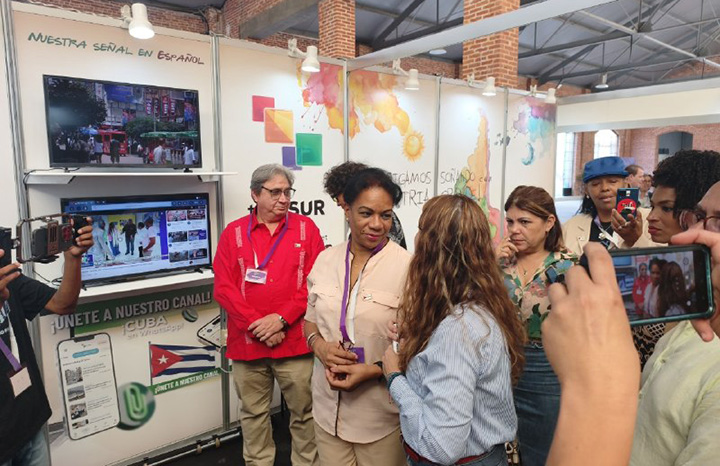
Deputy Prime Minister Inés María Chapman Waugh urged government management to be communicated with empathy and identification with citizens’ problems during her visit to the 5th International Patria Colloquium.
In exclusive statements to the Cuban News Agency, Chapman Waugh emphasized the usefulness of this forum, held at the Cultural Station on Línea and 18th Streets in Havana’s Vedado district, for the exchange of experiences necessary to improve communication, which is one of the pillars of government management.
In her remarks, she highlighted the growing prominence of this issue, given that technology has advanced to the point where it is increasingly easy to transform fake news into credible “information,” which is then used by some international media outlets to distort the realities of countries subjected to imperial aggression, such as Cuba.
In this complex scenario, the deputy prime minister stressed the urgent need to design a more comprehensive alternative communication strategy that reaches communities, informs them about the actions being taken, and explains how these actions impact the population suffering the consequences of the intensified blockade.
To this end, Chapman Waugh called for unity among all media outlets, not only nationally, but also internationally, including those that amplify the reality of Cuba beyond its borders.
However, she emphasized that these priorities will be ineffective without working from the heart, with sensitivity and a deep understanding of what needs to be conveyed, and with strategies and alternatives that can be implemented using the country’s own resources to reach the people with the truths that the mainstream media attempts to conceal.
For example, in Cuba we work with the Government Program for the Energy Transition. We need to be smart about how we communicate this, how, despite the problems, Cuba is working toward solutions and continuing the installation of renewable energy sources in priority centers to maintain the vitality of services.
Regarding the installation of photovoltaic systems in polyclinics, hospitals, schools, supply units, and other centers that provide services, she called on professionals in the national media to interview the people who receive this benefit, to create life stories and other materials that reflect the work on the ground and that appeal to the public’s awareness.
The key is how to inform the Cuban population better and with great sensitivity from government agencies, to go beyond general information that sometimes doesn’t communicate what should be communicated, and to see how we put ourselves in the shoes of others who have the same problems and make that visible to all Cubans and take it to the rest of the world, the deputy prime minister concluded.
With the participation of more than 25 countries, the Patria International Colloquium is consolidating itself as a space that brings together personalities from the field in Havana to fulfill an intense program of exchanges on the communication context, specialized workshops, conferences and panels on the subject.
IMAGE CREDIT: José Manuel Lapeira Casas | Photos: Luis Jiménez
[ SOURCE: AGENCIA CUBANA DE NOTICIAS ]