By Mark Friedman, Labor and Youth Activists Delegation, Member of the International Machinists Association
More than 30 people attended a public meeting on May 4th in Miami, where eyewitness accounts were presented by participants from the Labor and Youth Activists delegation who had just returned from May Day in Cuba. The meeting, titled “Cuba Under Siege, U.S. Threatens War, Cuban People Organize to Overcome It,” was organized by the Miami Coalition to End the U.S. Blockade of Cuba.
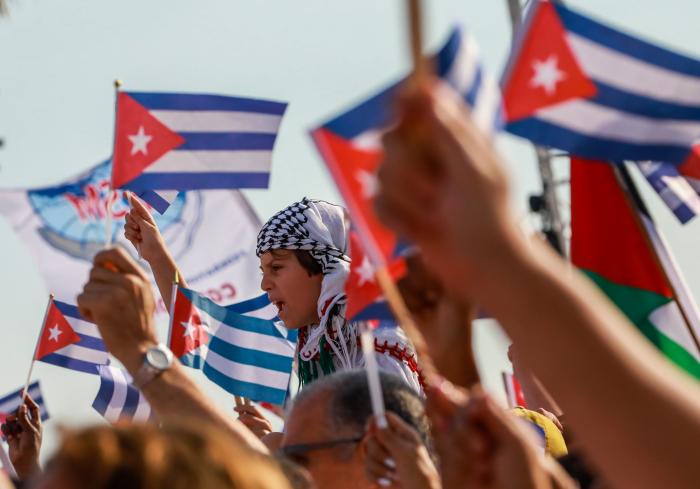
“Along with another Cuban-American from Miami, Gerardo Delgado, I traveled to Cuba with the U.S. Hands Off Cuba Committee as part of an international May Day brigade of about 45 people,” explained Andrés Suárez, a member of the Young Democratic Socialists of America at Florida International University. “We were among the 800 delegates from more than 38 countries who participated in the May Day march in Havana, which drew 500,000 people, and in the International Solidarity Conference the following day. Members of nine different unions were part of our delegation. They held meetings with the Cuban Workers’ Federation (CTC) and other Cuban organizations.
“For Cuban Americans like us, especially Cubans in Miami, it is important to see and understand the Cuban political system and the effects of U.S. sanctions, as well as their disastrous impact on the material conditions of the Cuban people. Washington claims that its sanctions are intended to help the Cuban people, but what we saw demonstrates that nothing could be further from the truth.
There was significant media interest in the presence of these young Cubans from Miami at the May Day demonstrations. Gerardo and I participated in a dozen interviews with Cuban news networks such as Cubavisión and international networks such as Telesur and AFG (France).”
“The United States has become more brazen in its plans to recolonize the island,” Suárez emphasized. “On May 1, International Workers’ Day, Donald Trump issued a new executive order tightening restrictions and limitations on individuals and entities working in support of Cuba, while threatening military action against the island.
“The U.S. embargo is the longest-running embargo in the world. It limits the Cuban people’s access to all kinds of goods, including food and medical equipment. As of January 29, Washington deepened the embargo by extending it to all oil shipments to the island.
Despite these restrictions designed to cripple the Cuban economy, the country has made incredible strides in medicine, science, technology, and much more. “At the end of last month, for example,” Suárez explained, “Cuba announced that it had successfully completed its first tests of thermoconversion techniques, allowing it to stop relying on the imports it previously needed to refine its domestic heavy crude.”
Suárez explained how Cuba has been a leader in Latin America and the Caribbean in formalizing sex education and defending LGBTQ+ rights. Its Center for Sex Education (CENESEX) and its medical counterparts strive to provide people undergoing hormone therapy and gender-affirming surgery with access to hormones and other vital resources, which are difficult to obtain due to the embargo.
She also described how, “Faced with shortages of equipment and spare parts, Cuban farmers and the Cuban Ministry of Agriculture have adopted the use of biopesticides and urban gardens to maintain agricultural production on the island.”
In his remarks, Gerardo Delgado explained that “Our purpose was simple: to learn directly from Cuba, deliver medical supplies and material aid to a school for children with special needs, and offer donations to the hotel staff in gratitude for their service and hospitality.”
“Before leaving, I was concerned about Trump’s rhetoric, which implied an imminent military intervention.” Trump’s threat to order Washington’s largest aircraft carrier to position itself off the coast of Cuba came as May Day demonstrations were taking place on the island.
Delgado explained: “As a Cuban-American, I cannot stand idly by and allow such violence against my family’s homeland.
I support Cuban Foreign Minister Bruno Rodríguez when he responded to these threats: ‘The United States has no right to impose measures against Cuba.’”
Delgado also described the delegation’s visit to Granma, the Communist Party newspaper named after the yacht that carried Fidel Castro, Che Guevara, and 80 other revolutionaries to Cuba in 1956 to begin the armed struggle. The editors described how digital sanctions hinder their work. They told us that: “In August 2020, Google shut down Granma’s YouTube channel, along with those of Cubavision International and CubaDebate, citing U.S. export laws.” These channels contained years of content, analysis, documentaries, and anti-COVID coverage. They disappeared. With no possibility of appeal.
Twitter has also repeatedly blocked Granma and other Cuban media outlets. They have been prohibited from using web services that all media companies worldwide rely on to do their reporting. This complicates any transition to a more digital platform, “a struggle that newspapers everywhere can understand,” Delgado said. More recently, due to the fuel embargo, the print edition of *Granma* was reduced to a weekly publication, although it remains a daily online edition.
Karibuni: Angolan and Ethiopian Veterans Meet with American Veterans
“I was moved to tears by the Cuban military veterans from Angola, Syria, and Ethiopia whom we met in Karibuni. For more than ten years, as soldiers, teachers, doctors, and engineers, they helped defeat the South African apartheid invasion of Angola and free Mandela. Two thousand Cubans gave their lives on African soil. They returned home without oil. Without diamonds. Without military bases. Only with solidarity.
“Pacha, an American veteran from our delegation — who served in the U.S. war in Afghanistan — stood up. Through tears, she asked the Cuban veterans if they had any words for the American veterans who feel remorse for what they did in imperialist wars.
The Cuban veteran responded: “We harbor no hatred toward you. The people of the United States are not to blame for the actions of your government.” In doing so, they reaffirmed Cuba’s international solidarity.
Delgado concluded by describing how the Cuban people displayed extraordinary passion and determination in their opposition to the U.S. blockade, chanting slogans, marching along the Malecón, and parading throughout the island on May Day. “Despite 66 years of blockade, designed to break the Cuban spirit… I can state with absolute certainty: they have not been broken. And they have not been broken.”
Both Suárez and Delgado urged those attending the meeting to share this information in their communities. “Organize against the new executive order,” Delgado said. “Keep sending aid. Keep building solidarity. Because the Cuban people have never stopped building theirs. Without blame. Without hatred. Only the truth.” Another speaker at the meeting was Brenda López, founder of the LA Hands-off Cuba Committee and leader of the delegation. She reviewed the history of building opposition to the U.S. embargo in Los Angeles and other cities, as well as the importance of the campaigns carried out by Global Health Partners to send medical aid to Cuba.
She emphasized the importance of having a unified solidarity committee. “We can achieve the greatest impact in building unity in action by organizing committees that focus on ending the embargo, the sanctions, and the trade and travel bans. We must demand that Cuba be removed from Washington’s list of alleged terrorist nations: the infamous State Sponsors of Terrorism (SSOT) list.”
López denounced Washington’s intensified efforts to further tighten the noose around Cuba, demanding that other countries expel Cuban doctors who are part of contracts that are often essential to their own healthcare systems. This cuts off vital funds for Cuba’s own healthcare budgets while denying millions of people the medical care that only Cuban brigades have provided.
López concluded: “Our task must be to act swiftly, conducting progress reports, educational programs, and public demonstrations throughout the United States to show that Cuba is not alone; that we, the people of the United States, stand with Cuba and against the U.S. blockade and its threats of war against the island.”
IMAGE CREDIT: Members of the U.S. delegation took part in the May Day march and rally in Havana. Photo: Jose Manuel Correa
[ SOURCE: U.S. Hands Off Cuba ]