Héctor Juanatey / Huffington Post
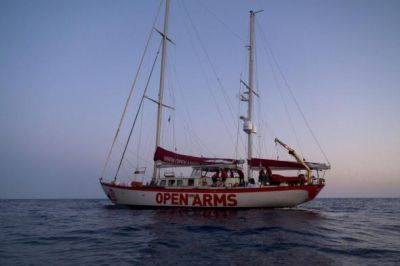
It was conceived as a luxury vessel until its last owner, Livio Lo Monaco (yes, the one with the mattresses that Constantino Romero advertised so much), realized it could be more useful than a simple pleasure boat. Aware that thousands of people die each year in the Mediterranean, the sea where he “lives like a king,” Lo Monaco lent the sailboat Astral to Open Arms so they could use it for rescue operations. The businessman made the right decision. Since 2016, the Astral has rescued more than 15,000 people, in addition to serving for observation, surveillance, and as a training vessel. And that’s not all. For the past few days, the sailboat has been sailing towards Havana as part of the “Rumbo a Cuba” (Heading to Cuba) mission, which aims to deliver photovoltaic panels to the Juan Manuel Márquez Pediatric Hospital, which depends on an increasingly unreliable electrical grid.
One of the promoters of the initiative is Miguel Urbán, a member of Anticapitalistas, founder of Podemos, and former Member of the European Parliament. Urbán spoke to El HuffPost by phone shortly after it was revealed that several Spanish companies were ceasing operations in Cuba following threats of sanctions from the United States. “Anything goes here,” Urbán said. “Where is the EU? Where is the most progressive government in history? This is affecting Spanish companies… If it’s not about Cuba, and speaking in their terms, what are they waiting for to protect the interests of Spanish companies? Don’t they realize that the US objective is to eliminate, for example, hotel chains in order to then replace them with their own companies?” he points out.
Beyond the €150,000 worth of photovoltaic panels that the Astral is carrying to Havana, the objective of the mission to Cuba is also similar to that of the various flotillas to Gaza. “The fundamental thing is to denounce the blockade. The Astral is a political argument, a symbol that takes on greater importance when the United States no longer even allows ships carrying food to enter Cuba. Only China can do that, but China only thinks about China. We are accepting a geopolitics of new imperialisms,” he explains.
The tightening of the US blockade against Cuba is increasing, which has subjected the island to a situation of suffocation, both economically and in terms of its very existence. “What they’re after,” Urbán points out, “is a popular uprising, for people to say they can’t take it anymore, and it’s understandable that they say that, because things are getting worse and worse. On the best of days, they go 20 hours without electricity. What does this mean? There’s no way to refrigerate food, hospitals don’t have power for incubators, for surgeries… And not only that, June and July are the worst months in terms of tropical heat, and it’s not just that they don’t have air conditioning, they can’t even plug in a fan.”
Faced with this situation, and despite a resistance that has lasted for years, Cubans are beginning to see no future, especially when the international community doesn’t seem likely to come to their aid. That’s precisely what the United States is playing on. “This is considered a war crime under international law, similar to the Israeli actions in Gaza, but without bombs, at least until then,” Urbán denounces, acknowledging that the government isn’t perfect either, “but whoever inflicts the beating is responsible for the other person bleeding; it’s not as if they just threw themselves to the ground and that’s it.”
For the initiative’s promoter, Palestine and Cuba are proof of “the death of the liberal order, of international law, and of the existing framework for international governance.” “The UN has 20,000 tons of aid in Cuba that the United States has forbidden it from distributing. How can a country prohibit the United Nations from distributing aid, especially in the context of a humanitarian crisis? I’ve missed the paragraph, the regulation, that says the UN must comply with something like this,” he points out.
Urbán also provides an example of this “anything goes” attitude in which not even the United Nations dares to contradict the United States. “When the CIA chief negotiated with the Cubans, one of those accompanying the American was responsible for the military operation in Venezuela that killed 38 Cubans. Imagine starting a meeting like this: ‘Hello, I’m So-and-so, and I was in charge of killing the Cubans who were protecting Nicolás Maduro.’ That’s the level of American brutality.”
IMAGE CREDIT: The Astral sailboat of Open Arms. aleria Ferraro/SOPA Images/LightRocket via Getty Images
[ SOURCE: www.cubainformacion.tv ]