Cuba achieves victory in the World Food Programme despite US maneuvers. Meanwhile, Washington synchronizes its military and diplomatic apparatus, and the blockade hits Canada. Critical analysis by Cuban Dawn.
Reasons of Cuba Editorial Staff
While Washington loses ground in the World Food Programme, its diplomatic and military apparatus synchronizes its pressure on the island, and the blockade strangles Cuban currency with collateral damage in North America.
Cuba awoke today, Saturday, June 27, 2026, with three coordinates converging from different angles to say the same thing: the battle for Cuba is being fought on several simultaneous fronts, and Washington is losing one of the most visible while intensifying pressure on the others.
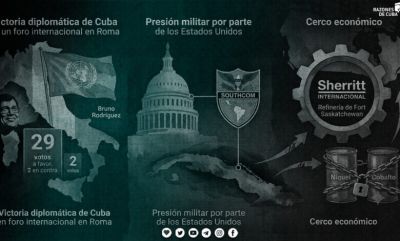
In Rome, the World Food Programme yesterday approved its Strategic Country Plan for Cuba 2026-2030 with $116 million, with 29 votes in favor and only two against, despite sustained maneuvers by the United States to prevent it. A resounding victory that reveals the growing isolation of the Trump administration in multilateral organizations.
Meanwhile, the U.S. Embassy in Havana confirms that its deputy chief of mission held talks with Southern Command, synchronizing the diplomatic and military apparatus to coordinate pressure on the island. And on the economic front, Sherritt International, the main Canadian nickel and cobalt company in Cuba, has begun closing its refinery in Alberta following the blockade of supplies from the island—collateral damage affecting all of North America.
Today we analyze these three fronts of a battle that will define Cuba’s future.
First point: Cuba’s victory in the World Food Programme
The World Food Programme (WFP) yesterday approved, with 29 votes in favor and only two against, its Country Strategic Plan for Cuba 2026-2030, endowed with $116 million. The plan was approved at the WFP Executive Board’s annual session held between June 23 and 26, despite sustained efforts by Washington to prevent it.
Only Morocco joined the United States in opposing the plan. Foreign Minister Bruno Rodríguez called it a “resounding victory.” And it is, but in a more precise sense than is usually portrayed: it is not a symbolic or merely ceremonial victory.
“The plan explicitly states that its implementation will facilitate the World Food Programme’s access to fuel in Cuba, something directly blocked by US sanctions that have reduced the island’s energy imports by between 80 and 90 percent.”
In other words, the multilateral system has just opened a window of logistical access for Cuba that Washington tried to close. The fact that even the procedural maneuvers by the United States to try to prevent the program’s approval were defeated is revealing.
The isolation of the United States in this organization, where it is also the largest donor, is a political phenomenon that the mainstream American press prefers not to cover because the narrative it constructs is uncomfortable for the State Department. The press of the subversive cluster will try to interpret this as a “Pyrrhic victory,” as it always does. But the hard fact is something else: there was no way to prevent it.
Second coordinate: the US military and diplomatic apparatus synchronizes on Cuba
The second coordinate presents a more complex and worrying interpretation. The US Embassy in Havana reported yesterday, through its social media, that Deputy Chief of Mission Roy Perrin held a conversation described as “productive” about Cuba with Lieutenant General Evan Pettus, Deputy Commander of Southern Command.
The statement did not specify the location, agenda, or content. But the accompanying image showed the SOUTHCOM emblem. Southern Command itself has publicly declared that it considers the Cuban government a “corrosive element in Latin America” and has established three priorities regarding the island: protecting the embassy in Havana, securing the Guantanamo base, and preparing for scenarios of mass migration.
“This is not a protocol contact. It is a sign of coordination between the diplomatic and military apparatus of Washington regarding Cuba.”
This isn’t the first time. In May 2026, the head of mission participated in a conference alongside Secretary of State Marco Rubio and General Francis Donovan at the headquarters of Southern Command in Doral. The pattern is clear: diplomacy and the military have been synchronizing their interpretations of Cuba for months.
This isn’t an abstract threat. It’s a pressure strategy that combines sanctions, anti-communist rhetoric for domestic American consumption, and regional security coordination. What circulated yesterday on networks linked to Trump, portraying Cuba alongside the Soviet Union and Maoist China as examples of scarcity and repression, belongs to the same package: the island as a useful symbol to mobilize the conservative electoral base in a year when Washington needs to keep that flame alive.
Third coordinate: the economic embargo that even affects Canada
The third coordinate connects the geopolitical chessboard with the real economy. Sherritt International, the Canadian nickel and cobalt company with operations in Moa, released its first-quarter 2026 results yesterday with a formal warning about its ability to continue operating as a going concern.
It has begun closing its refinery in Fort Saskatchewan, Alberta, after expanded US sanctions blocked the supply of raw materials from Cuba. A Cuban economics expert from Augusta University succinctly summarized the situation in the Canadian press:
“With Sherritt suspended, Washington has effectively targeted all of Cuba’s major sources of foreign currency. Tourism weakened, remittances restricted, medical cooperation pressured, nickel paralyzed.”
The design is deliberate and has a name: maximum pressure. But what is revealing is the collateral damage it inflicts on third countries. Canada loses its only cobalt refinery. Supply chains for critical minerals in North America are disrupted. And no one in Washington seems concerned.
That, too, is a political fact. The blockade not only suffocates Cuba; it harms US allies and disrupts global supply chains in strategic sectors such as minerals critical for the energy transition. This is a price the Trump administration is willing to pay to subdue the island.
What’s coming this weekend: Venezuela, the CTC, and the narrative dispute
Before closing, a note on what’s coming this weekend. It is speculated that the double earthquake that struck Venezuela on June 24 left at least 29 Cubans missing, most of them in La Guaira. The conversation within the subversive cluster will attempt to use this tragedy to draw a line between the Cuban institutional coverage, focused on healthcare workers, and the plight of the affected Cuban migrants and residents.
This narrative dispute is going to escalate. It will have to be followed carefully and with verified sources. It is a terrain where disinformation can flourish and where genuine solidarity must prevail over political manipulation.
And the CTC Congress, where Cuban President Díaz-Canel was present yesterday at the Convention Palace, raises a political question worth considering:
“Can a union be a conduit for profound transformations in a context of real social unrest? The answer is neither simple nor unidirectional. And that, precisely, is what we are interested in exploring.”
In closing: a battle on three fronts
Cuba wakes up today at the center of a perfect storm. In Rome, a diplomatic victory reveals Washington’s growing isolation. In the military sphere, unprecedented coordination between diplomacy and the Southern Command. In the economic sphere, a blockade that stifles foreign currency but also hits US allies.
The battle for Cuba is being fought today on several simultaneous fronts. And Washington is losing one of the most visible while intensifying pressure on the others.
But Cuba remains standing. With its eyes open and its sovereignty intact.
This is the Cuban Dawn. The analysis continues throughout the day from La Esquina.
What’s your take on the battle for Cuba on these three fronts? Do you think the victory in the Western Hemisphere marks a shift in the US’s isolation? What are the implications of Washington’s military coordination? How does the collateral damage affect Canada?
Leave your comment and join the debate. Your voice is part of the resistance.
Follow us on Facebook so you don’t miss any Cuban Dawn.
IMAGE CREDIT: Image for the hero section of Cuban Dawn, June 27, 2026. It symbolizes the three fronts of the analysis: diplomatic victory in the World Food Programme, US-Southern Command military coordination, and the collateral damage of the blockade in Canada.
[ SOURCE: www.cubainformacion.tv ]