By Hedelberto López Blanch* / Special Collaboration for Resumen Latinoamericano.
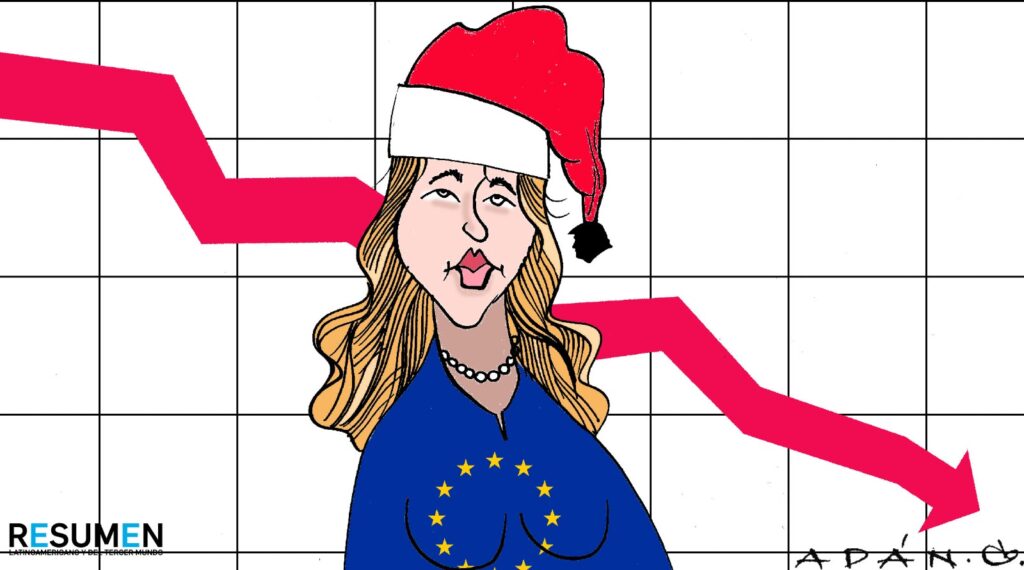
The subordination to Washington that the wealthy leaders of Western Europe have reinforced in the last decade with the aim of weakening Russia has cost these nations significant economic, political, and military deterioration, in addition to international disrepute.
The British newspaper Financial Times recently calculated that the numerous anti-Russian “sanctions” applied by the European Union (EU) and Great Britain at the behest of the White House have caused companies that did business in Russia to suffer losses of more than 100 billion euros, specifically those in the oil and gas sector, as well as financial companies, insurance companies, banks, public utilities, and the automotive industry.
Following the United States’ lead in its attempts to weaken Russia, first under Joe Biden and then under Donald Trump, Western Europe has been forced to pay large sums of money for the most expensive fuels from Washington while simultaneously breaking important agreements and transactions with the Eurasian giant.
A report published by Eurostat indicates that the volume of Russian oil imported by EU countries decreased from 29.2% (in 2021) to 1.4% (in 2025), and gas imports fell from 38.5% to 7.9% over the same period.
The price for “breaking free from dependence” on Russian fuel, as Washington demanded from the outset, is around one trillion euros, which has proven to be a disastrous deal.
The director of the Economic Cooperation Department of the Russian Foreign Ministry, Dmitry Birichevsky, stated during a speech at the recent St. Petersburg Forum that European Union nations have lost up to one trillion dollars after abandoning Russian raw materials and hydrocarbons due to rising prices and the fact that they now buy them at higher prices from other suppliers.
The White House forced the EU to stop purchasing Russian hydrocarbons and instead buy them from the United States at a higher price, under the “justification” that these countries should not be economically tied to Moscow.
Under these circumstances, the Yamal-Europe pipelines were closed, as was the second branch that ran through Ukraine, and the Nord Stream 1 and 2 pipelines were destroyed—actions that the Kremlin labeled as acts of terrorism.
However, according to Russia, those who abandoned these resources continue to buy Russian oil and gas through intermediaries at higher prices.
Let us recall that last year, the President of the European Commission, Ursula von der Leyen, signed a draconian and completely unbalanced trade agreement with President Trump, which constituted yet another act of European humiliation.
Under this agreement, EU products entering the United States will pay a 15% tariff, while EU members will pay nothing for US goods arriving in their countries. It’s that simple, a double standard.
Furthermore, the European Union agreed to buy $750 billion worth of US energy products, mainly liquefied natural gas and nuclear energy, reject those acquired at much lower prices from Russia, invest $600 billion in the US economy, and obtain large quantities of military equipment from the United States.
At the end of June 2025, under intense pressure from Trump, NATO members agreed at the Hague summit to allocate 5% of their Gross Domestic Product (GDP) to security and military spending by 2035, representing an annual erosion of €500 billion for these countries. Furthermore, Washington will remain the main arms exporter to Western Europe.
According to Mario Draghi, former head of the European Central Bank and former Prime Minister of Italy, “the Union is sinking into recession, and the future of its economy looks bleak.”
As a consequence of these events, the United States has managed to stifle the European Union as an economic and political competitor, but conversely, it has been unable to weaken Russia, which continues to be one of the world’s leading powers.
IMAGE CREDIT: Cover illustration: Adán Iglesias Toledo.
(*) Hedelberto López Blanch is a renowned Cuban journalist. He writes for the newspaper Juventud Rebelde and the weekly Opciones. He is the author of “Cuban Emigration to the United States,” “Secret Stories of Cuban Doctors in Africa,” and “Miami, Dirty Money,” among others.
SPECIAL THANKS TO THE AUTHOR: Hedelberto López Blanch
[ SOURCE: RESUMEN LATINOAMERICANO Y DEL TERCER MUNDO CUBA / EN RESUMEN ]