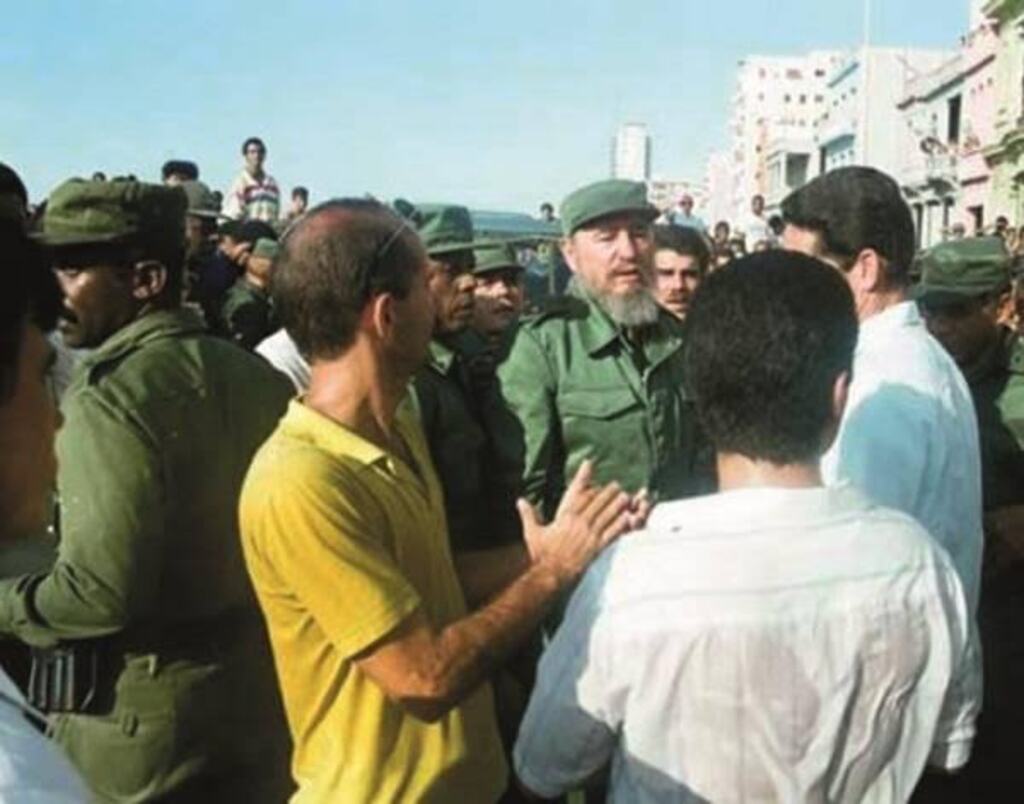
August 5, 1994, is a historic day for Cubans, as it was for Fidel Castro Ruz, when he appeared wearing his morale vest amidst the unrest in Havana.
Cuba was living through difficult years following the collapse of the socialist bloc in Eastern Europe. Fuel and food shortages were taking their toll on the daily lives of Cubans, who were resisting the escalating economic, commercial, and financial blockade imposed by the United States government and the growing subversive campaign that led to those events.
The historic leader of the Cuban Revolution immediately went to the scene to speak with the people and help restore calm.
Referring to that moment in 1995, Fidel said: “Every year we will have the duty to remember the great victory of August 5, 1994, when the people crushed the counterrevolution without firing a shot, because this date speaks volumes, teaches much, and inspires great enthusiasm.”
If we take this example and delve into what Fidel wrote and said, we will find countless quotes born from the leader’s daily prolific output, showing the path to follow in difficult times, which constitutes one of his contributions.
In this search, we find phrases from the people and from friends who accompanied him during the funeral of the Cuban Commander-in-Chief, because what led to his death allows us to understand the transcendence of a legacy that we have a duty to perpetuate as a valuable resource.
The slogans “Where is Fidel?” and “I am Fidel!” still resonate as a question and a response, calls to action in the face of powerful dominant forces that today seek to undermine the historical continuity of the Cuban social process, challenged as never before.
“I am Fidel!” implies a commitment to the thought and action of a leader, which must be used as a tool, a method, and a compass, especially in an economic and socio-political context that requires a firm step and a long-term vision, so as not to lose sight of the socialist construction enshrined, as irreversible, in the Constitution.
The task is not easy, as following Fidel never was, but the fact that Cubans are still standing is the best testament that they have succeeded. The first step is to analyze the multidimensional man he was: a rebellious and diligent student, a restless young man, a guerrilla leader, a statesman, a diplomat—all mediated by an unparalleled humanism.
In a text published on the Razones de Cuba website in 2022, titled “Difficult Times: Moments of Definition,” the author uses epistolary fragments from the leader, which express his process of radicalization toward the anti-imperialist we know.
“(…) Seeing the rockets they fired at Mario’s house, I swore to myself that the Americans are going to pay dearly for what they are doing. When this war is over, a much longer and greater war will begin for me: the war I am going to wage against them. I realize that this is going to be my true destiny,” he wrote on July 5, 1958, in a letter addressed to the revolutionary Celia Sánchez.
Later, he references a speech given by Fidel on September 5, 1992, which illustrates the confidence he had in his people: “In difficult times, some become confused, some become discouraged, some lose heart, some soften, some betray, some desert.
That happens in every era and in every revolution. But it is also in difficult times that men and women are truly tested, in difficult times that those who are truly worthwhile are revealed.”
It seems as if this fragment of a speech was delivered today, because we are living through difficult times in which human frailties and virtues come to the surface. Such is Fidel on his centenary, a man who transcended his biological life with such certainty in his words and deeds that we can walk upright on his legacy.
[ SOURCE: PRENSA LATINA ]