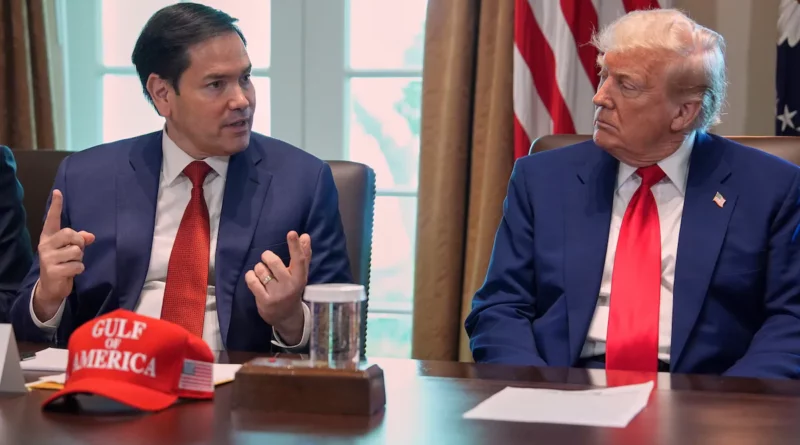
By Hedelberto López Blanch / Photo: Associated Press / LaPresse (APN)
Fulton Armstrong, a former U.S. intelligence official, told the Spanish newspaper El Mundo that “Trump and Rubio are constructing a narrative tailored to their needs to justify an escalation against Cuba.”
The former CIA member and one of the leading U.S. experts on Latin America, who has spent nearly three decades analyzing Washington’s relationship with Havana, indicated that the White House is reinforcing sanctions and the economic blockade amidst a regional escalation following the offensive against Venezuela and tensions with Iran.
In response to a question from El Mundo, Armstrong pointed out that after more than six decades of embargo, the United States has entered a much more aggressive phase against Cuba. “The blockade on oil reaching the island is, in practice, an act of economic warfare.” “The logic of Trump and Foreign Minister Marco Rubio is to increase the pressure until they provoke an internal collapse, convinced that economic strangulation, fear, and psychological warfare will ultimately push the population against the regime,” he stated.
The analyst then pointed out: “But there’s a fundamental error there: Cuba is not Venezuela. The Cuban revolution, with all its contradictions, still has very deep institutional, cultural, and historical roots, and that’s something that Washington often fails to grasp.”
Armstrong emphasized that Trump is undoubtedly constructing a political narrative tailored to his needs to justify a further escalation. We already saw this with the accusations of drug trafficking, terrorism, alleged Chinese spy bases, and the so-called sonic attacks against American diplomats—a theory that later morphed into alleged microwave attacks because no one could prove the first version.
The intelligence analyst indicated that he doesn’t believe he sees US troops entering Cuba directly, although he does foresee a much more aggressive escalation on the economic and military fronts.
During the interview, Armstrong acknowledged that the case of Cuba is different from that of Venezuela because Washington has an obsession with lumping everything together: terrorism, drug trafficking, China, Iran, authoritarianism… And that simplifies completely different realities. “There is a structural inability in the United States to understand the historical, cultural, and social factors of Latin America, and the average American citizen knows practically nothing about their country’s history of abuses and interventions in Cuba.”
When analyzing why, after so many years, there has been no progress in the relationship between the two countries, Armstrong ripped away the facade worn by different White House administrations:
“The problem is no longer just Trump. There is something structural in U.S. policy toward Cuba. Joe Biden didn’t change anything significant either. He loosened the purse strings a bit in some economic aspects, but always with so many conditions and limitations that in the end, everything went back to square one. There is a historical inability in Washington to understand the Cuban reality beyond ideological confrontation.” Every time the island tries to open its economy even slightly or seek new investments, the United States closes the doors again. This already happened during the normalization period between Barack Obama and Raúl Castro.
In this important statement, the analyst emphasized that in the present and future, “we will see a mix of military pressure, sanctions, and negotiation. The United States will probably increase pressure on Cuba even further before the midterm elections. But I also believe that Washington knows the island is not going to collapse easily.”
Mr. Armstrong failed to mention that Cuba has withstood all the attacks and aggressions from the United States due to its history of struggle against Spanish colonialism, the US neocolonialism, the dictatorship of Fulgencio Batista promoted and supported by Washington, and the close bond between the people and their leaders. For Cuba, the country’s sovereignty and independence are the fundamental bases for any understanding with the United States.
Recently, in response to renewed extortion attempts by Washington against the Cuban Petroleum Company (Cupet), Cuban President Miguel Díaz-Canel Bermúdez stated on his Twitter account: “They try to justify their crimes with absurd pretexts, which only seek to conceal their main objective: to suffocate the Cuban people, to force them to surrender through hunger, need, and disease. We are witnessing the rebirth of fascism in its purest form.”
Díaz-Canel emphasized that “the United States cannot forgive itself for the fact that, at this point, despite all the maximum pressure they have exerted, the Revolution continues to exist and the country continues to function. And not even they themselves believe what they so often talk about as a failed state.”
(*) Hedelberto López Blanch is a renowned Cuban journalist. He writes for the newspaper Juventud Rebelde and the weekly Opciones. He is the author of “Cuban Emigration to the United States,” “Secret Stories of Cuban Doctors in Africa,” and “Miami, Dirty Money,” among others.
SPECIAL THANKS TO THE AUTHOR: Hedelberto López Blanch
[ SOURCE: RESUMEN LATINOAMERICANO Y DEL TERCER MUNDO CUBA / EN RESUMEN ]