By: Ana Álvarez Guerrero, Enrique González Díaz (Enro)
In Cuba, saying that something is “de madre” means that something — referring to any situation, object, or even person — is really difficult, tough, and complicated. I don’t remember the first time I heard that expression. Whether it was day or night. Whether I was 6 or 14 years old. What does come to mind—perhaps as a constructed memory—are my own mother’s lips pronouncing it word by word. In the middle of a blackout, upon arriving home from work, at the end of the news broadcast…
What’s clear is that I didn’t truly understand the phrase until I became a mother myself. And I understood that there’s probably nothing in this world more “motherly” than being a mother.
Because yes, when you look at your baby, you feel a deep love blossom in your chest like never before. A force—wild, protective, powerful, capable of facing anything and anything—takes over your instincts. It doesn’t matter if you slept three, four, or zero hours; when your child smiles, it recharges your batteries to get you through another day. But, “motherly.”
My first shock was breastfeeding. I assumed it was an intuitive act. Put the baby to the breast and that’s it. Simple, I thought. However, it wasn’t.
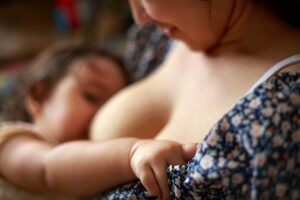
Breastfeeding isn’t always easy: it involves resilience, bonding, and care. Photo: Enrique González (Enro)/ Cubadebate.
The chill running through my body, the deep, bleeding sores, the pressure to do it, that everyone has done it before, that it “heals fast,” that the more you put the baby to the breast, the faster it heals.
But it’s not like that. It hurts more.
As a new mother, frustration arrived—in the form of fevers and trickle-in pumping sessions—accompanied by guilt, which visited me for a while. Because if there’s one thing that’s very “motherly,” it’s guilt.
“Am I failing? Am I doing it right?”
Luckily, other mothers took me under their wing. My own—who didn’t fully understand the situation but was still a pillar of support—and two others who changed everything.
Claudia—with a baby only a month older—pumped and froze several ounces of her breast milk and sent it to feed my baby. Is there anything more human and primal than a mother feeding another child, by instinct?
Janet encouraged me and offered advice constantly, drawing on her experience as a first-time mother. She enrolled me in a community called La Leche League Cuba so I would have the support and information I needed to save breastfeeding. And if that weren’t enough, she donated several cans and bottles of baby formula that she had saved. Is there anything more maternal than empathy for another mother?
Memories of that time are fragmented, but the gratitude is boundless.
If one thing is clear, it’s the certainty that it was the first, but not the last, time things got—or will get—”motherly.”
However, on this day, I can only think of my own mother and all the others who, in the midst of such complex circumstances, manage—what for others might be impossible—for their children.
Those who swat away mosquitoes and fan themselves tirelessly during the blackout. And yet, they get up early to go to work, to breastfeed, to love and support.
Those who care for their own mothers, those who don’t have them, those who miss them. Those who yearn for the children who have left. Those who worry about those who are here and their future.
Those who suffer because they don’t have the medicine they need—or the medicine that’s scarce—to heal the pain of others or their own.
Those who juggle everything to feed their families, to clothe them, to bathe them.
Those who didn’t give birth biologically and yet still became mothers.
Those who teach, those who heal, those who work the land, those who build, those who innovate, those who sustain this country through countless sacrifices and efforts.
To all of you, thank you for being there when life gets tough. Today and always.
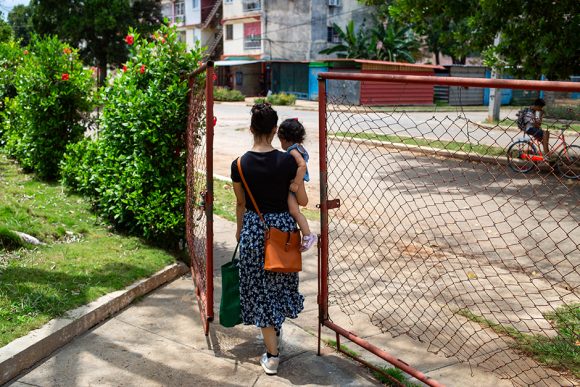
IMAGE CREDIT: A mother picks up her daughter from the daycare center. Photo: Enrique González (Enro)/ Cubadebate.
[ SOURCE: CUBA DEBATE ]