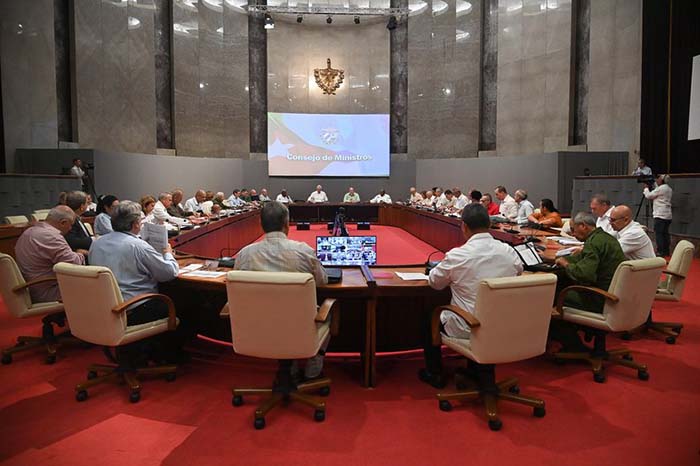
The Council of Ministers approved in its regular session for April the exercise of legislative initiative in favor of three draft laws, which will be presented in July to the National Assembly of People’s Power.
According to a statement released Saturday by the Cuban Presidency, these are the draft Labor Code, incorporating the results of consultations with workers; the draft Housing Law; and the draft Law on the Organization of the Central State Administration.
Regarding the draft Labor Code, the Minister of Labor and Social Security (MTSS), Jesús Otamendiz Campo, presented a summary, explaining the legal and political foundations for the proposed amendment. This process also included a consultation with labor collectives between September 8 and December 12, 2025, which encompassed 40,591 meetings: 36,416 with labor collectives, 2,522 with self-employed workers, 893 with micro, small, and medium-sized enterprises (MSMEs), and with mixed collectives and Cuban missions abroad.
During the exchanges, 96,250 proposals were made, of which 41,403 (43%) were accepted, 9,641 (10%) were partially accepted, 8,703 questions were clarified (9%), 33,687 (35%) were not accepted, and 2,816 (3%) were deemed outside the scope of the relevant authorities.
The draft of the new Housing Law was submitted to the Council of Ministers by the Minister of Construction (MICONS), René Mesa Villafaña, who explained that it addresses the need for a new law that integrates the production and management of housing and its urban developments with an economic, legal, sociocultural, and environmental approach, and responds to demographic dynamics and other economic transformations resulting from the presence of new actors, with a local and territorial perspective.
This is the result of an extensive consultation process with agencies of the Central State Administration, academia, the judiciary, delegates of the People’s Power, members of the National Assembly, local councils, the public (via email), the housing system, and others.
The proposed draft of the Law on the Organization of the Central State Administration was presented by Andry Matilla Correa, Dean of the Faculty of Law at the University of Havana, who stated that “this is not merely a structural change, but rather a redesign of each of the agencies of the Central State Administration.”
He explained that it aligns with the needs of public administration in our country and strengthens the focus on public policy, which is fundamental; and it redesigns the dialogue between the central administrative structure and its subordinate affiliated structures, as well as the business sector related to each of these agencies.
The project establishes the general framework for the organization of the Central State Administration and determines the number, names, missions, and functions of the ministries and other agencies that comprise it. The current 27 agencies of the Central State Administration will be reduced to 21.
When addressing the proposed new structure for the Central State Administration, Prime Minister Manuel Marrero Cruz commented: “A small country, a country with such a complex situation, cannot have such a large structure, so much bureaucracy, which makes processes inefficient and therefore requires a different design.”
The Head of Government added that this is a first and positive step, but that they will continue to study it after its implementation.
This is an opportunity to reorganize, to make better use of existing human resources, existing personnel; let there be no doubt that it is a complex process, but a necessary one, he commented.
IMAGE CREDIT: ACN | Photo: Cuban Presidency and Government Website
[ SOURCE: AGENCIA CUBANA DE NOTICIAS ]