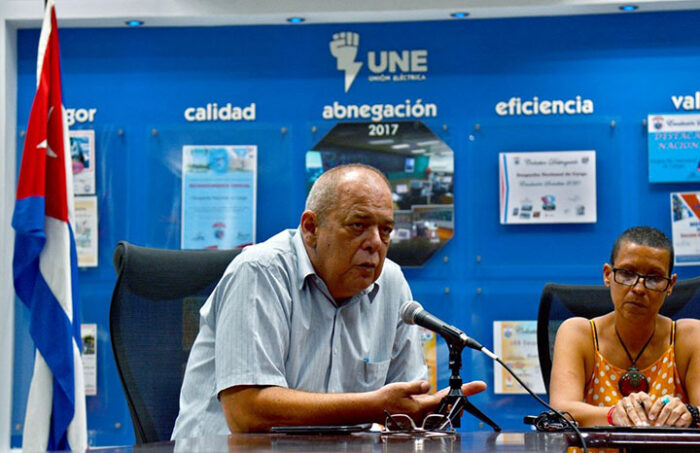
Cuba’s Minister of Energy and Mines, Vicente de la O Levy, provided an update during a press conference held this Wednesday on the country’s electricity situation, which is going through a complex period with intensified blackouts across the island.
“Once again, we will discuss the situation of the national electricity system, which is so acute and critical,” the official began, highlighting the impact of the energy blockade imposed by the United States, a policy that has worsened since its implementation.
The minister stated that one of the primary reasons for the worsening situation is the lack of fuel shipments. Since last December, only one donation of 100,000 tons of crude oil from Russia has arrived on the island. The Russian donation was put to good use during that period, allowing for increased energy generation and achieving days without blackouts in regions like Havana.
“This is fundamentally due to the ironclad energy blockade we are experiencing. An energy blockade that follows a blockade we endured for many years, and what it did was exacerbate and further strain the country’s economic and energy situation,” de la O Levy emphasized, referring to the reasons why the situation is becoming increasingly complex.
Vicente de la O Levy pointed out that, at this time, conditions have worsened regarding energy generation, with the electrical system once again left “without any fuel reserves” for generation. “Today we are experiencing higher temperatures, and the electric system is only operating with thermoelectric plants, Energás, and photovoltaic solar parks,” the minister explained.
The situation at thermoelectric plants is also a key cause of the current low availability of electricity in the country. The initial shutdown of the Guiteras plant, followed later by the Felton plant, has reduced generation capacity on days marked by fuel shortages. “This has made this week extremely tense, because the Felton plant has been shut down at the same time as Mariel and Havana, which are all without fuel, and distributed generation is also without fuel,” the official explained.
Photovoltaic energy, one of the government’s strategies to strengthen the national power grid (SEN), has not been fully utilized due to the inherent fragility of the electrical system. De la O Levy explained that of the 1,300 MW of installed capacity in the country, not all can be used due to the variations inherent in this type of energy and the weather. He added that “if the base system were more robust, it could absorb these fluctuations without major problems.”
The minister reaffirmed the commitment to the energy transition as a way to improve the situation of the National Electric System (SEN). “We will continue finding solutions, we will continue seeking our own national alternatives with our resources, as has been demonstrated by our colleagues at Cupet, as has been demonstrated by our colleagues at the National Electric Union,” the minister stated.
Cuban President Miguel Díaz-Canel Bermúdez denounced this Wednesday via social media that the tense situation of the SEN is due exclusively to the “energy blockade” imposed by the United States. The president reported that a deficit of more than 2,000 megawatts (MW) is forecast for the day during peak nighttime demand.
According to the president, the fuel shortage caused by the “criminal blockade” is preventing the generation of 1,100 MW this Wednesday. He emphasized that the slight improvement in service recorded in April was made possible by the arrival of a single fuel tanker, although he noted that at least eight tankers per month are needed to stabilize the grid. “The best demonstration of what we are saying is the significant improvement in service in April,” he stated, stressing that the blackouts lessened, but did not disappear.
The Cuban president rejected the narratives in U.S. media that attribute the crisis to alleged government mismanagement, calling them part of a “belligerent agenda,” and maintained that the crisis is the result of a “severe economic war” and the 243 measures tightening the blockade, including executive orders that penalize fuel trade and investment on the island.
“Our response remains the same: always open to dialogue on equal terms, we will continue to resist and build, increasingly convinced that it is up to us to overcome enormous difficulties through our own efforts, united as a nation, and resolute in facing the toughest challenges,” the president stated on his Twitter account, highlighting Cuba’s resilience in the face of the difficulties imposed by the U.S.
IMAGE CREDIT: Minister of Energy and Mines press conference 2 1536×1024 1
Vicente de la O Levy indicated that, at this time, conditions have worsened regarding power generation, with the electrical system once again left “without any fuel reserves.” Photo: ACN.
[ SOURCE: teleSUR ]