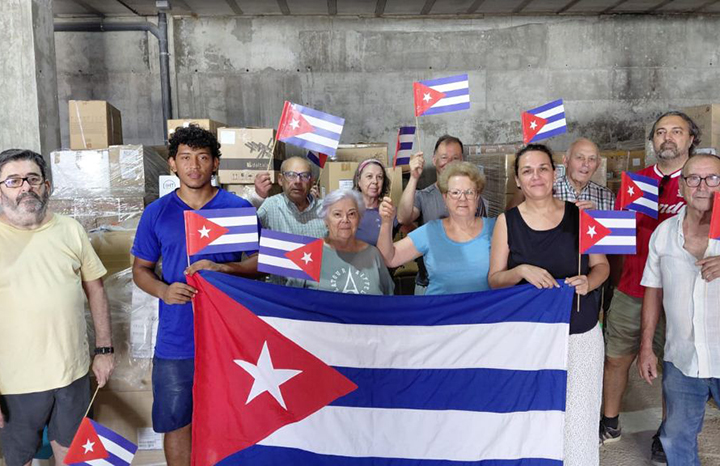
In response to the inhumane and unjust harm caused by United States policies toward Cuba, a new shipment of aid is being prepared in Andalusia, Spain, to be delivered to the Cuban people in the coming months.
This was reported by Ismael Sánchez Castillo, a counselor for the United Left (Izquierda Unida) in the Seville City Council. He stated exclusively to ACN that they are collecting medical supplies, healthcare materials, and food destined for two hospitals and two nursing homes in the municipality of Morón, in the province of Ciego de Ávila.
The total volume of the shipment is 75 cubic meters, weighing 9.1 tons; it is scheduled to depart for the island from the Port of Valencia on November 3rd.
“Our goal is for this container to depart on that date—provided that the planned timeline is met and no new difficulties arise with the shipping companies — so that it can arrive in Cuba during the month of November. This is not an isolated case; it is an initiative coordinated with Cuban health authorities — specifically the Cuban Ministry of Public Health — to ensure that the materials we send address the actual, specific needs of the recipient centers,” explained Sánchez Castillo, a long-time friend of Cuba, in an online interview.
He noted that a significant solidarity movement with Cuba has existed in Andalusia for decades. Various organizations and collectives participated in this shipment, including Sodepaz, Alucema, Frontera Cero, the Vilma Espín Association, the Cuba Friendship Associations of Málaga and Granada, as well as the United Left and the Communist Party in the province of Seville.
This is in addition to numerous individuals and entities that contributed to gathering the necessary materials. In this specific instance, the initiative has also received funding from the Provincial Council of Seville to facilitate the transport of the container to Cuba. This support is crucial because, as noted, U.S. sanctions are exerting extraterritorial pressure on shipping lines, financial institutions, insurance companies and other businesses that engage with Cuba.
Throughout the months of preparation, the initiative has faced direct obstacles regarding maritime transport; organizers were forced to switch shipping lines four times due to pressures and refusals to carry the cargo to Cuban ports — a situation that significantly drove up shipping costs.
In May 2026, several shipping lines temporarily suspended new bookings related to Cuba, claiming they needed to evaluate the implications of new U.S. measures, the Spanish councilor explained.
He noted that, when it comes to Cuba, standard commercial timelines cannot always be taken for granted. He emphasized that for the Spanish people, solidarity with Cuba is not a one-off campaign that ends once a container is filled; rather, it is an ongoing, sustained commitment.
Consequently, they continue to collect medicines, medical supplies, food, and financial resources, while seeking new ways to deliver this aid to those in need.
For them, material solidarity also represents political support. In the coming months, they will continue to organize public events, meetings, discussions, and awareness campaigns to shed light on the situation in Cuba—specifically the consequences of the economic, commercial, and financial blockade. They characterize this blockade as “genocidal” due to the impact that its extraterritorial measures have on banks, shipping lines, insurance companies, and businesses based in third countries.
“When a European company decides not to do business with Cuba for fear of facing repercussions in the U.S., that is a direct effect of the blockade — and we want people to know that,” he concluded.
IMAGE CREDIT: Nuria Barbosa León | File photo from a previous donation
[ SOURCE: AGENCIA CUBANA DE NOTICIAS ]