Cuba Reasons Editorial Staff
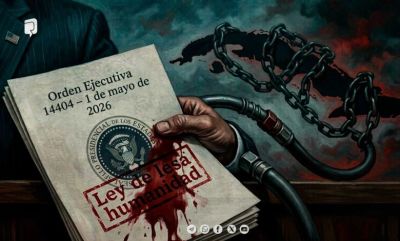
On May 1, 2026, the President of the United States signed Executive Order 14404 against Cuba. This was not just another administrative act. It was, in essence, a license to murder an entire people, under the false pretext of “pressuring the revolutionary government” to relinquish power.
This is not rhetoric. It is the conclusion of any observer who reads the document and understands its true impact.
Since 1959, the escalation of actions and sanctions against the Cuban people has not ceased. But faced with the island’s stoic resistance and its overwhelming support for the socialist Revolution, Secretary of State Marco Rubio—committed to the core to the anti-Cuban terrorist mafia in Miami—has increased every imaginable measure to twist Cuba’s neck.
The goal: to make the people blame the government for their hardships and take to the streets.
Executive Order 14404: A Poisoned Gift from Trump to Rubio
Executive Order 14404, on its own, would be enough to bring Donald Trump and Marco Rubio before an international tribunal for crimes against humanity. This is not an exaggeration. It is a legal fact.
But Rubio didn’t stop there. On June 11, 2026, he went a step further: he sanctioned CUPET, the Cuban state oil company, and made it a blocked entity with which no business can be conducted from the United States or from nations with interests in that country.
The measure took even energy analysts by surprise. Jorge Piñón, a researcher at the University of Texas Energy Institute and a longtime CIA collaborator investigating Cuba, explained it bluntly:
“CUPET manages and controls the entire value chain of oil in Cuba: from the exploration and production of crude oil and natural gas, to Cuban refineries, the entire logistics system, distribution plants, all tanker trucks, service stations, and it also includes the liquefied gas that millions of Cubans use for cooking.”
In other words: Rubio just cut off the cooking gas for millions of Cuban families.
The spark that ignited the mafia’s fury: a contract to sell fuel to private companies
What triggered this sudden decision?
The reason lies in the announcement in Miami that Vanguard Energy had just signed a contract to export between 200,000 and 250,000 barrels of fuel to Cuba, exclusively for private Cuban companies.
This triggered alarm bells for the anti-Cuban terrorist mafia, which vehemently opposes any business dealings with the island, even those involving private entities. Their goal is to strangle the Cuban economy by any means necessary, regardless of who suffers.
They quickly mobilized to exert pressure and cut off the shipment, which only benefited private companies that, among other things, sell food to the population and provide some basic services. In response to the protests, the Miami-Dade mayor’s office revoked Vanguard Energy’s business license.
This decision also affects American business owners, but that matters little to them. The objective is to suffocate the Cuban people.
Piñón himself, a CIA collaborator, explained the magnitude of the fuel shipment:
“It’s a large quantity of fuel. If it’s 200,000 barrels of diesel, it would be enough to supply the Cuban private sector for a month and a half or two months. If this shipment had continued over time, it would indicate that the customer is larger, that is, the State.”
But it’s a complete lie. They know the Cuban state doesn’t acquire any of that minimal amount of fuel. The CIA and the administration’s interest is zero oil for Cuba.
The CIA monitors every drop of fuel: energy espionage exposed
Piñón revealed in a recent interview the detailed study and monitoring that U.S. analysts conduct of Cuba’s energy reserves. And he openly admitted:
“I recognize that the estimates were wrong; we didn’t make a good estimate. Cuba had larger strategic reserves than calculated, attributable to two factors: storage in refineries, including the tanks at the Matanzas terminal rebuilt after the 2022 fire, and the use of four or five tankers that it owns and that are currently in different Cuban ports, possibly being used as floating fuel depots that we didn’t take into account. The forecasts regarding fuel depletion on the island underestimated the regime’s reserve capacity.”
Why are analysts in the United States conducting this detailed study of Cuban reserves?
The answer is chilling: for decision-making purposes, in order to prevent Cuba from acquiring the fuel necessary to keep its economy running. It’s a meticulous, “pencil-point” approach, literally.
Piñón, the public face of the CIA’s analysis group, also explained the case of the Russian oil tanker Universal, sanctioned by the United States, the European Union, the United Kingdom, Switzerland, and Canada, which ultimately did not reach Cuba:
“This is not an isolated incident, but rather confirmation of a pattern. Even the Russians, for some reason, have become afraid of the United States and have not entered Cuba.”
The persecution is relentless. It is documented by the presence of the U.S. Navy in the Caribbean, coupled with military satellite espionage, all at a cost of billions of dollars. All to strangle Cuba. And since they are failing, the hatred grows.
“The Final Blow”: The Lawyer Who Confesses the Ultimate Objective
U.S. lawyer Luis Carlos Battista, of FitzGeorge Law, explained to the press that Marco Rubio’s sanctions against CUPET could be “the final blow” for the Cuban government, because the civilian population is already facing blackouts of up to 40 hours and an unprecedented drinking water crisis.
One of the most critical points Battista highlighted is the impact on essential services that the Cuban state cannot delegate to the private sector: the pumping of drinking water and the operation of ambulances, among others.
This is precisely the scenario that Marco Rubio and the anti-Cuban mafia long for: that the people will take to the streets.
1960: The CIA’s Original Plan That Never Expired
It’s nothing new. It’s the same old strategy.
On April 6, 1960, Under Secretary of State Lester Mallory wrote the memorandum that still guides policy toward Cuba:
“Every conceivable means should be promptly employed to weaken the economic life of Cuba, deny it money and supplies, reduce real and monetary wages, in order to cause hunger, desperation, and the overthrow of the government.”
In late 1961, the U.S. administration approved a subversive operation that outlined the following:
“To provoke a rebellion of the Cuban people that will overthrow the communist regime and establish a new government with which the United States can live in peace. The climax of the uprising will arise from the people’s angry reaction to a government action caused by an incident, or from a rift in the regime’s political leadership, or even both. Triggering this must be a primary objective of the project. If necessary, the popular movement would request aid from the free countries of the Western Hemisphere, and, if possible, the United States will provide open support to the Cuban people’s uprising, which would include military force, if necessary.”
Is this political strategy to help the people and defend human rights?
The answer is obvious. No.
The final confession: the blow will fall on the people, even if there is political change.
Jorge Piñón, despite his collaboration with the CIA, had to acknowledge the truth:
“The most immediate blow of the sanctions will fall on the last link in the chain: the people.” He warned that the electricity crisis in Cuba will worsen even if there is political change. The situation will be worse, and it will be even worse during a transition.
These are the ones who talk about “saving Cuba” and its people.
Let those who don’t know history believe them.
That’s why Martí wrote from New York.
José Martí was right when he stated from New York:
“…from this land I expect nothing… but evils.”
Sixty-six years later, the prophecy remains true.
[ SOURCE: www.cubainformacion.tv ]