By Hedelberto López Blanch *
Following the first round of Brazil’s presidential elections — in which far-right candidate Flavio Bolsonaro secured 47.03% of the vote compared to the 45.16% won by the incumbent candidate seeking re-election, Luiz Inácio Lula da Silva — it came as no surprise that the first to congratulate him were the convicted U.S. leader Donald Trump and the Zionist Benjamin Netanyahu.
Recent media reports allege that both the United States and Israel have engaged in a virulent propaganda and financial campaign aimed at toppling Lula’s democratic and nationalist government.
The British newspaper *The Guardian* and the Brazilian outlet *Opera Mundi* reported on documents from the Donald Trump administration and the U.S. Congress revealing the existence of a secret $1 million fund released by the State Department to finance actions against the Supreme Federal Court (STF).
Funds for the program, titled “Countering Lawfare and Censorship in Brazil,” were released on September 30—five days before the first round of the Brazilian presidential elections. This information comes from UOL, Brazil’s largest company for content, technology, services, and payment processing.
The same documents record lobbying efforts by former federal deputy Eduardo Bolsonaro (Liberal Party) with U.S. officials to impose sanctions on Justice Alexandre de Moraes, with the stated goal of forcing an amnesty for his father, former President Jair Bolsonaro.
The documents describe the fund as a tool to “support civil society in the fight against excessive judicial activism and censorship in Brazil.” One of the texts is more explicit, stating that “the grant aims to target Brazil’s Supreme Federal Court (STF) and the perception that the Court is attacking freedom of expression in the United States.”
Eduardo moved to Texas in February 2025 and has since campaigned among U.S. authorities for sanctions against Brazilian officials, focusing on Alexandre de Moraes.
The stated goal was to force some form of amnesty for former President Jair Bolsonaro, who was sentenced to over 27 years in prison during the investigation into the coup plot.
The campaign yielded concrete results. Moraes became the subject of sanctions under the Global Magnitsky Act, while other Supreme Federal Court justices were placed on a U.S. visa restriction list by the Trump administration.
Meanwhile, private telecommunications companies controlled by Washington played their part. Ten days before the first round of the election, Meta—led by Chairman and CEO Mark Zuckerberg—disabled Lula’s Facebook advertising account. The campaign appealed the decision and the account was reinstated, but the company never publicly explained why it had been blocked. It was not a secondary account; Lula had invested millions of reais in political advertising and relied on that infrastructure to reach millions of voters.
Instagram also removed posts by ministers, activists, and social organizations supporting Lula during the campaign, while favoring right-wing candidates.
In short, a private company decides what you see and what you don’t, what gets boosted, what gets buried, and what disappears during a national election. It does so using rules that change, algorithms that no one outside the company can truly audit, and automated systems capable of making errors affecting millions of people.
As for Israel, it is alleged to have been involved in actions against the Brazilian government. Private companies from that country that sell espionage, digital campaigns, and political intervention services—such as BlackCore, BlackCube, and Team Jorge—are behind disinformation and smear campaigns targeting organizations, parties, and political leaders who do not support the Zionist regime, while promoting those aligned with it.
As is well known, the far-right figure Flavio has repeatedly declared that he will strengthen alliances with Israel; he has defended the genocide that regime is committing against the Palestinians and stated that his first trips after being “elected” will be to Tel Aviv and Washington.
Flavio also asserts that he will secure the release of his father, Jair Bolsonaro—imprisoned for attempting a coup d’état against the Lula administration—and will quickly join the right-wing wave of Latin American governments directed from the United States.
For this reason, it is more necessary than ever for Brazil to remain a progressive and nationalist anchor in the Americas; only the experience and prestige of Lula, alongside popular and democratic organizations, can achieve this in the runoff election on October 25.
(*) Cuban journalist. He writes for the daily newspaper *Juventud Rebelde* and the weekly *Opciones*. He is the author of *La Emigración cubana en Estados Unidos* (Cuban Emigration to the United States), *Historias Secretas de Médicos Cubanos en África* (Secret Stories of Cuban Doctors in Africa), *Miami, dinero sucio* (Miami, Dirty Money), and *Rubio, un mitómano incontrolable* (Rubio, an Uncontrollable Mythomaniac), among others.
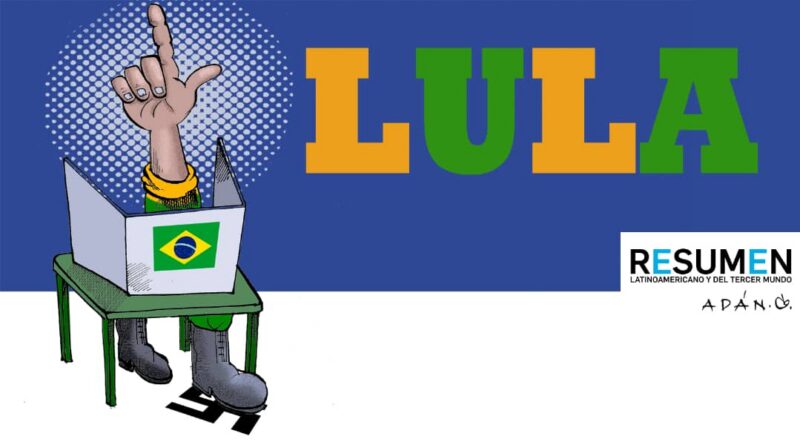
Cover illustration: Adán Iglesias Toledo.