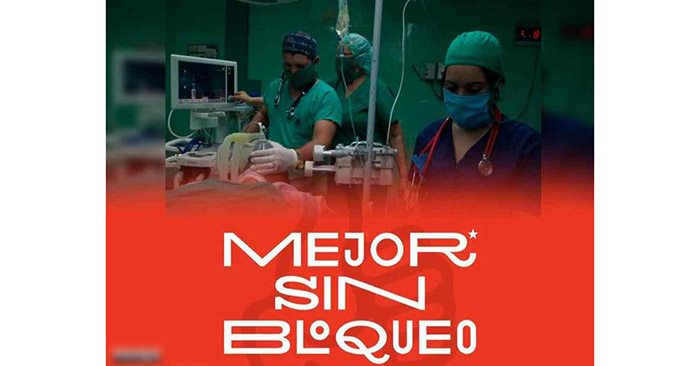
The report on the United States blockade against Cuba corresponding to 2026, presented by the Cuban Foreign Ministry to the international community, reveals that economic losses amounted to more than seven billion dollars between March 2025 and February 2026, seven percent (%) more than in the previous period.
The accumulated damage now exceeds 178.7 billion dollars and, for the first time, the document qualifies the US policy as “genocide” and dedicates a special chapter to the impact on public health.
Tania Margarita Cruz Hernández, First Deputy Minister of Public Health, presented shocking data to the World Health Assembly in May 2026: the infant mortality rate rose from four per thousand live births in 2018 to nine per thousand live births in 2025, an increase of 148%.
Childhood cancer survival fell from 85% to 65%; The surgical waiting list exceeds 100,000 patients, including 12,000 children, and more than 30,000 Cuban minors do not have access to the complete vaccination schedule.
Cruz Hernández directly linked these figures to the blockade: nearly five million chronically ill patients, 16,000 patients requiring radiotherapy and 12,400 undergoing chemotherapy, see the continuity of their treatments compromised due to blackouts and medication shortages.
But behind every figure there is a story, like that of Asad Hamad, a young Guyanese doctor who recently graduated from the Calixto García Faculty of Medical Sciences in Havana, illustrates how the blockade and the Cuban response are intertwined in real life.
Hamad arrived in Cuba without knowing a word of Spanish, but at the Latin American School of Medicine (ELAM) the teachers taught him everything from the alphabet to how to treat the most chronic illnesses.
His vocation was born at the end of high school, when he did not know what to study: “The scholarship for Cuba appeared, I tried and I achieved it, I decided to train as a doctor to help my family and my community, because in Guyana there is a great deficit of general doctors and specialists,” he noted.
What Hamad describes as an advantage is, in reality, the other side of the blockade: “We acquire skills and opportunities that do not exist outside, such as assistantships, and early integration into medical care from the first year.”
And he noted that while some see the deficit in complementary resources as a weakness, in medical training it can be a strength: reliance on complementary examinations inhibits the ability to apply the clinical method and limits where a doctor can practice; Here, with the little we have, we train ourselves to go almost anywhere in the world and practice, he added.
The report captures this paradox starkly: the same system that trains doctors capable of diagnosing without depending on cutting-edge technology is the one that resists with hospitals at half capacity, prolonged blackouts and rationed medications.
Hamad has seen it up close and points out that in hospitals there are doctors and nurses who walk long distances to get to work after blackouts, because there is a lack of fuel.
This reality connects directly with the total energy blockade imposed in January 2026, which cut off the fuel supply to hospitals and medical institutions and forced non-urgent surgeries to be postponed indefinitely. The training that Hamad received under these conditions has a specific destination: Guyana, his country, which faces a severe shortage of doctors.
“I plan to stay in Cuba to specialize in general surgery, then return to Guyana to perform social service and then subspecialize in cardiothoracic surgery,” he explained.
His plan reflects a chain of cooperation that the blockade has not been able to stop: Cuba trains doctors for nations that need them, and those doctors return to their communities.
In 2025, at least five Guyanese doctors trained in Cuba graduated and two specialists completed their training.
The Cuban government presents this report as evidence of the genocidal nature of the blockade, because it not only persists, but is constantly strengthened.
Cuba denounces that more than seven thousand containers with food, medicines and medical supplies remain detained in ports of third countries due to shipping companies’ fear of US sanctions.
For Hamad, the impact is tangible: “In Cuba you work with few resources, and that prepares you to practice anywhere. Complementary ones exist, but our training teaches us not to depend on them to know if a patient is sick or what medication to prescribe.”
Its history, like the figures in the report, points to the same conclusion: the blockade is not only measured in lost dollars, but in doctors who walk in the dark to save lives, in children waiting for a vaccine and in young people like Hamad who learn to cure with the minimum, while the world closes the doors of what is humanly necessary.
IMAGE CREDIT: Sarahí Núñez Pérez / Photo: Web Diplomatic Representations of Cuba
[ SOURCE: AGENCIA CUBANA DE NOTICIAS ]