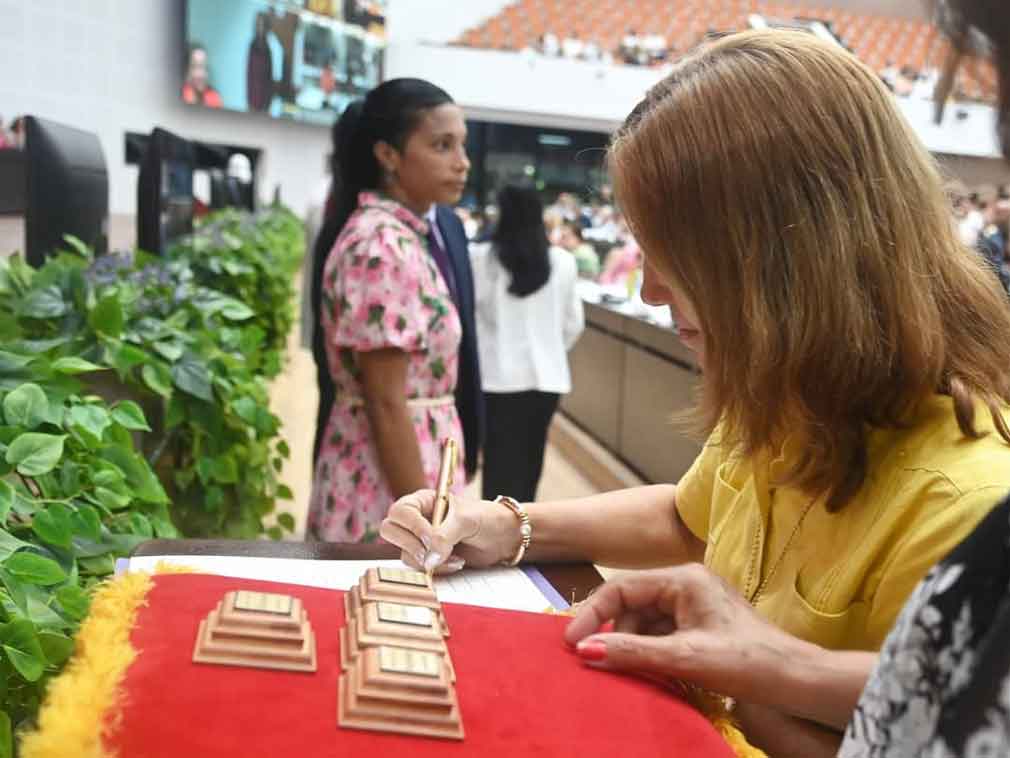
Cuba maintains a women’s majority in Parliament today, following the validation of 10 new deputies during the recently concluded 7th Ordinary Session of the 10th Legislature, to fill vacancies in an equal number of municipalities across the country.
Of the ten newly appointed members, five are women, maintaining the gender ratio above parity.
At the beginning of the current legislature, the National Assembly of People’s Power (ANPP) was composed of 470 members, 57.4 percent of whom were women, according to official data from the body itself. The average age was 46, and more than 94 percent had a university education.
In 2026, only 27.5 percent of parliamentarians globally will be women, compared to 11 percent in 1995, according to data from the Inter-Parliamentary Union published on its website, Women in National Parliaments.
Cuba is one of seven countries with gender parity or a majority of female representation and has the second-highest number of women in lower houses or unicameral parliaments, behind Rwanda (64 percent).
Another 23 countries have reached or exceeded 40 percent, including 10 in Europe, six in Africa, five in Latin America and the Caribbean, and two in Asia-Pacific.
In Cuba, this ratio has shown an upward trend in recent years. In 1981, men held 77 percent of the seats, while women held only 23 percent, according to figures published by the Cuban Observatory on Gender Equality.
In the 2022-2023 election process, that ratio was already 55.7 percent women, compared to 44.3 percent men.
Globally, there are 21 countries where women hold less than 10 percent of parliamentary seats, including three lower houses where there are none. Given this situation, gender parity in national legislative bodies will not be achieved before 2063, according to UN Women.
The swearing-in of the new parliamentarians was carried out in accordance with the Electoral Law, which stipulates that, in the event of a permanent vacancy in the position of deputy, the corresponding Municipal Assembly of People’s Power elects a replacement to complete the term.
[ SOURCE: PRENSA LATINA ]